

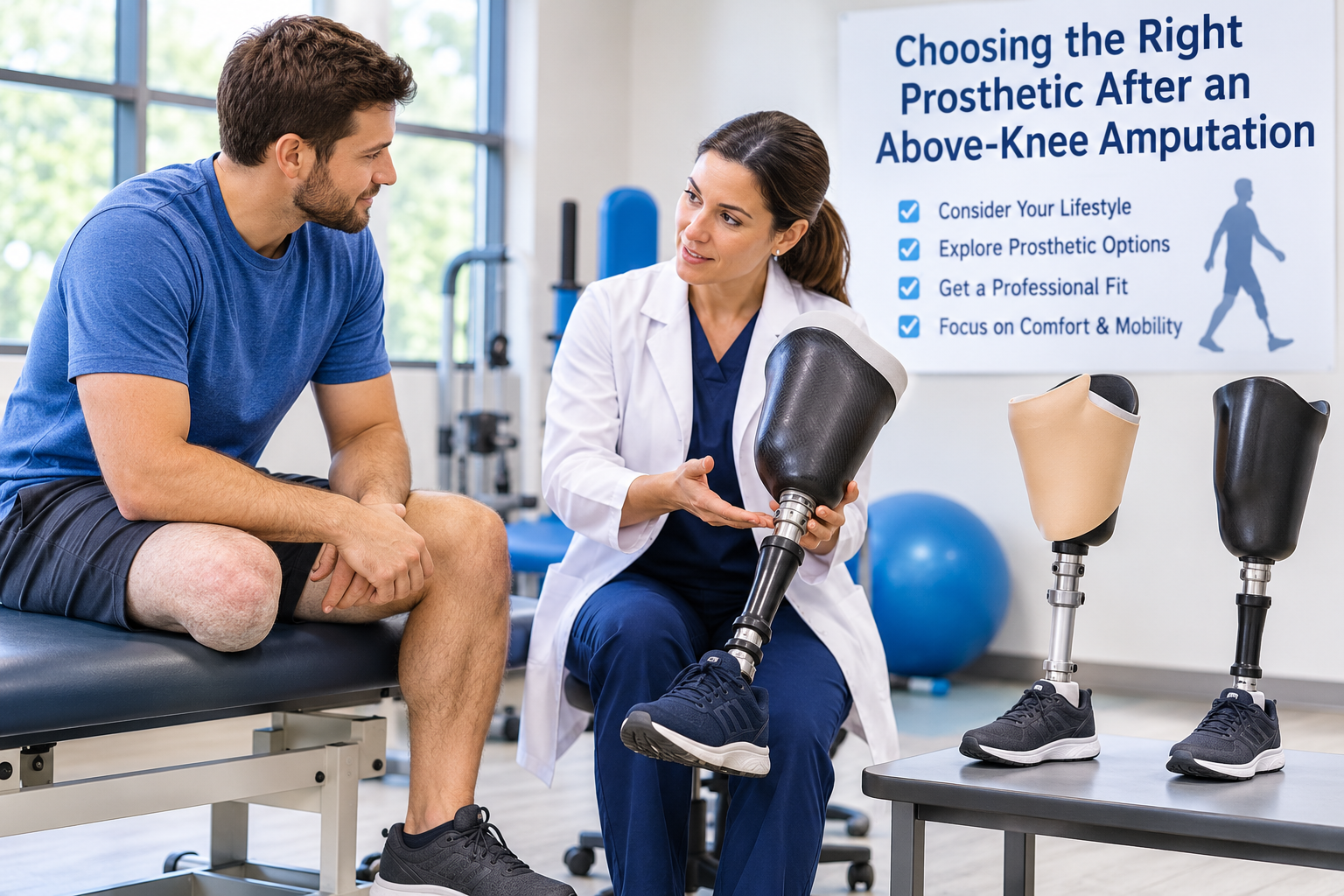

Losing a leg above the knee changes daily life, but the right prosthetic can restore mobility, confidence, and independence. The challenge is that no two people have the same needs, and an above knee prosthetic is a combination of several components, each of which affects how you walk, balance, and move. Understanding your options before you sit down with a prosthetist helps you make a confident, informed decision.
This guide explains how transfemoral prosthetics work, what to consider before choosing one, and how to find the right care team. If you'd like to explore the specific designs available, you can learn more about prosthetics above the knee and how they're matched to different lifestyles.
Understanding Above-Knee (Transfemoral) Prosthetics
A transfemoral prosthesis replaces the limb from the thigh down. Because the natural knee is gone, the prosthetic must also replace its function, which makes these devices more complex than below-knee prostheses. Walking with an above-knee prosthesis generally takes more energy and balance, so choosing the right components matters.
Every above-knee prosthetic has four main parts:
- Socket: the custom-fitted cup that holds your residual limb
- Knee joint: replaces the natural knee and controls how your leg swings and supports weight
- Pylon: the connecting tube that links the knee to the foot
- Foot: absorbs impact and helps with push-off and balance
Key Factors to Consider Before Choosing
Your Activity Level
Prosthetists commonly describe mobility using K-levels, which range from K0 to K4:
- K1: can walk on level surfaces at a fixed pace, such as around the home
- K2: can handle low-level obstacles like curbs and stairs
- K3: walks at variable speeds and across most terrain, typically a community walker
- K4: high-impact or athletic use
Your K-level guides which components are appropriate. Insurers also use it when deciding what to cover, so it's worth discussing openly with your care team.
Lifestyle and Daily Demands
Think about your typical week. Do you work on your feet, drive, garden, hike, or play sports? A desk-based routine has very different requirements from a job on uneven ground. Be honest about both your current activity and the activities you hope to return to.
Residual Limb Health and Shape
The length, shape, skin condition, and strength of your residual limb affect socket design and comfort. Limb volume can also change in the months after surgery, so early prosthetics are often adjusted frequently.
Overall Health and Strength
Balance, core strength, and cardiovascular fitness all influence how well you adapt to a prosthesis. Physical therapy before and after fitting makes a significant difference in results.
Choosing the Right Components
Prosthetic Knee Types
- Mechanical knees (single-axis or polycentric) are durable, lightweight, and generally more affordable. They suit many everyday walkers.
- Hydraulic or pneumatic knees offer smoother control as walking speed changes.
- Microprocessor knees use sensors to adjust resistance in real time. They can improve stability and reduce stumbles, which can be especially helpful for people who walk on varied terrain or worry about falls. They cost more, and not everyone needs one.
Socket Types
A well-fitting socket is often the biggest factor in comfort. Common options include suction sockets, which hold the limb with a tight seal, and sockets used with silicone liners and locking systems. Your prosthetist will recommend a design based on your limb shape, skin sensitivity, and activity level.
Foot Types
Feet range from simple designs for stable walking to energy-storing carbon fiber feet that give more spring and push-off. Choosing a foot that matches your activity level improves both comfort and efficiency.
The Fitting and Adjustment Process
Getting a prosthetic leg is a process, not a single appointment. It typically includes:
- Evaluation: your prosthetist reviews your health, goals, and limb condition.
- Measurements and casting: a precise model of your residual limb is created.
- Test socket: a trial socket checks fit and comfort before the final version is made.
- Fitting and alignment: the full prosthesis is assembled and adjusted.
- Gait training: a therapist helps you learn to walk safely and naturally.
- Follow-up care: adjustments are normal as your body adapts.
Timelines vary from person to person, so ask your care team what to expect for your situation.
Understanding Cost and Insurance
The cost of an above-knee prosthesis depends mainly on the components you need, the level of customization, and the follow-up care. Coverage varies by plan, and many insurers require documentation of medical need and activity level. A good clinic will help with paperwork and pre-authorization, so ask about this early.
Questions to Ask Your Prosthetist
Before choosing a provider, consider asking:
- How much experience do you have with above-knee amputations?
- Which knee and foot options do you recommend for my lifestyle, and why?
- Can I try different components before deciding?
- What follow-up care and adjustments are included?
- How do you handle repairs and replacements?
If you're in Southwest Florida, working with a local team makes follow-ups far easier. A clinic offering prosthetics and orthotics Fort Myers can provide hands-on fitting, adjustments, and ongoing support close to home.
Final Thoughts
The right above-knee prosthetic isn't the most expensive or the most advanced one. It's the one that fits your body, supports your goals, and feels comfortable day after day. Start by understanding your activity level, learn the basics of knees, sockets, and feet, and choose a prosthetist who listens to your goals. With the right device and a supportive care team, many people return to work, family life, and the activities they love.
Frequently Asked Questions
1. How do I know which above-knee prosthetic is right for me?
The right choice depends on your activity level (K-level), lifestyle, limb shape, and overall health. A prosthetist will evaluate these factors and recommend a knee, socket, and foot that fit your goals. Trying different components, when possible, and giving honest feedback about comfort helps you find the best match.
2. What is the best prosthetic knee for above-knee amputees?
There isn't one best knee for everyone. Mechanical knees are durable and affordable, and they suit many everyday walkers. Hydraulic knees give smoother control at different speeds. Microprocessor knees add stability on varied terrain and can help reduce falls. Your activity level, budget, and goals decide which one fits.
3. How long does it take to walk with an above-knee prosthetic?
Timelines vary from person to person. After the limb has healed and the prosthesis is fitted, most people begin gait training with a physical therapist, starting in parallel bars and progressing from there. Strength, balance, and consistency with therapy all affect progress, so ask your care team for an estimate based on your situation.
4. What is the difference between a mechanical and a microprocessor prosthetic knee?
A mechanical knee relies on built-in hydraulic or friction mechanisms to control movement, and it is typically lighter, more durable, and less costly. A microprocessor knee uses sensors and a computer to adjust resistance as you walk. It can offer added stability and a more natural gait, but it costs more and needs regular maintenance.
5. Will insurance cover my above-knee prosthetic leg?
Many insurance plans, including Medicare, cover prosthetic limbs when they are medically necessary, but coverage varies by plan. Insurers often look at your K-level and require documentation from your doctor and prosthetist. Contact your provider early, and ask your clinic to help with pre-authorization and paperwork.



