

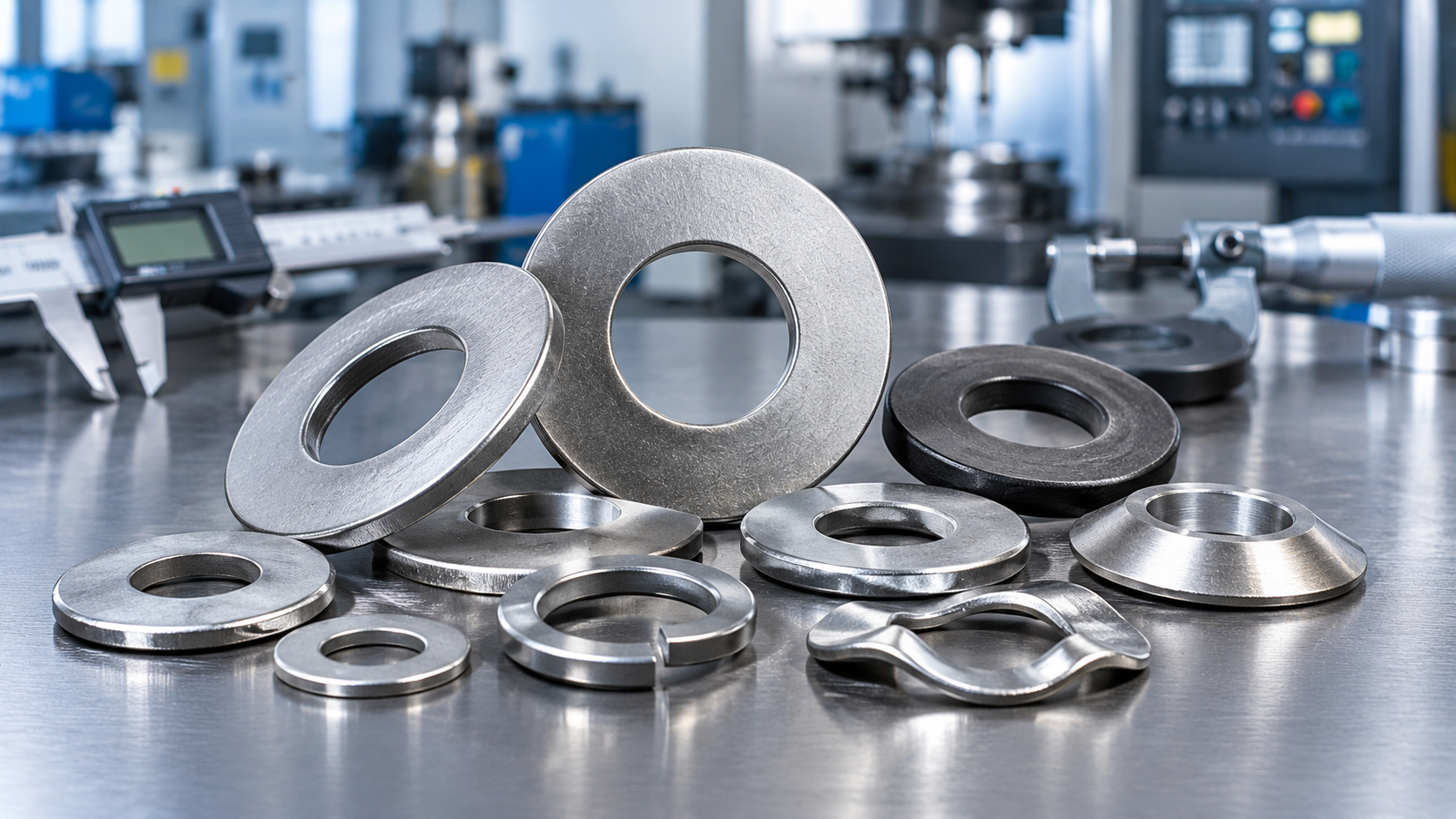

In industrial engineering, the performance of a fastening assembly often depends on components that receive little attention. A washer is one such component. Although small in size, it can play an important role in load distribution, surface protection, spacing and maintaining the functional performance of mechanical assemblies.
Different industrial applications require different washer designs. Understanding their characteristics and uses helps engineers, manufacturers and procurement professionals select suitable components for their equipment.
What Is an Industrial Washer?
An industrial washer is a mechanical component generally placed between a fastener and the surface being secured. It helps distribute pressure, protects the mating surface and supports the fastening arrangement.
Washers are available in different shapes, thicknesses, materials and finishes. Their selection depends on the type of fastener, load requirements, operating environment and dimensional specifications.
In automotive manufacturing, heavy machinery, construction equipment and electrical assemblies, the correct washer can contribute to dependable fastening performance.
Common Types of Industrial Washers
1. Plain Washers
Plain washers are among the most widely used washer designs. They have a flat, circular shape with a central opening.
Their primary purpose is to distribute the load created by a nut or bolt over a larger surface area. This helps reduce localized pressure and minimizes the possibility of surface damage.
They are commonly used in machinery, fabrication, equipment manufacturing and general mechanical assemblies.
2. Spring Lock Washers
Spring lock washers are designed with a split or spring-like construction. Their geometry provides an elastic response when compressed during installation.
These washers are used in fastening arrangements where spring action is required. Proper selection depends on the joint design, loading conditions and applicable engineering specifications.
3. Wave Washers
Wave washers have a distinctive undulating profile. When compressed, they provide axial spring force and can accommodate small dimensional variations.
They are useful in compact mechanical assemblies, rotating equipment and applications where preload or controlled spacing is required.
4. Disc Spring Washers
Disc spring washers, commonly called Belleville washers, have a conical disc shape. Their design allows them to generate spring force under compression.
They are used in applications requiring controlled deflection and load characteristics. Depending on the design, multiple disc washers may be arranged to achieve specific spring performance.
5. Bearing Washers and Spacers
Bearing washers and spacer-type components help maintain positioning and separation between mechanical parts.
They are often selected according to dimensional accuracy, surface requirements and the loads encountered during operation.
Where Are Industrial Washers Used?
The applications of washers extend across numerous industrial sectors.
Automotive industry: Washers are used in engine assemblies, chassis components, suspension systems and equipment mounting arrangements.
Construction and infrastructure: Industrial washers support bolted connections in structural equipment, machinery and fabricated assemblies.
Heavy engineering: Large mechanical systems often require washers designed around specific load, material and dimensional requirements.
Electrical equipment: Washers are used in equipment mounting, enclosures and mechanical fastening arrangements.
Industrial machinery: Plain, spring and specialty washers help meet the requirements of different machine assemblies.
The exact washer type should always be selected according to engineering specifications rather than appearance alone.
How Materials Influence Washer Performance
Material selection is an important part of washer manufacturing. Carbon steel is widely used for general fastening requirements, while stainless steel is preferred in applications requiring corrosion resistance.
SS304 is suitable for many industrial environments, whereas SS316 may be considered where stronger resistance to corrosive exposure is required. Spring steel is selected when specific elastic properties are needed.
Manufacturers may also offer different surface finishes, including black oxide, zinc trivalent, zinc flake and PTFE Xylan coatings. The correct finish depends on the operating environment and application requirements.
What Should Buyers Check Before Purchasing?
Procurement teams should evaluate more than the unit price when sourcing industrial washers.
Important considerations include:
-
Inner diameter, outer diameter and thickness.
-
Material grade and mechanical properties.
-
Relevant ISO, DIN or customer-specific standards.
-
Surface finish and corrosion protection.
-
Dimensional tolerances.
-
Inspection and testing procedures.
-
Production capacity and delivery consistency.
Working with experienced suppliers makes it easier to maintain consistent specifications across repeat orders.
Choosing the Top Washer Manufacturers
The top Washer Manufacturers should demonstrate an understanding of industrial requirements rather than simply offering standard products. Their capabilities should include material selection, dimensional control, quality inspection and the ability to handle different washer designs.
EASCO offers industrial washer solutions for various fastening and engineering applications. Buyers looking for washers can explore its product range and discuss their dimensional, material and finishing requirements.
Conclusion
Industrial washers are available in several designs, each serving a specific mechanical purpose. Plain washers support load distribution, spring lock washers provide spring action, wave washers accommodate dimensional variations and disc spring washers deliver controlled spring force.
Understanding these differences helps engineers and procurement teams choose suitable components. Selecting the right washer and a dependable manufacturing partner can support better assembly quality and long-term equipment performance.
Frequently Asked Questions
1. What are the main types of industrial washers?
Common types include plain washers, spring lock washers, wave washers, disc spring washers and bearing washers.
2. What is the difference between plain and spring washers?
Plain washers primarily distribute loads and protect surfaces, while spring washers are designed to provide elastic spring action.
3. Are stainless steel washers suitable for outdoor applications?
Stainless steel washers can be suitable for outdoor use, depending on the grade and environmental exposure.
4. What standards are used for industrial washers?
Common dimensional standards include ISO 7089, DIN 125A, DIN 127B, DIN 6796 and DIN 137A/B.
5. Why should buyers compare different Washer Manufacturers?
Comparing manufacturers helps buyers evaluate technical capabilities, product consistency, quality controls, material availability and delivery reliability.



