

The Definitive Guide to Choosing the Right IoT Data Collection Platform for Your Business

The Internet of Things (IoT) is no longer a futuristic concept confined to sci-fi novels; it is the backbone of modern digital transformation. Across every industry—from manufacturing and agriculture to healthcare and smart cities—physical assets are being outfitted with sensors and connected to the internet. This proliferation of connected devices has resulted in a data deluge.
Every connected thermostat, vibration sensor, GPS tracker, and flow meter is constantly generating streams of valuable operational intelligence. However, raw data is inherently useless. A temperature reading of "25°C" on a sensor means nothing without context, history, and the ability to act upon it.
The critical link between physical assets and business value is the IoT Data Collection Platform.
This specialized software infrastructure is the command center for your IoT ecosystem. It is responsible for ingesting, processing, storing, and securing the massive influx of data from diverse edge devices. Without a robust platform, your IoT initiative is merely a collection of expensive gadgets generating noise.
This guide explores what an IoT data collection platform is, why it is essential, the core features you must demand, and how to select the right solution to turn your data into a strategic asset.
What is an IoT Data Collection Platform?
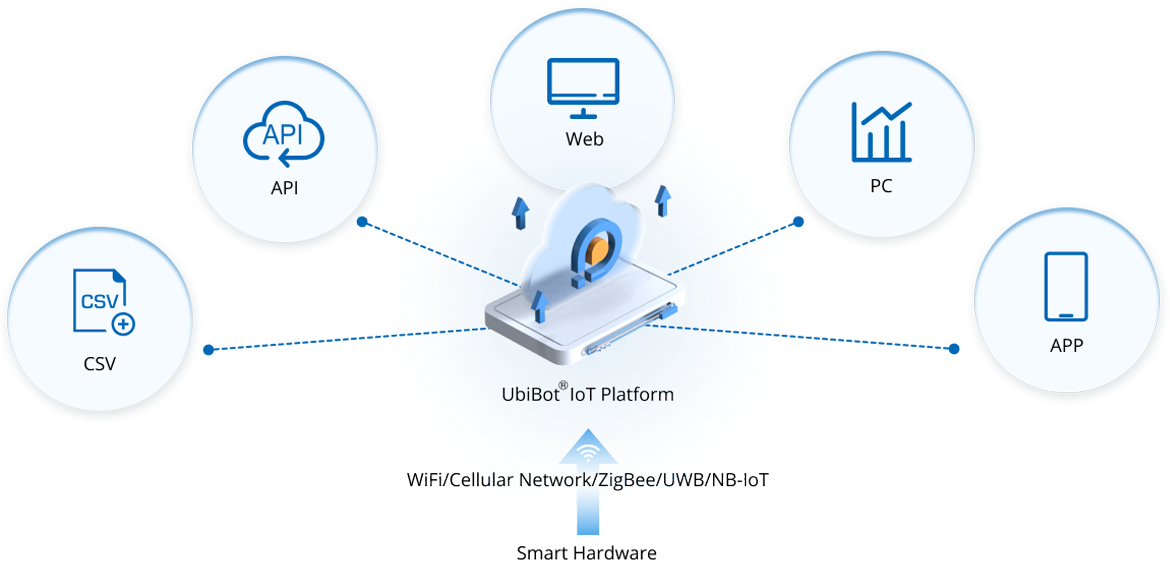
At its simplest, an IoT data collection platform (often referred to as an IoT Platform or IoT Middleware) acts as the secure bridge between the physical world of sensors and devices and the digital world of applications and analytics.
It sits between the "edge" (the devices) and the "cloud/datacenter" (where the data is consumed). Its primary function is to handle the complex task of communicating with heterogeneous devices—which often speak different languages (protocols)—and normalizing that data into a format that business applications can understand.
Think of it as a universal translator and a massive, organized filing system that operates in real-time.
The Core Functions of the Platform
Device Connectivity and Management: The platform handles the messy reality of connecting devices over various networks (cellular, Wi-Fi, LoRaWAN, Ethernet). It manages device authentication, security provisioning, firmware updates over-the-air (FOTA), and monitors device health (battery levels, connectivity status).
Data Ingestion and Normalization: Sensors speak many protocols (MQTT, HTTP, CoAP, Modbus, OPC-UA). The platform ingests these disparate streams and normalizes them, tagging the data with metadata (device ID, location, timestamp) so it is searchable and usable.
Data Storage: It provides scalable, secure storage solutions optimized for time-series data—data that is continuously collected over time to show trends and changes.
Data Visualization and Rules Engine: The platform provides tools to create dashboards for human operators and allows for the creation of automated rules. (e.g., If vibration > X threshold for 5 minutes, then send an SMS alert to the maintenance manager).
Why Your Business Cannot Ignore IoT Data Collection Platforms
The business case for investing in a dedicated IoT data collection platform extends beyond just "getting data." It addresses fundamental operational challenges that unmanaged IoT deployments fail to solve.
Scalability and Reliability
Connecting five sensors in a lab is easy. Connecting 5,000 sensors across 50 global manufacturing facilities is an engineering nightmare. DIY solutions or consumer-grade cloud services quickly buckle under the strain of high-frequency data ingestion, leading to data loss and system downtime.
A professional IoT data collection platform is built on distributed, scalable architectures (often leveraging cloud-native technologies like Kubernetes) designed to handle massive concurrency and guarantee data delivery.
Protocol Agnosticism and Future-Proofing
Your existing industrial machinery likely uses Modbus or OPC-UA. Your new asset trackers might use cellular LPWAN (LTE-M/NB-IoT). Your environmental sensors might use LoRaWAN.
A robust platform supports a wide array of industry-standard and proprietary protocols. This allows you to integrate legacy equipment alongside modern sensors without requiring a forklift upgrade of your hardware. It also future-proofs your infrastructure, ensuring that the next generation of sensors you buy will integrate seamlessly with the existing system.
Enhanced Security from Edge to Cloud
IoT security is a frequent vulnerability. Devices are often deployed in insecure locations, and unencrypted data transmission is a massive risk.
IoT platforms enforce security best practices at every layer:
-
Device Authentication: Using X.509 certificates or unique keys to ensure only authorized devices connect.
-
Transport Security: Utilizing TLS encryption (HTTPS, MQTTS) for data in transit.
-
Access Control: Granular user permissions determining who can view data or reconfigure devices.
Accelerated Time-to-Value
Building the infrastructure to ingest, parse, secure, and store IoT data from scratch takes months or years of specialized engineering effort. By licensing a pre-built platform, you bypass the R&D phase and move directly to configuration and deployment. You can begin collecting data and deriving insights in days or weeks, dramatically accelerating your ROI.
Key Features of a Best-in-Class Platform
When evaluating vendors, the checklist of features can be overwhelming. Ensure your short-listed platforms excel in these critical areas.
Comprehensive Device Management
-
Zero-Touch Provisioning: The ability to register and configure thousands of devices automatically upon power-up.
-
Remote Diagnostics and Troubleshooting: Tools to view device logs, signal strength, and configuration parameters without sending a technician to the site.
-
Bulk Operations: The ability to push configuration changes or firmware updates to entire fleets of devices simultaneously.
Powerful Data Visualization and Dashboards
Data is only as good as its presentation. The platform should offer intuitive, drag-and-drop dashboard builders that allow you to create customized views for different stakeholders (e.g., a maintenance technician needs real-time equipment status; a plant manager needs OEE [Overall Equipment Effectiveness] KPIs). Support for charts, gauges, maps (for asset tracking), and tables is essential.
Sophisticated Rules Engine and Alerting
The system must move from passive monitoring to active management. The rules engine allows you to set thresholds and triggers. When data violates these rules, the platform must be capable of multi-channel alerting (Email, SMS, Webhooks to trigger other enterprise systems like Jira or Salesforce). Advanced platforms support complex event processing (CEP), allowing rules based on multi-variable correlations, not just single-point thresholds.
Open APIs and Seamless Integration
An IoT platform should not be a data silo. To maximize value, the collected IoT data must feed into your existing enterprise ecosystem. Look for platforms with comprehensive, well-documented REST APIs and pre-built connectors for major enterprise systems (AWS, Azure, Google Cloud, SAP, Salesforce, PowerBI, Tableau).
Edge Computing Capabilities
In many industrial scenarios, sending every raw data point to the cloud is bandwidth-prohibitive or introduces unacceptable latency (e.g., an autonomous robot needing sub-second reaction times). The best platforms extend their software to the edge gateway, allowing for local data pre-processing, filtering, and execution of critical control logic, sending only summarized data or alerts to the cloud.
Choosing the Right Partner for Your IoT Journey
Selecting an IoT data collection platform is a long-term strategic commitment. The choice of vendor will define the capabilities of your connected business for years to come.
Define Your Use Case: Are you tracking mobile assets, monitoring stationary infrastructure, or controlling manufacturing processes? The "best" platform often depends on the specific vertical.
Evaluate TCO (Total Cost of Ownership): Beware of hidden costs. Look beyond the per-device licensing fee. Consider data egress charges, storage costs, support contracts, and the cost of training your team.
Assess Vendor Viability and Support: The IoT landscape is volatile. Ensure your vendor is financially stable and offers robust enterprise support SLAs (Service Level Agreements). Do they offer professional services to help you architect your solution?
Conclusion
The promise of IoT is not in the connectivity; it is in the intelligence that connectivity unlocks. A world of unconnected physical assets is a world of reactive maintenance, inefficient resource usage, and blind spots in your operations.
An IoT data collection platform is the essential investment to transition your business from reactive to predictive, and from analog to intelligent. It is the foundation upon which you will build new business models, optimize operational efficiency, and enhance customer satisfaction.
Do not let your valuable sensor data go to waste. Choose a platform that is secure, scalable, and built to handle the complexities of the modern connected enterprise. We invite you to explore how Ubibotus can serve as the intelligent core of your IoT ecosystem. Our platform is engineered to provide the robust device management, secure ingestion, and powerful analytics you need to turn data into decisive action. Connect, collect, and control your world with Ubibotus.
Also see our guide.



