

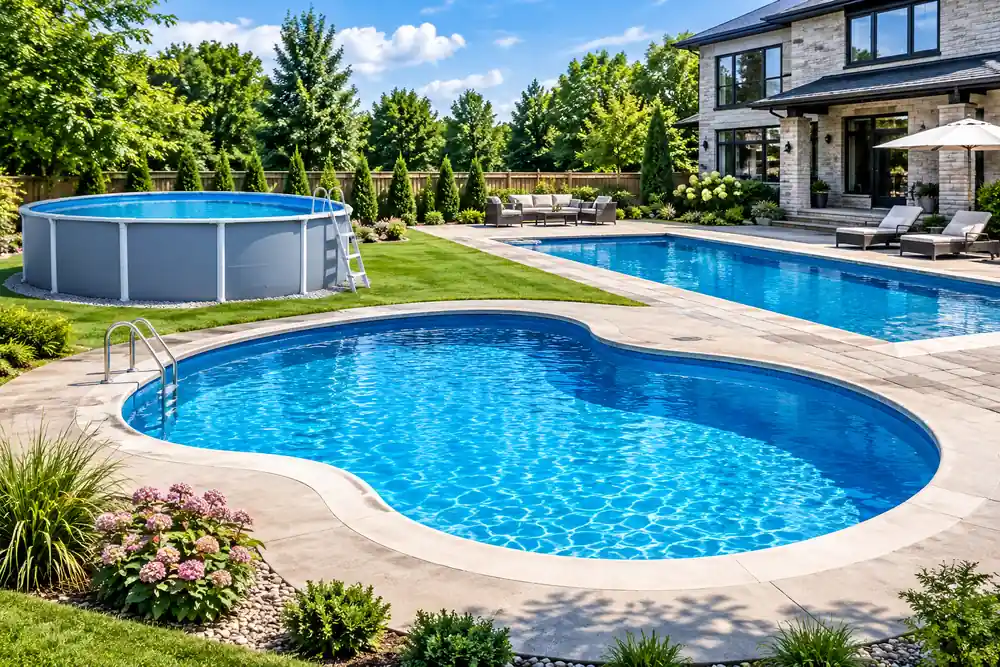
Pool Types: Different Swimming Pools, Costs & Pros and Cons
Pool Types: A Complete Guide to Different Swimming Pool Types, Costs, Pros and Cons
Choosing the right swimming pool starts with understanding the different pool types available. Whether you want an affordable above-ground pool, a beautiful inground swimming pool, or a low-maintenance fiberglass design, every option has its own advantages, disadvantages, and costs.
Some swimming pools are designed for small backyards, while others offer complete customization, luxury features, and plenty of space for swimming. Therefore, comparing pool types before making a decision can help you choose an option that matches your budget, available space, and lifestyle.
In this guide, we will explore different pool types, compare inground and above-ground swimming pools, discuss their pros and cons, and explain what to consider before investing in a swimming pool.
## What Are the Different Types of Swimming Pools?
Swimming pools come in several designs and construction styles. The most common way to classify them is by installation method and construction material.
The main swimming pool types include:
- Above-ground swimming pools
- Inground swimming pools
- Fiberglass swimming pools
- Concrete swimming pools
- Vinyl liner swimming pools
- Semi-inground swimming pools
- Natural swimming pools
- Infinity swimming pools
- Plunge pools
- Indoor swimming pools
However, these categories are not all mutually exclusive. For example, an infinity pool describes a design feature, while fiberglass describes the material used to construct the pool.
Understanding this difference makes comparing pool types much easier.
## Above-Ground Pool Types: Affordable and Convenient Options
Above-ground pools are installed on a prepared surface instead of being built entirely below ground. They are popular among homeowners who want an affordable swimming solution without major excavation or permanent construction.
### Steel Frame Above-Ground Pools
Steel frame pools use a metal support structure to hold the pool walls and water. They are designed to provide stability and are available in several sizes.
**Pros:**
- Generally affordable compared with inground pools.
- Strong frame construction.
- Available in different shapes and dimensions.
- Suitable for family swimming.
**Cons:**
- Metal components may rust if protective coatings become damaged.
- Require a properly prepared and level surface.
- Usually have less design flexibility than inground pools.
### Resin Above-Ground Pools
Resin pools use molded plastic components instead of traditional metal parts. Resin is resistant to corrosion and can be a practical option in environments where moisture is a concern.
**Pros:**
- Resistant to rust and corrosion.
- Lightweight components.
- Attractive designs are available.
- Generally require less concern about metal corrosion.
**Cons:**
- Some models cost more than basic steel-frame options.
- Quality varies between manufacturers.
- Plastic components can be damaged by impact or poor installation.
### Inflatable Above-Ground Pools
Inflatable pools are among the simplest swimming pool options. They are usually made from flexible materials and can be installed temporarily in a backyard.
**Pros:**
- Low initial investment.
- Easy to set up and remove.
- Suitable for small outdoor spaces.
- Convenient for seasonal use.
**Cons:**
- Limited depth and swimming space.
- More vulnerable to punctures.
- Usually have a shorter lifespan.
- Not ideal for serious swimming activities.
### Above-Ground Pool Types: Pros and Cons Comparison
Above-ground pools are generally less expensive and easier to install than permanent inground designs. However, their depth, appearance, and customization options are more limited.
| Pool Type | Main Advantage | Main Disadvantage |
|---|---|---|
| Steel frame | Strong support | Possible corrosion |
| Resin | Corrosion resistance | Higher price on some models |
| Inflatable | Affordable and portable | Less durable |
Above-ground pools are a good choice for homeowners who prioritize affordability, convenience, and seasonal swimming.
## Inground Swimming Pool Types: Which One Is Best?
Inground swimming pools are permanently installed below ground level. They offer more design flexibility and can become an attractive part of a property's outdoor living area.
There are three main inground pool types based on construction material: fiberglass, vinyl liner, and concrete.
### Fiberglass Swimming Pools
Fiberglass pools are manufactured as one-piece shells and transported to the installation site. The shell is placed inside an excavated area and connected to the necessary plumbing and filtration equipment.
**Pros of fiberglass pools:**
- Smooth and comfortable interior surface.
- Generally lower routine maintenance requirements.
- Faster installation than many concrete pools.
- Nonporous surface helps limit algae attachment.
- Available in several factory-designed shapes.
**Cons of fiberglass pools:**
- Shape and size options are limited by available molds.
- Initial investment can be relatively high.
- Transportation and installation require suitable site access.
- Repairs to the shell may require specialized professionals.
Fiberglass pools are particularly suitable for homeowners who want a durable inground swimming pool with relatively low maintenance.
### Concrete Swimming Pools
Concrete pools, also called gunite or shotcrete pools, are constructed on-site using reinforced concrete. They are among the most customizable inground swimming pool types.
**Pros of concrete pools:**
- Almost unlimited design possibilities.
- Custom shapes, sizes, and depths.
- Suitable for infinity edges and integrated water features.
- Multiple interior finishes are available.
- Can provide a long service life with proper maintenance.
**Cons of concrete pools:**
- Higher initial construction costs.
- Longer installation time.
- More demanding surface maintenance.
- Periodic resurfacing may be necessary.
- Rough finishes can require additional attention.
Concrete pools are an excellent option for homeowners who want a completely customized swimming pool and are comfortable with higher construction and maintenance costs.
### Vinyl Liner Swimming Pools
Vinyl liner pools use a supporting wall structure with a flexible vinyl sheet covering the interior. The liner holds the water and provides a smooth swimming surface.
**Pros of vinyl liner pools:**
- Usually lower initial cost than other inground construction options.
- Smooth interior surface.
- Flexible design possibilities.
- Available in different patterns and colors.
- Relatively straightforward liner replacement.
**Cons of vinyl liner pools:**
- Liners can tear or become damaged.
- Replacement is eventually necessary.
- Sharp objects can damage the interior.
- Long-term costs should include future liner replacement.
Vinyl liner pools are worth considering when affordability and design flexibility are important priorities.
## Inground Pool Types: Pros and Cons Comparison
Comparing inground pool types side by side makes it easier to understand their differences.
| Feature | Fiberglass | Concrete | Vinyl Liner |
|---|---|---|---|
| Initial cost | Medium to high | High | Low to medium |
| Installation | Relatively fast | Usually slow | Moderate |
| Maintenance | Generally low | Higher | Moderate |
| Design flexibility | Limited by molds | Excellent | Good |
| Surface | Smooth gelcoat | Depends on finish | Smooth liner |
| Replacement needs | Repairs as needed | Periodic resurfacing | Liner replacement |
The best option depends on your priorities. Fiberglass is attractive for lower routine maintenance, concrete offers the most customization, and vinyl liner pools can provide a more affordable entry into inground pool ownership.
## Comparing Costs of Different Inground Pool Types
Cost is one of the most important factors when choosing a swimming pool. However, the cheapest initial installation does not always provide the lowest long-term ownership cost.
The total investment depends on pool dimensions, excavation, soil conditions, labor, equipment, decking, finishing materials, and local construction prices.
Generally, the cost order is:
- Vinyl liner pools: Usually the lowest initial construction cost.
- Fiberglass pools: Generally a medium-to-high initial investment.
- Concrete pools: Usually the highest construction cost.
Remember that these are relative cost categories, not fixed prices. Actual quotes can vary considerably by location and project requirements.
When comparing costs, consider:
- Initial construction and installation.
- Excavation and site preparation.
- Pumps, filters, and plumbing.
- Water treatment and electricity.
- Cleaning and routine maintenance.
- Interior repairs or replacement.
- Pool covers, fencing, and decking.
For a better understanding of your project budget, visit the [Swimming Pool Calculator homepage](https://swimmingpoolcalculator.online/). You can explore pool-related calculations and plan your swimming pool project more effectively.
## Other Popular Swimming Pool Types
Apart from construction materials, swimming pools can also be classified by their design, location, and intended use.
### Semi-Inground Swimming Pools
Semi-inground pools are installed partly below ground and partly above ground. They can be useful for sloped yards or properties where a traditional inground installation is difficult.
They provide a middle ground between above-ground and fully inground designs.
### Infinity Swimming Pools
Infinity pools feature an edge designed to create the visual impression that water flows continuously into the surrounding landscape.
They are particularly popular in luxury properties, resorts, and locations with scenic views.
### Natural Swimming Pools
Natural swimming pools use biological filtration and aquatic plants or other natural treatment systems to help maintain water quality.
They offer an alternative to conventional chemical-based pool systems, although proper water management remains essential.
### Plunge Pools
Plunge pools are compact swimming pools designed primarily for cooling off, relaxation, and limited-space installations.
They are ideal for smaller backyards where a full-size swimming pool may not be practical.
### Indoor Swimming Pools
Indoor pools are installed inside enclosed structures. They allow year-round swimming while providing protection from outdoor weather.
However, indoor installations require appropriate ventilation, humidity control, and moisture-resistant construction.
## How to Choose the Right Pool Type for Your Home
Selecting the right pool requires more than comparing appearance and construction prices. You should consider how you plan to use the pool and what your property can accommodate.
**Consider your budget**
If you want an affordable option, an above-ground or vinyl liner pool may be worth considering. Fiberglass and concrete pools generally require a larger initial investment.
**Evaluate your available space**
Measure your backyard and consider the space needed for decking, fencing, equipment, and safe access.
**Think about maintenance**
Fiberglass pools generally require less routine surface maintenance than concrete pools. Concrete pools often require more brushing and periodic resurfacing.
**Choose the right design**
If you want a unique shape, custom depth, or integrated water features, concrete may be the best choice. If you prefer a standard design, fiberglass can be a practical alternative.
**Consider long-term ownership**
Think about repair costs, equipment replacement, energy consumption, water treatment, and future renovations before making your final decision.
You can also explore our detailed guide to [different swimming pool problems and their solutions](https://swimmingpoolcalculator.online/pool-problems/) to understand common maintenance challenges and how to manage them.
## Frequently Asked Questions About Pool Types
### What are the main types of swimming pools?
The main residential swimming pool types include above-ground, inground, fiberglass, concrete, vinyl liner, and semi-inground pools. Other popular designs include infinity, natural, indoor, and plunge pools.
### What are the three main types of inground swimming pools?
The three main inground construction types are fiberglass, concrete, and vinyl liner pools. They differ in installation methods, design flexibility, maintenance requirements, and initial costs.
### Which type of swimming pool is the most affordable?
Above-ground pools are generally the most affordable overall. Among inground options, vinyl liner pools usually have the lowest initial construction cost.
### Are fiberglass pools better than concrete pools?
Fiberglass pools generally offer faster installation and lower routine maintenance. Concrete pools provide more design flexibility and customization. The better choice depends on your budget and requirements.
### What are the disadvantages of above-ground pools?
Above-ground pools usually offer less depth, fewer customization options, and a less permanent appearance than inground pools. Their lifespan also depends heavily on construction quality and maintenance.
### Which inground pool type requires the least maintenance?
Fiberglass pools generally require the least routine surface maintenance because their smooth, nonporous finish makes cleaning easier and helps limit algae attachment.
### How do I compare different pool types?
Compare construction cost, installation time, durability, maintenance, available designs, and long-term repair requirements. These factors provide a more realistic picture than initial price alone.
## Final Thoughts
Understanding different pool types helps you make a more informed decision before investing in a swimming pool. Above-ground pools are convenient and affordable, fiberglass pools offer a smooth surface and relatively low maintenance, concrete pools provide exceptional customization, and vinyl liner pools can reduce initial construction costs.
There is no single swimming pool type that works best for every homeowner. The right choice depends on your available space, budget, preferred design, and long-term maintenance expectations.
Take time to compare your options, understand the total ownership costs, and choose a swimming pool that fits your property and lifestyle.



