

One-Year Government Exam Preparation Plan: What Should You Study Month by Month?

One year's preparation for the Sarkari Naukri examination needs systematic approach, continuous practice and revision on time. For those who are preparing for SSC, Railway, Banking, Defence, Teaching or State Govt. exams, need to know about the nature of the exam and syllabus first. This month-by-month approach will help to break down the syllabus into bits and pieces, improve accuracy and also detect weak areas prior to exam.
Depending upon the nature of exam, qualification and the existing knowledge level of the candidates, the right preparation approach varies. Nevertheless, the below mentioned approach for 12 months is useful.
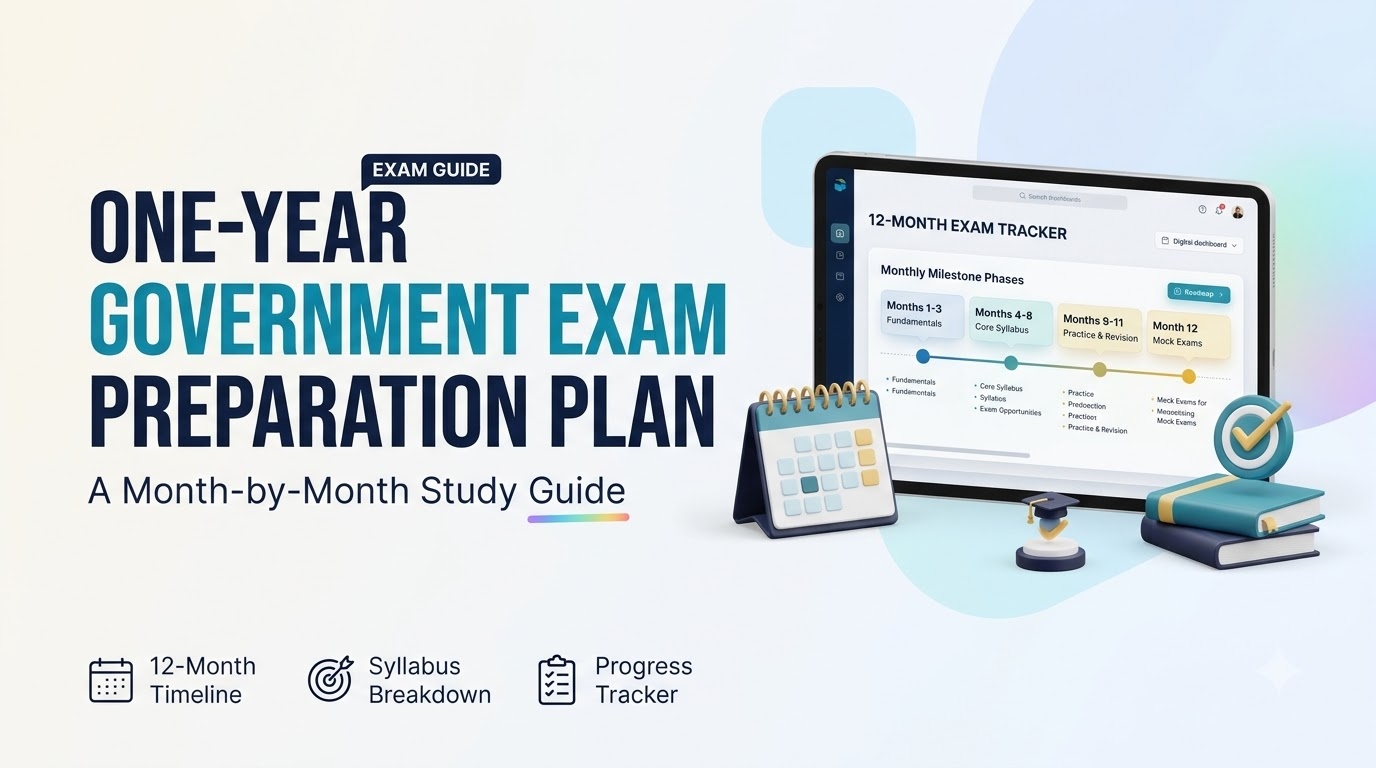
One-Year Government Exam Preparation Plan: Month-Wise Strategy
The schedule below is a general preparation framework, not an official examination calendar.
Month 1: Understand the Exam and Assess Your Level
-
Choose one primary examination and one or two related secondary examinations.
-
Go through the most recent notification and syllabus.
-
Take the previous year's question paper in order to understand your strengths and weaknesses.
-
Draw up a daily schedule for yourself.
Month 2: Build Basic Concepts
-
Study basic math, reasoning, language and general awareness as per the examination requirements.
-
Practice requires percentage, ratio, average, number system and reasoning questions.
-
Grammar, vocabulary and reading comprehension should be improved.
-
Take short notes on difficult topics.
Month 3: Strengthen Core Subjects
-
Cover these the major subjects mentioned in the syllabus.
-
Study these topics history, geography, politics, economics, and general science, wherever applicable.
-
For banking, concentrate on quantitative aptitude, reasoning and English.
-
Solve questions based on different topics regularly.
Month 4: Complete the First Major Syllabus Sections
-
Cover a significant part of the syllabus.
-
Solve previous year question papers on covered topics.
-
Revise previous topics every week.
-
Take notes on mistakes made repeatedly.
Month 5: Cover General Awareness and Current Affairs
-
Revise static GK and current affairs per the examination needs.
-
Maintain notes about significant national happenings, government schemes, awards, appointments, and sports monthly.
-
Practice computer awareness or banking awareness if required.
-
Keep practising mathematics, reasoning, and language skills.
Month 6: Finish the First Syllabus Cycle
-
Strive for one complete round of the syllabus.
-
Rework mathematical formulas, grammatical rules, facts, and concepts of the subject.
-
Take sectional tests each week.
-
Conduct analysis of the answers attempted in terms of accuracy and time taken for each question.
Month 7: Start Regular Mock Tests
-
Begin practicing full length mock exams as per the recommended exam pattern.
-
Summarize wrong, left-out and guesswork questions.
-
Determine whether your errors are conceptual, inaccurate or due to time shortage.
-
Persist with revision of difficult topics along with practice.
Month 8: Improve Speed and Accuracy
-
Take timed practice questions.
-
Develop effective techniques to solve problems without compromising correctness.
-
Better your weaker subjects from your analysis of mock tests.
-
Solve previous year question papers of several years.
Month 9: Revise the Complete Syllabus
-
Reread all main topics and subjects already covered through various chapters.
-
Study using concise notes, formulae sheets, and question papers chapter wise.
-
Self-review current affairs related to the current examination.
-
Conduct mock tests and analyze the results periodically.
Month 10: Practise Exam-Level Papers
-
Practice writing full essays using the real examination environment.
-
Try to stick to the prescribed duration of time and marking scheme.
-
Support improvement of question selection and management of time for sections.
-
For the physical or practical recruitment process, keep practicing.
Month 11: Focus on Revision and Weak Areas
-
Study often-tested areas and your errors repeatedly.
-
Revise brief notes and do not begin multiple resources from scratch.
-
Mock tests should continue at an easy pace.
-
Cross-check official notifications for application dates, test dates and guidance.
Month 12: Final Revision and Exam Readiness
-
Some formulas and key facts should be revised again.
-
Take mock tests in case these tests keep you ready but do not make you tired.
-
Verify your admit card, examination center, reporting time, and required documents.
-
Have enough sleep and never use new study material on the final day.
Daily Study Timetable for Sarkari Naukri Exam Preparation
Study hours could be managed by candidates as per their duties and their level of preparation.
-
Major subject or technical subjects: 2 hours
-
Mathematics & Reasoning: 1 hour
-
English or Hindi: 45 minutes
-
GK and Current Affairs: 45 minutes
-
Solving questions and revising: 1 hour
-
Totals number of study hours: 5 hours 30 minutes
Working candidates may study for 2 to 3 hours each day and weekends could be used for practice. Technical, teaching and defence exams would need extra subject preparation and physical training respectively.
Important Tips to Follow During the 12-Month Plan
-
Consult official source: Visit the respective commission or recruitment organization’s website to find the latest syllabus, exam pattern, and notice. For instance, SSC releases the notice of recruitment on its official site (ssc.gov.in). Bank job aspirants can visit IBPS website (ibps.in).
-
Beware of collecting too many sources: Refer to a few sources such as books, official sources and previous year question papers.
-
Note errors: Note down incorrect answers and review them regularly.
-
Assess performance: Check the progress related to syllabus completion, test scores, and weaknesses once a month.
-
Prepare for every selection procedure: Find out whether there is any interview, physical test, skill test, typing test, and/or document verification involved in the selection procedure of your selected recruitment.
Conclusion
An annual preparation schedule for government examinations is more useful if the candidates take into consideration the factors of syllabus completion and practice along with revision and analysis of mock tests. Start with gaining knowledge about the examination pattern. Then try to create concepts right from the beginning and gradually proceed to timed exams and revision. Make sure that you keep checking the notices and stick to your timetable. This is definitely going to assist you in preparing for Sarkari Naukri.



