

How Ballet Helps Preschoolers Develop Balance, Posture and Body Awareness

Ballet builds foundational physical skills in young children by introducing structured, rhythmic movement that trains the body to move with control and coordination. For children aged three to six, age-appropriate ballet exercises encourage upright posture, spatial awareness, and bilateral coordination — all without demanding technical perfection. The focus is exploration, play, and learning how the body moves through space.
If you've been considering a ballet class for toddlers, you're likely wondering what your child will actually gain beyond a cute tutu moment. The answer lies in how early movement experiences shape the developing nervous system — and ballet, even at its most basic level, delivers a surprisingly structured environment for that growth.
Why Early Movement Matters for Physical Development
Children between the ages of two and six are in a critical window for gross motor development. During this stage, the brain is forming movement pathways that influence coordination, balance, and muscle memory well into adulthood. Introducing structured movement — even in a playful, low-pressure setting — during this period has measurable benefits.
According to the Health Promotion Board (HPB) Singapore, children aged three to six should engage in at least three hours of physical activity daily, including activities that promote balance, coordination, and muscle strength. Ballet class for toddlers fits naturally into this recommendation by combining light aerobic movement with balance-focused exercises.
How Ballet Specifically Trains Balance in Young Children
Balance in toddlers is not automatic — it develops through repeated practice and sensory feedback. Ballet introduces this through a series of simple positional exercises that challenge a child's centre of gravity in a safe, supported way.
Standing on One Leg and Weight Shifting
One of the earliest ballet exercises children learn is standing on one leg, even briefly. This activates the proprioceptive system — the body's internal sense of position — and strengthens the ankle and core stabilisers. Over weeks of practice, most children show noticeable improvement in how long they can maintain single-leg balance.
Plié and Relevé Movements
Simple pliés (bending the knees) and relevés (rising onto the balls of the feet) are standard in beginner ballet. These movements strengthen the calves, thighs, and hip stabilisers — the exact muscle groups that support upright posture and stable walking. For toddlers, these feel like a fun game, not structured exercise.
Posture: What Ballet Actually Teaches Young Spines
Poor posture habits can begin surprisingly early, particularly as children spend more time seated during meals, screen time, and early learning activities. Ballet counteracts this by consistently reinforcing an upright, elongated body position.
Instructors cue children to "grow tall like a tree" or "pull their tummies in gently" — language that makes postural alignment accessible and engaging for young minds. Over time, these cues become internalised habits. Children begin to carry themselves differently, not just during class but throughout daily life.
It's important to note that at the preschool stage, the goal is not forced posture correction. It is about introducing good alignment patterns before compensatory habits set in. No ballet class should place undue physical demands on a three or four-year-old's still-developing skeleton.
Body Awareness: Understanding Where the Body Is in Space
Body awareness — technically called proprioception and kinaesthesia — is a child's ability to understand where their limbs are and how they're moving without looking directly at them. It sounds simple, but many children struggle with it, which affects everything from handwriting to sports participation.
How Ballet Builds Proprioception
Ballet class for toddlers teaches children to:
-
Isolate specific body parts (arms, legs, head) and move them independently
-
Mirror a teacher's movements, building visual-motor coordination
-
Navigate space without bumping into peers, developing spatial judgement
-
Coordinate rhythm with movement, which links auditory processing to physical action
These are not abstract skills. A child who understands their body in space is less likely to trip, more capable of following multi-step physical instructions, and better prepared for school-based physical education activities.
What a Developmentally Appropriate Ballet Class Looks Like
Not every ballet class in Singapore is structured with young children's developmental needs in mind. Here's what separates an age-appropriate class from one that simply scales down adult ballet:
|
Age-Appropriate Approach |
What to Avoid |
|---|---|
|
Play-based learning with music and imagination |
Strict technical drilling for under-5s |
|
Short activities with variety (10–15 minute rotations) |
Long static holds |
|
Positive, encouraging instruction style |
Avoid pressure and harsh corrections. |
|
Flat shoes or bare feet for natural foot development |
Avoid pointe work and forced turnout. |
|
Focus on exploration and coordination |
Comparing children to each other |
Is Ballet in Singapore a Good Option for Young Children?
In Singapore, structured extracurricular activities often begin early, and parents are rightly discerning about what genuinely benefits their child versus what adds unnecessary pressure. Ballet Singapore offerings vary widely — from performance-focused academies to developmental programmes designed for preschool-aged children.
For the three-to-six age group, the best-fit programmes prioritise guided play, creative movement, and gentle coordination exercises over technique and performance outcomes. Look for classes with small group sizes, qualified instructors with early childhood or dance education backgrounds, and a curriculum built around developmental milestones rather than recital preparation.
Additional Physical Benefits Worth Knowing
Beyond balance, posture, and body awareness, regular ballet participation supports:
-
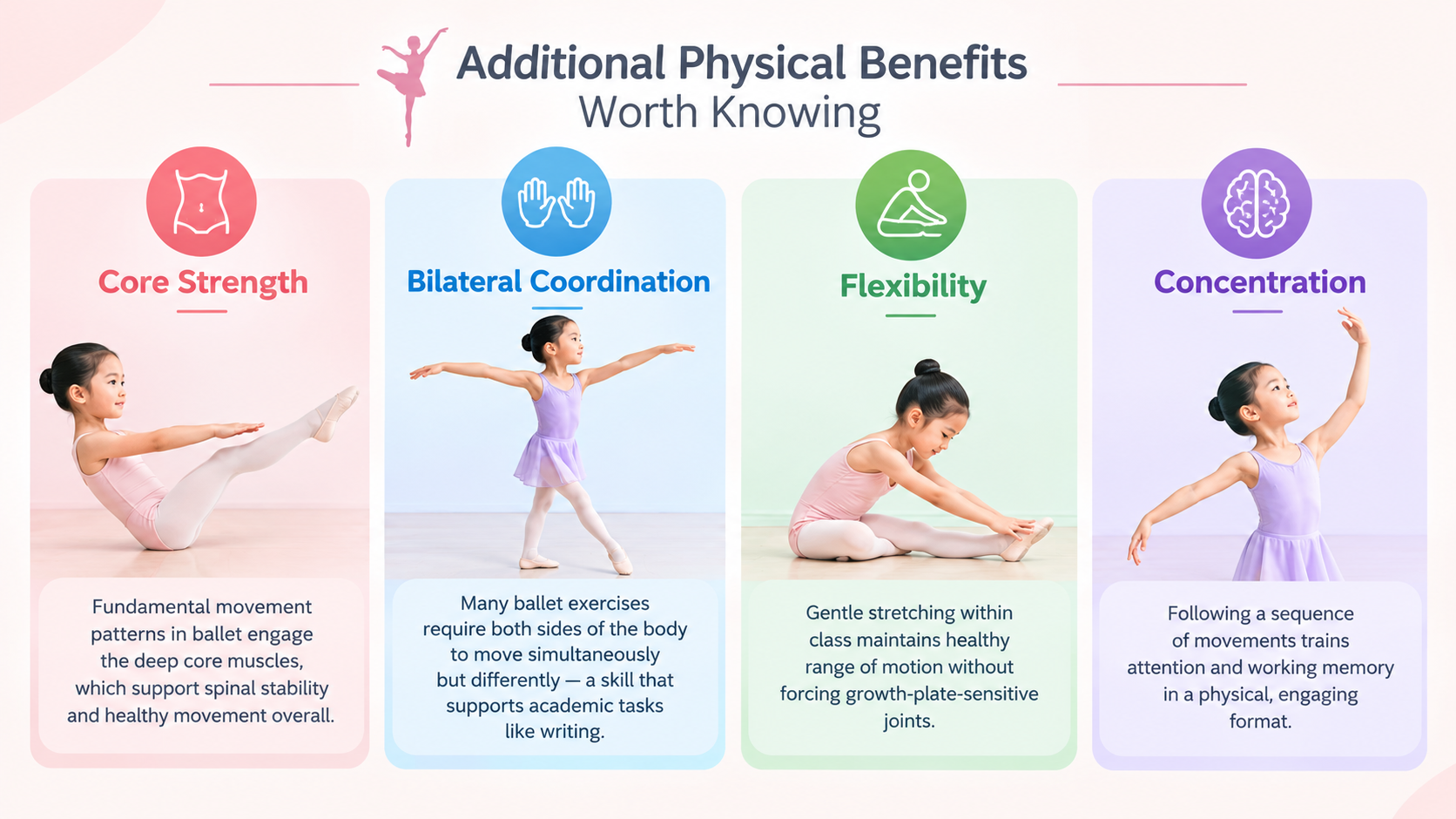
Core strength: Fundamental movement patterns in ballet engage the deep core muscles, which support spinal stability and healthy movement overall.
-
Bilateral coordination: Many ballet exercises require both sides of the body to move simultaneously but differently — a skill that supports academic tasks like writing.
-
Flexibility: Gentle stretching within class maintains healthy range of motion without forcing growth-plate-sensitive joints.
-
Concentration: Following a sequence of movements trains attention and working memory in a physical, engaging format.
What Parents Should Realistically Expect
It's worth being honest: a five-year-old won't emerge from six months of ballet class with professional posture or measurable athletic performance gains. That's not the point. What you will likely observe is a child who is more comfortable in their body, more spatially aware, and more confident during physical play.
Progress is gradual and often visible in small moments — standing steadier, jumping with more control, or simply enjoying the feeling of moving to music. These small wins are the foundation for lifelong physical confidence.
Finding the Right Class
When evaluating options, visit a trial class before committing. Watch how the instructor manages energy levels, responds to distracted children, and structures the lesson. A well-run beginner class for preschoolers should feel joyful, not regimented.
Elevate Dance offers ballet programmes in Singapore specifically designed with young learners in mind, blending structured movement with creative play. For families looking to explore ballet as a developmental foundation — not a performance pathway — their early childhood ballet classes are worth exploring. Visit the Elevate Dance homepage to learn more about their full range of programmes.
Frequently Asked Questions
What is the right age to start ballet class for toddlers?
Most ballet schools in Singapore accept children from age three. At this age, classes focus on creative movement and coordination rather than technique. The goal is to build physical confidence and introduce structured movement in an age-appropriate, play-based environment.
Does ballet actually improve balance in young children?
Yes. Exercises like single-leg standing, pliés, and relevés directly train the stabilising muscles and proprioceptive system. Research consistently shows that structured movement activities improve balance outcomes in preschool-aged children when practised consistently over several weeks or months.
Is ballet safe for preschoolers' developing bodies?
When taught correctly, ballet is safe for young children. Reputable preschool programmes avoid forced turnout, pointe work, and high-impact jumps. Classes should use flat shoes or bare feet and focus on natural movement patterns that support — rather than strain — a developing musculoskeletal system.
How is ballet different from other physical activities for toddlers?
Ballet uniquely combines balance training, spatial awareness, rhythm, and postural alignment in a single structured session. Unlike general gym play, it introduces children to intentional body control and sequential movement patterns, which supports both physical and cognitive development in the early years.
How many classes per week are recommended for a toddler starting ballet?
One class per week is standard and sufficient for children aged three to five. Consistency over time matters more than frequency at this stage. A weekly class provides enough repetition to build motor memory without overscheduling a young child's developmental needs.



