

C_THR97 Exam Guide: Exam Topics, Preparation Strategy, and Certification Tips

Quick Summary
C_THR97 is the exam code for the SAP Certified Associate certification in SAP SuccessFactors Onboarding. It tests whether you can configure and support onboarding processes, including preboarding, task assignment, document collection, and the handoff of new hire data to other HR processes.
Introduction: what this C_THR97 exam guide covers
Anyone starting an SAP certification has to balance product knowledge, business process thinking, and exam technique. This C_THR97 Exam Guide explains what the certification measures, which topics deserve the most attention, and how to plan your preparation so the hours you spend count.
SAP SuccessFactors Onboarding helps organizations move a new hire from accepted offer to productive employee. That involves preboarding activities, forms and documents, tasks for managers and HR, and notifications that keep everyone informed. The exam checks whether you understand how those pieces fit together and why an administrator would set them up a certain way. Memorized definitions will not carry you far on that kind of question.
What is the C_THR97 exam?
C_THR97 is an associate-level SAP certification for people who implement or support SAP SuccessFactors Onboarding. Public descriptions of the exam place it at consultant level, aimed at professionals who work as part of a project team and configure the module under guidance. Prior exposure to the wider SuccessFactors platform, such as role-based permissions and the way processes are triggered, makes the material noticeably easier.
SAP releases exam versions with a date suffix, such as C_THR97_2405 or C_THR97_2505, and older versions are retired over time. Third-party pages disagree on details. Some list 80 questions in 180 minutes, others describe a newer scenario-based format, and the reported cut scores range from 60% to 69%. These differences are a good reason to treat any summary, including this one, as a starting point and to confirm the details with SAP before scheduling.
Who should take it
The certification suits several groups:
- Implementation consultants who configure Onboarding for customers.
- HR systems administrators who maintain onboarding processes after go-live.
- HR professionals moving from a general HR role into a systems role.
- Partner consultants who need a recognized credential on their profile.
If you have never opened an onboarding configuration screen, plan for extra hands-on time. Reading alone rarely prepares you for scenario questions.
C_THR97 exam topics to focus on
SAP publishes the weighting of each topic area for every exam version. Use that list as your master outline. The areas below appear consistently in descriptions of the exam, and each rewards a different kind of preparation.
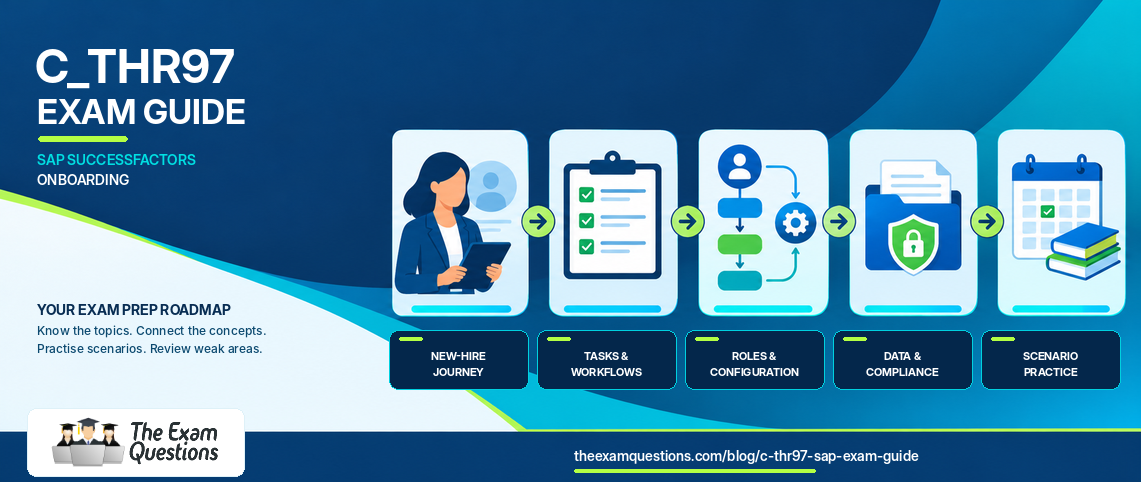
Onboarding process design and workflow
Know what happens at each stage of the process, who owns each step, and which steps depend on others. A typical dependency is a new hire submitting personal data before HR can complete an assignment. Questions often describe a stalled process and ask what to check first.
Roles, permissions, and user experience
New hires, managers, HR administrators, and other participants each see and do different things. Study how access is granted and what a user would experience when a task is assigned, missed, or reassigned.
Configuration and templates
Expect questions on forms, document templates, task definitions, and email notifications. Focus on the reasoning: what business requirement does a setting address, and what changes for the user when you adjust it? Behavior can differ between systems because of enabled features, permissions, and release updates, so avoid assuming that one implementation you know represents all of them.
Data, integration, and compliance
Onboarding data often moves into other HR processes, so accuracy at the point of collection matters. Understand how document handling, access restrictions, and data privacy affect design decisions. Legal requirements vary by country and employer, which means no single configuration is correct everywhere.
Understanding the format and the official requirements
Before you commit time, read the SAP official certification page for the current exam code, topic weightings, delivery format, and recommended preparation. That page overrides anything you read elsewhere, including summaries from training vendors whose information may reflect an older exam version.
Two details are worth noting. SAP exams can include unscored items that are being tested for future versions, so a question that seems oddly out of scope may not count. SAP also changes how it delivers certification access over time, so confirm how and where you will sit the exam, and whether your attempt is included in any subscription you hold.
How to prepare for C_THR97
A workable plan has five parts, and the order matters.
- Download the current topic outline and mark each area as strong, shaky, or new to you.
- Build or borrow access to a test system and complete the main configuration tasks yourself, from creating a process to triggering it with a test hire.
- Read the official product documentation for every shaky topic, then close it and explain the topic aloud from memory.
- Keep a revision log with three columns: the topic, what you got wrong, and the correct explanation.
- In the final week, reread the log and attempt a timed set of practice questions to check pacing.
Hands-on work does the most for scenario questions. When you have personally watched a task fail to appear because of a missing assignment rule, you recognize the pattern immediately on the exam.
Choosing practice questions carefully
Practice questions are useful for finding gaps, but their quality varies widely. Prefer sets that explain why each answer is right, reflect the current product, and ask you to reason through a situation. Be skeptical of any provider that claims to publish real exam questions. Beyond the integrity problem, those collections tend to be out of date, and memorizing answers gives you nothing to fall back on when the wording changes.
Common mistakes to avoid
Candidates most often lose marks in a few predictable ways. Some study an old exam version because the material was easy to find. Others spend equal time on every topic instead of weighting their effort by the published percentages. Some skip hands-on practice, and others read scenario questions too quickly and miss a detail, such as which user role is affected. Slow down on long scenarios and identify what is actually being asked before you look at the answer options.
Frequently asked questions
How hard is the C_THR97 exam?
It is an associate-level exam, but it expects applied knowledge. Candidates with configuration experience generally find it manageable, while those relying only on reading often struggle with the scenarios.
How long should preparation take?
That depends on your background. Someone already working in SuccessFactors may need a few weeks of focused review, while a newcomer should plan for considerably longer, with most of the time spent in a test system.
Is the passing score the same for every version?
No. Published figures vary by exam version and by source, so rely on the SAP certification page for the number that applies to your attempt.
Final thoughts
Passing C_THR97 comes down to knowing the current scope, practicing the configuration yourself, and reviewing your mistakes methodically. If you want additional exam-focused guidance and practice material to support that plan, you can find it at The Exam Questions. Start with the official topic outline, set a test date that gives you a realistic runway, and adjust your plan after each practice set.



