


How to Create AI UGC Video Ads From an AI Avatar
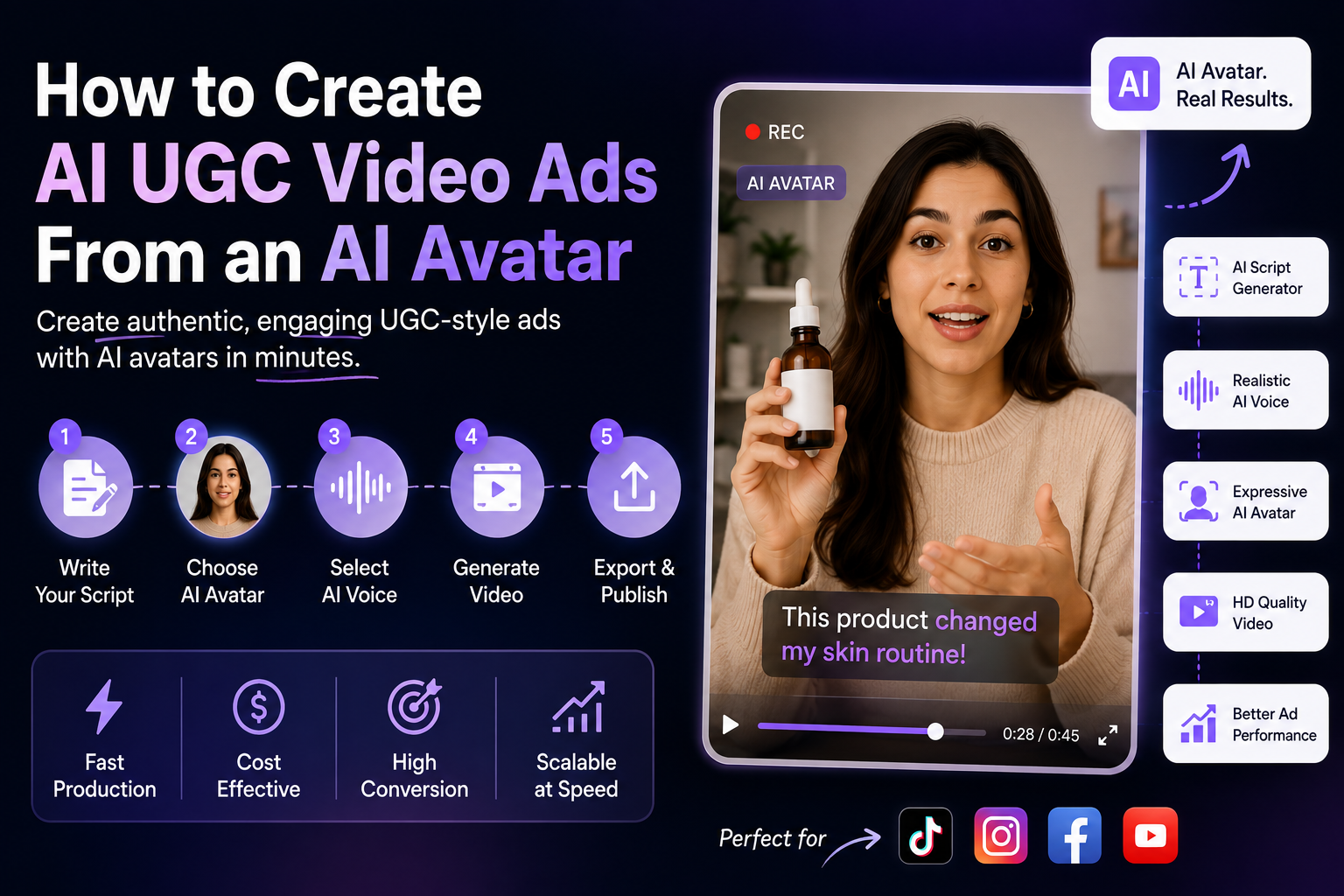
Video advertising has changed dramatically in recent years. Consumers are spending more time watching short-form content on social media, while brands are under increasing pressure to produce fresh creative at scale. Traditional video production can be expensive and time-consuming, especially when a campaign requires multiple creators, scripts, locations, revisions, and different versions for different audiences.
This is where AI UGC Video ads are becoming increasingly useful.
AI-generated UGC combines the familiar, social-first style of user-generated content with artificial intelligence. Instead of relying entirely on a human creator to record every advertisement, brands can use an AI avatar to present scripts, demonstrate products, explain benefits, and deliver calls to action.
The result can be a UGC-style advertisement that is faster to produce, easier to customize, and more scalable for creative testing.
But creating an AI avatar video is not simply about selecting a digital person and generating a video. A successful advertisement still needs a strong hook, relevant messaging, natural delivery, compelling visuals, and a clear reason for viewers to take action.
In this guide, you'll learn how to create AI UGC Video ads from an AI avatar, how to structure the script, choose the right avatar, make the video feel authentic, and optimize your creative for better advertising performance.
What Are AI UGC Video Ads?
AI UGC Video ads are advertisements created with artificial intelligence while following the visual and storytelling conventions of user-generated content.
Traditional UGC ads often feature creators speaking directly to the camera, showing a product, sharing an experience, or explaining why they like a particular product.
AI UGC follows a similar structure but uses artificial intelligence to generate some or all of the content.
An AI UGC ad can include:
-
AI avatars
-
AI-generated voiceovers
-
Product demonstrations
-
AI-generated scripts
-
Captions and subtitles
-
Lifestyle scenes
-
Product images
-
Social-media-style editing
-
Customer-problem storytelling
-
Calls to action
The goal is to create content that feels native to platforms where people already consume short-form videos.
Instead of looking like a traditional television commercial, an AI UGC Video ad can feel more like a person casually explaining a product to the viewer.
What Is an AI Avatar?
An AI avatar is a digitally generated or AI-powered virtual person that can deliver spoken content.
Depending on the technology, an avatar may be selected from a library of virtual presenters or created from a specific identity. The avatar can then speak a written script using an AI-generated voice.
For advertising, AI avatars are useful because they provide a consistent presenter without requiring repeated filming sessions.
A brand can create different versions of the same advertisement by changing:
-
The script
-
The avatar
-
The voice
-
The background
-
The product
-
The hook
-
The call to action
-
The language
-
The audience angle
This flexibility makes AI avatars particularly useful for brands that need a continuous supply of creative content.
Why Use an AI Avatar for UGC-Style Advertising?
One of the biggest challenges with traditional UGC is production scalability.
If a brand wants ten different video concepts, it may need multiple creators, briefs, products, filming sessions, editing, revisions, and approvals.
An AI avatar can simplify parts of this process.
Faster Production
AI-generated videos can often be created much faster than traditional filmed content.
This allows marketers to move from an idea to a testable creative concept quickly.
More Creative Variations
A single concept can be transformed into multiple versions with different hooks, presenters, scripts, and calls to action.
Consistent Messaging
An AI avatar can deliver the same core message across multiple versions while keeping the wording and positioning consistent.
Easy Localization
Scripts can be adapted into different languages, allowing brands to experiment with international audiences.
Scalable Creative Testing
Instead of investing heavily in one advertisement, marketers can create multiple variations and identify which creative direction deserves additional investment.
However, speed should never come at the expense of quality. AI can make production easier, but the strategy behind the advertisement still matters.
Step 1: Define Your Advertising Goal
Before creating an AI UGC Video ad, determine what the video is supposed to accomplish.
Do you want to:
-
Generate product awareness?
-
Drive website traffic?
-
Increase purchases?
-
Explain a product?
-
Promote a specific offer?
-
Retarget existing visitors?
-
Introduce a new product?
-
Address customer objections?
Your goal should influence the entire video.
For example, an awareness-focused advertisement may prioritize curiosity and education, while a conversion-focused advertisement may emphasize product benefits, social proof, objections, and a strong call to action.
Without a clear objective, AI-generated videos can become visually interesting but strategically weak.
Step 2: Understand Your Target Audience
AI UGC Video ads work best when the message feels relevant to the person watching.
Before writing your script, identify your target audience.
Consider:
What problem are they experiencing?
What are they trying to achieve?
What frustrates them about existing solutions?
What questions do they have about your product?
What might stop them from purchasing?
For example, a fitness brand targeting busy professionals might focus on convenience and time savings.
A skincare brand targeting first-time buyers might focus on simplicity and product education.
A SaaS company targeting small businesses might focus on reducing repetitive work.
The avatar is simply the presenter. The audience insight is what gives the advertisement its relevance.
Step 3: Choose the Right AI Avatar
The avatar should match your audience, product, and brand personality.
For example, a professional software product may benefit from a polished and confident presenter, while a lifestyle product may work better with a casual and approachable personality.
Consider:
-
Age appearance
-
Presentation style
-
Clothing
-
Facial expressions
-
Voice
-
Tone
-
Background
-
Overall brand fit
Avoid choosing an avatar simply because it looks impressive.
Ask whether the person looks believable as someone who would naturally discuss the product.
The closer the avatar feels to the intended audience, the easier it can be for viewers to connect with the message.
Step 4: Write a Strong UGC Script
The script is arguably more important than the avatar.
A realistic AI presenter cannot save a weak advertisement.
A strong AI UGC script should sound conversational and focus on one clear message.
A simple structure can look like this:
Hook → Problem → Product → Benefit → Proof → CTA
For example:
“I kept struggling with dry skin until I changed one thing in my routine. This product helped simplify my skincare routine without adding five extra steps. Here's what I noticed after using it consistently. If you're dealing with the same problem, check it out.”
The exact script will depend on the product, but the structure provides a useful starting point.
Keep the Script Conversational
Avoid corporate language such as:
“Our innovative solution provides an unparalleled experience for modern consumers.”
Instead, write as someone would naturally speak:
“I didn't expect this to make such a difference, but it completely changed my routine.”
UGC-style content works because it feels like communication rather than a formal advertisement.
Step 5: Start With a Powerful Hook
The first few seconds of an advertisement are critical.
People scroll quickly through social feeds, so your video needs to establish relevance immediately.
Some useful hook formats include:
Problem Hook
“Still struggling with this every morning?”
Curiosity Hook
“I didn't understand why this kept happening until I tried this.”
Experience Hook
“I've tested several products for this, and here's the one that surprised me.”
Mistake Hook
“If you're doing this, you're probably making your routine harder than it needs to be.”
Benefit Hook
“Here's a simple way to save time without sacrificing results.”
The best hook depends on your audience and product.
Don't create a hook simply because it sounds catchy. Create one that attracts the people who are most likely to care about the product.
Step 6: Add the Product Naturally
The product should not feel randomly inserted into the video.
Instead, connect it directly to the problem introduced in the hook.
For example:
Problem: “I was spending too much time editing every product video.”
Product: Introduce the solution.
Benefit: Explain how it simplifies the workflow.
Demonstration: Show the product or process.
This creates a natural story.
For ecommerce brands, product visuals are particularly important. Make sure the product looks accurate and recognizable throughout the video.
Step 7: Use Product Demonstrations
Showing is often more effective than simply telling.
Instead of saying:
“This product is easy to use.”
Show how it works.
Instead of saying:
“This bottle is convenient.”
Show the bottle being used.
Instead of saying:
“Our software saves time.”
Show the workflow.
Product demonstrations make AI UGC Video ads more informative and can help viewers understand the product quickly.
You can combine the AI avatar with:
-
Product close-ups
-
Screen recordings
-
Product photography
-
Lifestyle scenes
-
Before-and-after visuals
-
On-screen text
-
Motion graphics
The AI avatar becomes the storyteller while the supporting visuals demonstrate the product.
Step 8: Make the AI Avatar Feel Natural
One of the biggest challenges with AI-generated video is avoiding an artificial or robotic feeling.
Even highly realistic avatars can feel unnatural when the script or delivery is overly formal.
To improve the experience:
-
Use conversational language
-
Keep sentences relatively short
-
Avoid complicated wording
-
Choose an appropriate voice
-
Match the avatar to the audience
-
Use natural pauses
-
Avoid excessive claims
-
Keep the visual environment believable
The goal is not to convince viewers that the presenter is necessarily a real person.
The goal is to create an advertisement that feels comfortable, clear, and engaging to watch.
Step 9: Add Captions
Captions are essential for short-form advertising.
Many people watch videos without sound, particularly when scrolling through social platforms.
Captions make the core message accessible even when audio is muted.
Use short lines and emphasize important phrases.
For example:
“I finally found a simpler way to do this.”
Then follow with:
“Here's what changed.”
Avoid placing large amounts of text on the screen at once.
The viewer should be able to understand the main message without stopping the video.
Step 10: Keep the Video Focused
A common mistake when creating AI UGC Video ads is trying to communicate everything at once.
A short advertisement does not need to explain every feature.
Instead, choose one primary message.
For example:
-
Save time
-
Reduce cost
-
Solve a specific problem
-
Improve convenience
-
Discover a new product
-
Get a specific result
One clear benefit is usually easier to communicate than ten competing benefits.
Once you identify the strongest message, build the entire video around it.
Step 11: Add a Strong Call to Action
Every performance-focused advertisement should have a clear next step.
Your CTA could encourage viewers to:
-
Shop now
-
Learn more
-
Try the product
-
Visit the website
-
Start a free trial
-
See how it works
-
Get the offer
-
Explore the collection
The CTA should match the customer's stage in the buying journey.
For example, a cold audience may respond better to “Learn More,” while an audience already familiar with the product may be ready for “Shop Now.”
Step 12: Create Multiple AI UGC Video Ad Variations
One of the biggest advantages of AI-powered creative production is the ability to test variations.
Instead of creating one video and assuming it will work, create several versions.
You can change:
Hooks
Test different opening statements.
Avatars
Try presenters with different appearances and communication styles.
Scripts
Focus on different benefits or customer problems.
CTAs
Compare different calls to action.
Visuals
Test product demonstrations, lifestyle scenes, and close-ups.
Offers
Experiment with different promotions where appropriate.
This approach turns AI UGC into a creative testing system rather than a one-time content-generation process.
Step 13: Optimize AI UGC Video Ads for Different Platforms
Different platforms have different content expectations.
For short-form vertical advertising, a 9:16 format is generally appropriate.
Your videos should also consider:
-
Safe areas for text
-
Subtitle placement
-
Video pacing
-
Mobile viewing
-
Platform-specific audience behavior
A video created for a social feed should not simply be treated like a traditional television advertisement.
The content needs to feel native to the platform.
Common Mistakes to Avoid
Making the Video Too Promotional
UGC-style content should feel informative or conversational rather than like a traditional sales pitch.
Using Generic Messaging
If the script could apply to almost any brand, it probably needs more specificity.
Choosing an Unrelated Avatar
The presenter should make sense for the target audience and product.
Overloading the Video
Too many features, claims, and messages can make the advertisement confusing.
Ignoring Product Accuracy
AI-generated visuals can sometimes introduce inconsistencies. Always check the final output carefully.
Creating Only One Version
A single creative cannot tell you whether the concept itself works.
Testing multiple variations is essential.
How to Measure AI UGC Video Ad Performance
Once your AI UGC Video ads are live, measure their performance using relevant advertising metrics.
Important metrics can include:
Hook or thumb-stop performance: Shows whether the opening attracts attention.
Video watch time: Helps indicate whether viewers stay engaged.
Click-through rate: Measures how effectively the video encourages people to visit the destination.
Conversion rate: Shows how many visitors complete the desired action.
Cost per acquisition: Helps determine how efficiently the campaign generates customers.
Return on ad spend: Helps evaluate the financial performance of advertising.
Do not evaluate a video using only one metric.
For example, a video can generate strong views but weak conversions. That may indicate that the hook works but the offer, product positioning, or landing page needs improvement.
AI UGC Video Ads and Creative Testing
The biggest opportunity with AI-generated advertising is not simply production speed.
It is the ability to experiment.
Imagine having one product and creating:
-
5 hooks
-
3 avatars
-
3 benefit angles
-
2 CTAs
That creates many potential creative combinations.
You don't necessarily need to launch every combination at once. Instead, you can build a structured testing process.
Start with different messaging angles.
Identify which concepts generate the strongest engagement.
Then create additional variations around the best-performing ideas.
This creates a continuous creative optimization loop:
Research → Create → Test → Analyze → Improve → Repeat
Are AI UGC Video Ads Better Than Traditional UGC?
There is no universal answer.
Traditional UGC has an important advantage: real people can provide genuine experiences and personal opinions.
AI UGC provides different advantages, including scalability, consistency, speed, and creative flexibility.
For many brands, the best strategy may involve using both.
Real customer content can provide authentic social proof.
AI UGC can help expand the creative library, test messaging, and produce variations.
The two approaches can complement each other rather than compete directly.
The Future of AI Avatar Advertising
AI avatars are becoming an increasingly useful part of digital advertising.
As AI video technology continues to improve, avatars are likely to become more expressive, natural, customizable, and adaptable.
Brands may eventually create highly personalized AI UGC Video ads based on audience segments, product preferences, languages, and campaign objectives.
The biggest shift will likely be from creating individual advertisements to building scalable creative systems.
Instead of producing one video for an entire audience, brands can potentially create different versions for different customer groups and continuously learn which messages perform best.
That makes AI UGC particularly relevant for DTC brands operating in competitive markets.
Final Thoughts
Creating AI UGC Video ads from an AI avatar is more than choosing a virtual presenter and generating a script. The most effective advertisements combine the speed of AI with strong marketing fundamentals.
Start with your audience.
Identify a specific problem.
Create a strong hook.
Write a conversational script.
Choose an avatar that fits the audience.
Show the product clearly.
Use captions and social-first visuals.
Add a relevant call to action.
Then create multiple variations and use performance data to determine what works.
The real power of AI UGC is not simply the ability to generate videos quickly. It is the ability to make creative experimentation more scalable.
For DTC brands, this can transform video advertising from a slow production process into a continuous cycle of creating, testing, learning, and improving.
As competition for attention continues to increase, brands that combine authentic storytelling, smart creative strategy, and scalable AI production will be better positioned to create advertising content that captures attention and drives action.
- Goth Lifestyle
- Fashion & Style
- Music & Bands
- Art & Photography
- Creative Writing & Poetry
- Events & Scene
- Occult & Spirituality
- DIY & Tutorials
- Beauty & Self-Care
- Relationships & Dating
- Gaming & Media
- Tech & Gadgets
- Body Art & Piercings
- Underground Culture
- Spotlights & Interviews
- Travel & Places
- Lifestyle & Daily Life
- Fitness & Health
- Travel & Adventure
- Books & Literature
- Tech & Gaming
- Movies & TV
- Food & Drinks
- Humor & Memes
- Pets & Animals
- General Arts & Crafts

 English
 Arabic
 French
 Spanish
 Deutsch
 Turkish
 Dutch
Dutch
 Italiano
 Russian
 Romaian
 Portuguese (Brazil)
 Greek
Greek