


🖤 What Being Goth Really Means (Beyond the Stereotypes)
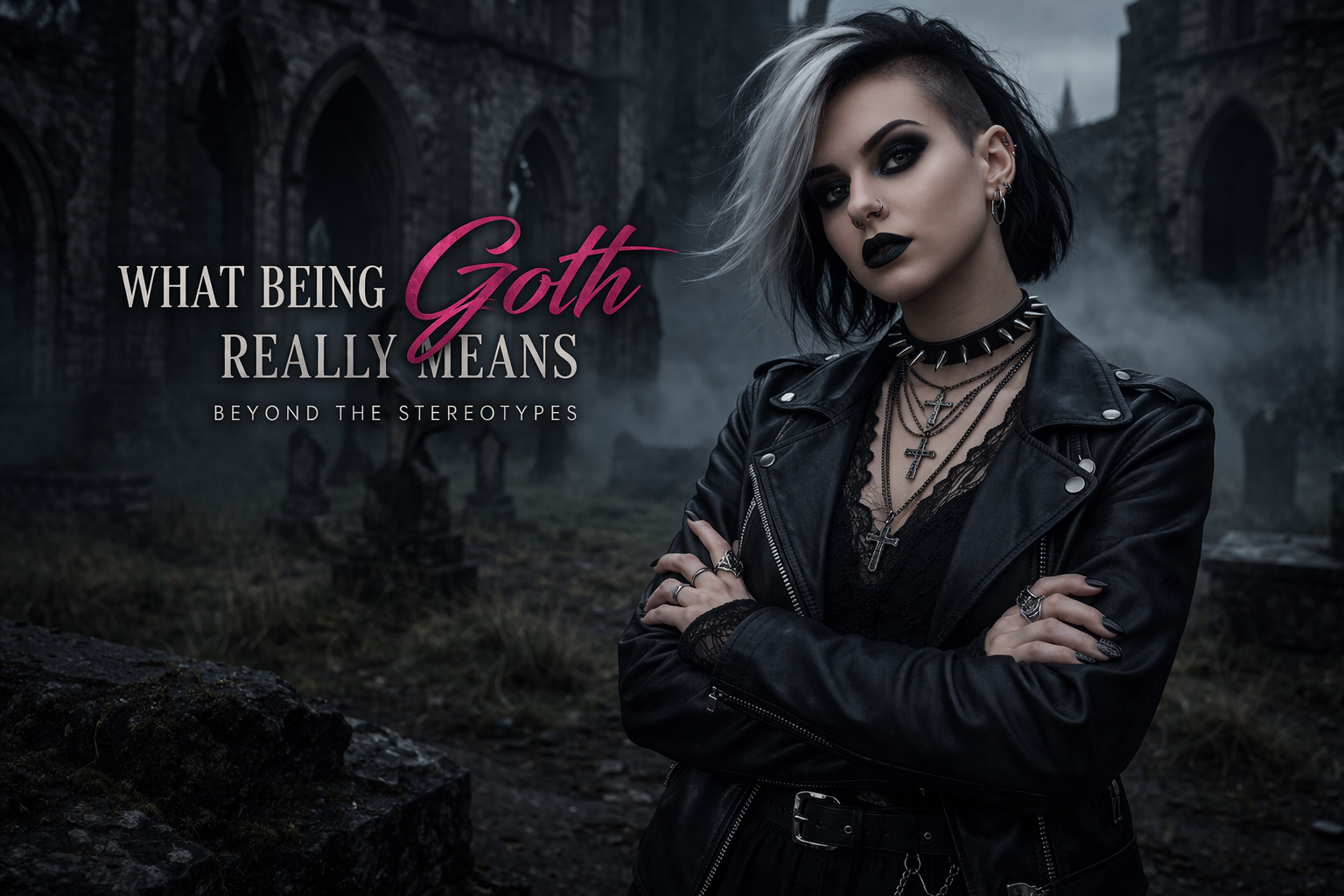
To outsiders, “goth” is often reduced to black clothing, dark makeup, and a fascination with the macabre. It’s treated like a costume, a phase, or something purely visual.
But those inside the culture understand something different: goth is not defined by appearance alone — it’s shaped by music, emotion, perspective, and a deep sense of identity.
If you strip away the stereotypes, what remains isn’t a trend — it’s a way of seeing and experiencing the world.
🕯️ It Starts With Music — Always
Goth culture is rooted in sound before anything else. Post-punk, gothic rock, and darkwave didn’t just influence the aesthetic — they created the emotional foundation of the entire scene.
The atmosphere of the music — minimal, haunting, introspective — shaped how people dressed, expressed themselves, and connected with others.
Without the music, goth becomes surface-level. With it, everything gains meaning.
🌑 It’s About Emotional Honesty
One of the biggest misconceptions is that goth equals sadness. That’s not accurate.
Goth culture doesn’t glorify negativity — it simply refuses to hide from reality.
It allows space for complex emotions: melancholy, nostalgia, longing, reflection. Instead of suppressing them, it acknowledges them.
That’s why many people feel understood when they discover goth culture — it doesn’t ask them to pretend.
🕸️ It Rejects Surface-Level Living
Mainstream culture often prioritizes speed, trends, and constant distraction. Goth moves in the opposite direction.
It values:
- Depth over popularity
- Atmosphere over attention
- Meaning over aesthetics alone
That’s why goth culture tends to feel timeless. It isn’t chasing relevance — it already exists outside of it.
🌙 Individual Expression — Not a Uniform
There is no single “correct” way to look goth.
Some people lean into dramatic styles — lace, corsets, heavy makeup. Others keep it minimal — subtle black clothing, simple accessories.
Both are valid.
What matters is intention. Goth style isn’t about copying an image — it’s about reflecting your internal world outward.
🦇 It’s Something You Grow Into
Most people don’t consciously decide to “become goth.”
It usually starts with small things: a song that feels different, a preference for darker visuals, a growing disconnect from mainstream culture.
Over time, those preferences connect. And eventually, people recognize themselves in the culture.
It’s less of a choice — more of a realization.
⚰️ Not a Phase — Not a Costume
Another common stereotype is that goth is temporary.
While people’s styles may evolve, the core mindset tends to stay. The appreciation for depth, atmosphere, and authenticity doesn’t just disappear.
That’s why many people who connect with goth culture early continue to carry parts of it throughout their lives — even if their outward appearance changes.
💬 What Does Goth Mean to You?
Everyone experiences goth differently. For some, it’s rooted in music. For others, it’s visual, emotional, or philosophical.
New to HeyFreaks? Create your profile and connect with others who see beyond the surface.


- Goth Lifestyle
- Fashion & Style
- Music & Bands
- Art & Photography
- Creative Writing & Poetry
- Events & Scene
- Occult & Spirituality
- DIY & Tutorials
- Beauty & Self-Care
- Relationships & Dating
- Gaming & Media
- Tech & Gadgets
- Body Art & Piercings
- Underground Culture
- Spotlights & Interviews
- Travel & Places
- Lifestyle & Daily Life
- Fitness & Health
- Travel & Adventure
- Books & Literature
- Tech & Gaming
- Movies & TV
- Food & Drinks
- Humor & Memes
- Pets & Animals
- General Arts & Crafts

 English
 Arabic
 French
 Spanish
 Portuguese
 Deutsch
 Turkish
 Italiano
 Russian
 Romaian
 Portuguese (Brazil)
 Greek
Greek