

Powering the Future: The Definitive Guide to the Best LiFePO4 Rack Battery Module

The global energy landscape is undergoing a seismic shift. The reliance on centralized, fossil-fuel-dependent power grids is rapidly diminishing, replaced by a decentralized model centered on renewable energy sources like solar and wind. However, the intermittent nature of these sources presents a significant challenge: energy is often generated when it's least needed and unavailable when demand peaks.
The critical solution to this energy paradox is advanced storage. While various battery technologies exist, Lithium Iron Phosphate (LiFePO4 or LFP) has emerged as the undisputed champion for stationary energy storage applications. Among the various form factors available, the LiFePO4 Rack Battery Module has become the gold standard for residential, commercial, and industrial installations.
This comprehensive guide explores why you need a LiFePO4 rack battery module, what constitutes the "best" module on the market, and how to select the right system for your specific energy requirements.
The Ascendancy of Lithium Iron Phosphate (LiFePO4)
Before diving into the specifics of rack modules, it is essential to understand why LiFePO4 chemistry is vastly superior to its predecessors, particularly the ubiquitous lead-acid battery, and even other lithium-ion variants like NMC (Nickel Manganese Cobalt).
Unparalleled Safety
Safety is paramount when dealing with high-capacity energy storage systems installed in homes or businesses. LiFePO4 is inherently the safest lithium chemistry. Its strong molecular bond makes it extremely stable and resistant to thermal runaway—the primary cause of battery fires in less stable chemistries. Unlike NMC batteries, which can catch fire if punctured or overcharged, LiFePO4 modules remain cool and safe under duress.
Exceptional Longevity
When investing in energy storage, longevity is the key metric for return on investment. LiFePO4 batteries offer a staggering cycle life. While a high-quality lead-acid battery might provide 300-500 cycles, and a standard NMC lithium battery offers perhaps 2,000-3,000, a premium LiFePO4 rack battery module typically delivers 6,000 to 8,000 cycles or more.
If you cycle your battery daily (charging via solar during the day and discharging at night), an LFP battery can last upwards of 15 to 20 years before its capacity drops below 80% of its original rating.
High Power Density and Efficiency
LiFePO4 batteries are compact and lightweight relative to their energy capacity. Furthermore, they boast a very high "round-trip efficiency" (often exceeding 95%). This means that nearly all the energy you put into the battery is available for retrieval, minimizing energy waste. They also excel at handling high charge and discharge currents, making them suitable for demanding applications like EV charging or supporting large HVAC systems.
Why the "Rack Battery Module" Form Factor Dominates
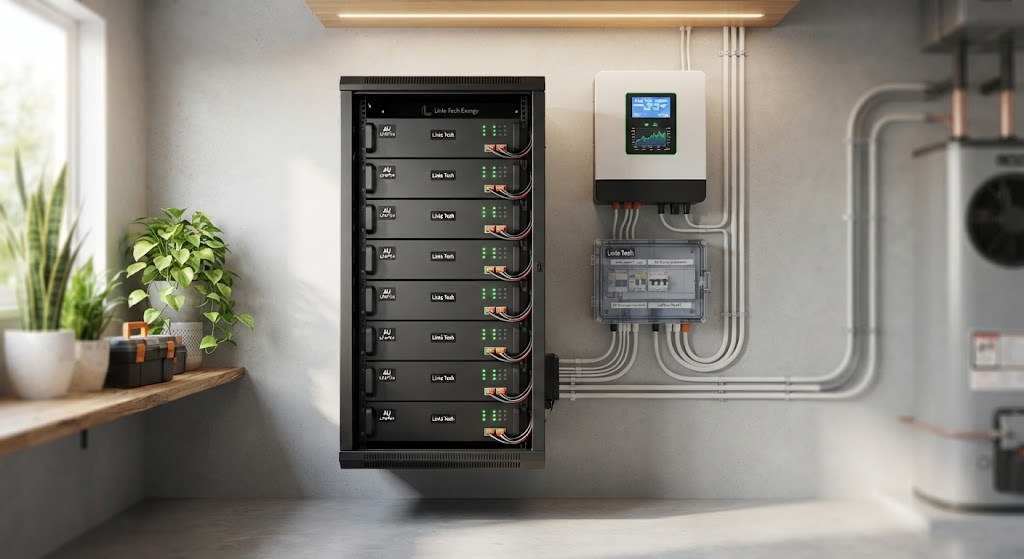
The term "rack battery module" refers to a battery unit designed to be installed in a standard 19-inch server rack enclosure. This design was originally developed for the IT industry to create scalable, organized, and easily serviceable data centers. Applying this concept to energy storage has revolutionized the industry.
Modular Scalability
Energy needs are rarely static. You might start with a 5 kWh system for basic solar self-consumption, only to add an electric vehicle (EV) or a home office two years later, requiring a 15 kWh system. With rack modules, expansion is effortless. You simply slide in an additional LiFePO4 rack battery module into the existing rack, connect the cables, and the system integrates seamlessly. This "pay-as-you-go" approach offers unmatched flexibility.
Space Optimization and Organization
Traditional battery banks often consist of mismatched, haphazardly wired components. Rack systems turn this into a clean, professional installation. Batteries stack vertically, utilizing minimal floor space. The integrated design hides complex wiring, reduces clutter, and presents a clean, industrial aesthetic.
Enhanced Serviceability and Safety
In a standard rack system, each module operates somewhat independently. If a single module were to fail—a rare occurrence with Tier 1 LFP cells—it can be easily removed and serviced or replaced without bringing down the entire storage array. Furthermore, professional rack enclosures include secure buss bars and fuse protection, significantly reducing electrical hazards compared to DIY setups.
Superior Thermal Management
Battery performance and lifespan are heavily impacted by temperature. Server racks are designed specifically for optimal airflow management. Many high-end LiFePO4 rack battery module designs include active cooling features or passive heat dissipation that integrates perfectly with standard rack enclosures, ensuring the batteries operate within their ideal temperature range.
Defining the Best LiFePO4 Rack Battery Module: Critical Criteria
The market for LFP rack modules is flooded with options, ranging from budget-friendly generic brands to premium Tier 1 manufacturers. To ensure you are investing in the best system, you must evaluate modules based on these non-negotiable criteria.
Cell Quality and Origin
The heart of any battery is the electrochemical cell. The best manufacturers utilize prismatic or large-format pouch cells sourced from Tier 1 suppliers such as CATL, EVE, BYD, or CALB. These manufacturers employ rigorous quality control, resulting in consistent capacity, matched internal resistance, and validated longevity. Be wary of ultra-cheap modules; they often use Grade B or recycled cells that degrade rapidly.
The Battery Management System (BMS)
The BMS is the brain of the module. It is responsible for safety, performance optimization, and longevity. An advanced BMS must offer:
-
Cell-Level Monitoring and Balancing: It must monitor the voltage and temperature of every individual cell and actively balance them during charging to ensure the entire module operates at peak capacity.
-
Robust Protections: It must provide instantaneous cutoffs for over-voltage, under-voltage, over-current, short-circuit, and over/under temperature.
-
Real-Time Communication: The BMS must communicate critical data (state of charge, voltage, health) to the hybrid inverter via standard protocols like CAN Bus or RS485. This closed-loop communication allows the inverter to treat the battery exactly as intended, maximizing its lifespan.
Depth of Discharge (DoD) and Usable Capacity
The "best" module maximizes the amount of energy you can actually use. While LFP batteries are robust, deep discharges to 0% can damage them. Premium modules are designed with a high usable capacity, often allowing for an 80% to 90% DoD without compromising lifespan. An intelligent BMS manages this buffer zone to protect the cells.
High Discharge/Charge Current Capability
Your storage system is only as good as the power it can deliver. The best modules feature a low internal resistance, allowing them to sustain high continuous discharge and charge rates (often 0.5C to 1C). A 5 kWh module with a 1C rating can output 5 kW of power, essential for powering heavy loads during grid outages or peak demand periods.
Certifications and Compliance
Energy storage systems must meet stringent safety standards to pass electrical inspections and satisfy insurance requirements. Look for modules that are certified to standards such as UL 1973 (Standard for Batteries for Use in Stationary and Motive Auxiliary Power Applications), UL 9540 (Standard for Safety of Energy Storage Systems and Equipment), CE, and IEC.
Applications: From Residential to Industrial
The versatility of the LiFePO4 rack battery module means it is the ideal solution across a vast spectrum of energy storage needs.
Residential Energy Storage
For homeowners, a stack of 5 kWh or 10 kWh rack modules is the ultimate solution for maximizing solar self-consumption. Instead of exporting excess solar energy to the grid for pennies on the dollar, you store it to power your home during the expensive evening hours. Furthermore, these systems provide reliable whole-home or critical-load backup power during grid failures.
Commercial and Industrial (C&I) Microgrids
Businesses face high demand charges on their utility bills, often based on their 15-minute peak usage window. A rack-based LFP system can perform "peak shaving," automatically discharging stored energy during those high-demand periods to drastically reduce monthly electricity costs. They also provide crucial UPS (Uninterruptible Power Supply) functionality for data centers, server rooms, and manufacturing lines, preventing costly downtime.
Conclusion
As the world transitions toward a sustainable energy future, the need for reliable, safe, and scalable energy storage has never been more acute. The LiFePO4 rack battery module represents the pinnacle of current battery technology, offering an unbeatable combination of safety, longevity, and modular flexibility.
Investing in an energy storage system is a significant decision, one that impacts your energy resilience and financial well-being for decades. Do not compromise on quality. By insisting on Tier 1 cells, an advanced BMS, robust communication protocols, and certified safety standards, you ensure that your investment provides reliable power for years to come.
At Linio Tech, we have dedicated ourselves to engineering the absolute best in renewable energy solutions. Our LiFePO4 rack battery modules are built to the strictest international standards, utilizing top-tier components and intelligent software designed for maximum uptime and longevity.
Whether you are a homeowner seeking energy independence or a business looking to optimize your power consumption, Linio Tech provides the high-performance storage foundation you need to power your future securely and efficiently. Join the energy revolution with confidence.
Also see our guide.



