

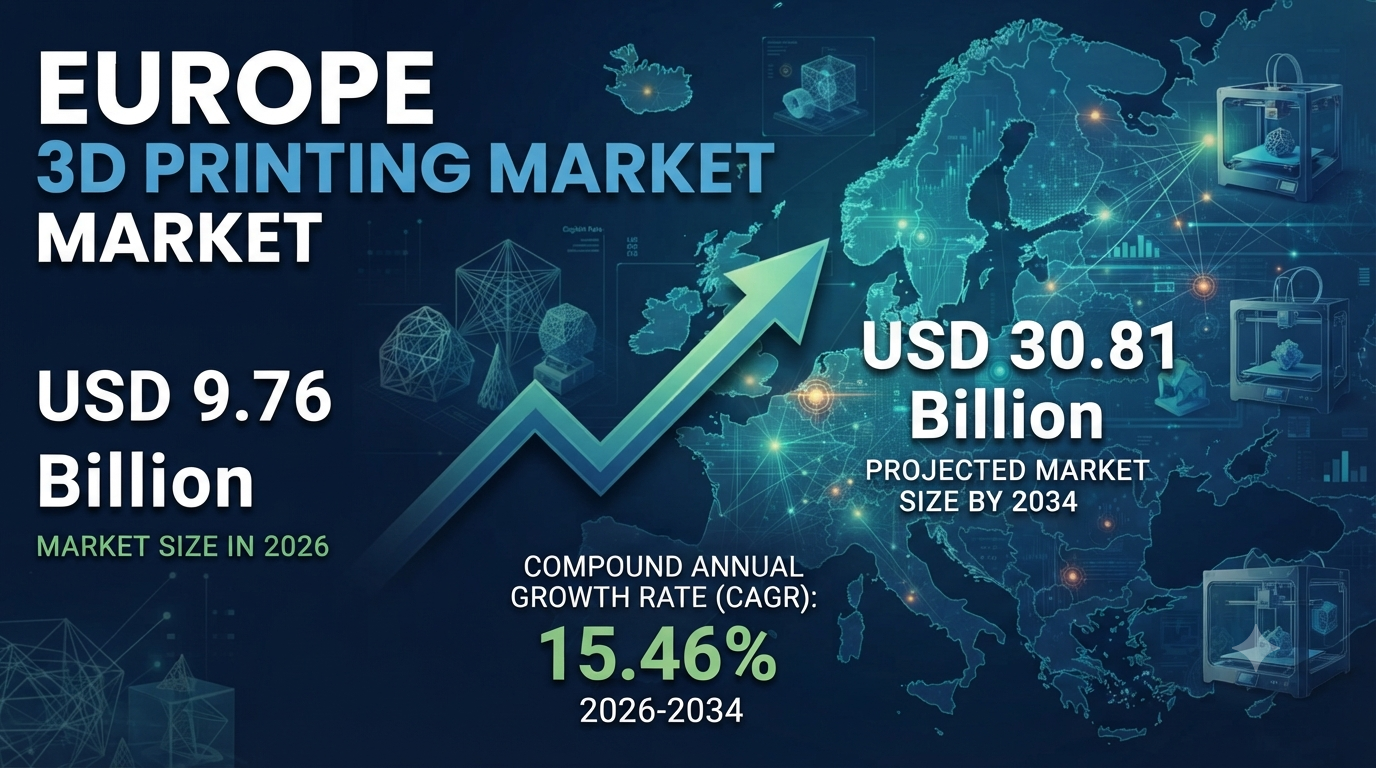

The Europe 3D printing market is witnessing strong expansion as additive manufacturing becomes increasingly embedded across automotive, aerospace, healthcare, and industrial equipment manufacturing. The market grew from USD 8.45 Billion in 2025 to USD 9.76 Billion in 2026 and is projected to reach USD 30.81 Billion by 2034, exhibiting a compound annual growth rate (CAGR) of 15.46% during 2026-2034. Rising demand for rapid prototyping, mass customization, and low-volume localized production, along with a growing focus on shorter production cycles and minimal material waste, is accelerating adoption across the region. Investments in R&D and supportive government and industry initiatives, including the CECIMO Manifesto for a Competitive European Additive Manufacturing Sector launched in July 2025, are further strengthening the market’s trajectory. This market is strategically important to Europe’s economy as it directly supports advanced manufacturing, supply chain resilience, and industrial innovation across the region.
The Europe 3D printing market is poised for sustained expansion, driven by growing additive manufacturing adoption across automotive, aerospace, and healthcare industries. With a projected CAGR of 15.46% through 2034, the market presents significant opportunities for printer manufacturers, material suppliers, software developers, and service providers focused on industrial-grade, multi-material, and sustainable additive manufacturing solutions.
EUROPE 3D PRINTING MARKET SUMMARY
The Europe 3D printing market encompasses a wide range of additive manufacturing technologies, materials, software, and services used to build three-dimensional objects layer by layer from digital designs, primarily for prototyping, tooling, and functional part production. The ecosystem includes printer manufacturers, material and powder suppliers, software developers, service bureaus, research institutions, and end users across automotive, aerospace, healthcare, machinery, and consumer products. The key highlights of the market are:
- Market Size and Growth: The market grew from USD 8.45 Billion in 2025 to USD 9.76 Billion in 2026 and is projected to reach USD 30.81 Billion by 2034, at a CAGR of 15.46% during 2026-2034.
- By Technology: Fused deposition modeling dominates with a 28.03% share in 2025, driven by its cost-effectiveness, ease of operation, and widespread adoption among small and medium enterprises for functional prototyping.
- By Process: Material extrusion leads with a 28.12% share in 2025, owing to its versatility in handling diverse thermoplastics, lower equipment costs, and suitability for durable end-use parts.
- By Material: Plastics represent the largest segment with a 38.10% share in 2025, supported by lightweight properties, design flexibility, and compatibility with multiple printing technologies.
- By Offering: Printers dominate with a 75.04% share in 2025, owing to continuous technological advancements, rising industrial applications, and expanding desktop printer adoption in educational institutions.
- By Application: Prototyping is the largest segment with a 53.76% share in 2025, driven by the need for rapid design validation, reduced time-to-market, and cost-efficient product development.
- By End User: Automobile leads with a 21.08% share in 2025, owing to demand for lightweight components, rapid prototyping of vehicle parts, and customized tooling solutions.
- Key Challenges: High initial investment and operational costs, limited production speed and scalability, and material property limitations and certification requirements for safety-critical applications.
PORTER'S FIVE FORCES ANALYSIS – EUROPE 3D PRINTING MARKET
The competitive dynamics of the Europe 3D printing market can be analyzed using Porter’s Five Forces framework.
Porter's Five Forces Analysis – Europe 3D Printing Market
· Competitive Rivalry: Moderate to High. The market is fragmented, with established technology providers competing alongside emerging startups across technology platforms, material offerings, application expertise, and service capabilities. Mergers, acquisitions, and strategic partnerships continue to reshape the landscape. Business implication: Companies must differentiate through product innovation, application-specific solutions, and integrated hardware, material, and software offerings.
· Supplier Power: Moderate. Industrial additive manufacturing depends on specialized powders, resins, filaments, and precision components, and material ecosystems are often linked to specific printer platforms. However, a growing base of material developers is expanding supplier choice. Business implication: Manufacturers should diversify material sourcing, qualify alternative suppliers, and invest in open-material platforms and sustainable feedstocks.
· Buyer Power: Moderate. Large automotive and aerospace manufacturers can negotiate on price and demand stringent quality and certification standards, while small and medium enterprises are cost-sensitive and weigh equipment investment carefully. Business implication: Vendors must offer scalable pricing, financing and service models, and demonstrable total-cost-of-ownership benefits to win and retain customers.
· Threat of Substitutes: Moderate. Conventional manufacturing methods such as injection molding, casting, and CNC machining remain cost-effective for high-volume production, limiting additive adoption in mass manufacturing. Business implication: Additive players should target applications where complexity, customization, lightweighting, and short lead times offer clear advantages over conventional methods.
· Threat of New Entrants: Moderate. Capital requirements, intellectual property, and certification hurdles create barriers in industrial printer hardware, but lower barriers exist in software, materials, and service bureau segments, where startups such as AI-driven software and bio-based material developers are emerging. Business implication: Established players should strengthen their positions through proprietary technology, qualified material portfolios, and strategic partnerships.
Competitive Rivalry – Moderate to High (Healthy)
- Multi-tier competition spans established printer manufacturers, material and chemical suppliers, software developers, and service bureaus – driving differentiation through technology innovation, material development, sustainability credentials, and application expertise rather than destructive price competition.
- HP’s unveiling of the HP IF 600HT high-temperature filament 3D printer at Formnext (November 2025), Stratasys’ launch of TrueDent-D™ resin in Europe (January 2025), and Shapeways’ addition of FDM services to its European offering (February 2025) reflect active portfolio expansion that is strengthening the overall market ecosystem.
Request for Sample Report: https://www.imarcgroup.com/europe-3d-printing-market/requestsample
MARKET GROWTH DRIVERS:
Rising Demand for Mass Customization and Accelerating Digital Transformation
Several key factors are propelling the expansion of the Europe 3D printing market. The growing demand for mass customization and personalization is a powerful driver, as additive manufacturing enables economically viable production of individualized components without the tooling investments required by traditional methods. Healthcare applications benefit particularly through patient-specific medical devices, surgical guides, and prosthetics, while the automotive sector uses additive technologies for bespoke components in luxury and limited-edition vehicles. In November 2024, Materialise enhanced its Magics 3D printing software and expanded collaborations to help European manufacturers build customized workflows and support mass personalization. Additionally, accelerating digital transformation across manufacturing industries is creating favorable conditions for adoption, as organizations pursuing Industry 4.0 recognize additive manufacturing as a key enabler of flexible, data-driven production. Cloud-based design platforms and secure data-transfer solutions, such as ProCloud3D developed by RWTH Aachen and partners for decentralized laser powder bed fusion, are further integrating digital design with additive production.
MARKET GROWTH DRIVERS:
Supply Chain Resilience, Technology Advancements, and Sustainability Priorities
The Europe 3D printing market is also benefiting from a growing focus on supply chain resilience and localized production. Additive manufacturing enables on-demand production of components and spare parts closer to end-use locations, reducing dependence on extended supply networks and lowering logistics costs and delivery times. In June 2025, 3YOURMIND was selected for the European Defence Innovation Scheme to enhance on-demand, distributed 3D printing of spare parts for Europe’s defense supply chain. Furthermore, technology adoption is accelerating, including the integration of artificial intelligence and machine learning for real-time monitoring and defect detection (Icelandic startup Euler secured €2 Million in November 2025 to scale its AI-powered software), and the expansion of multi-material and hybrid printing, with AMAREA Technology delivering its MMJ ProX printer capable of up to six materials in a single build to Fraunhofer IKTS. Finally, a growing emphasis on sustainable and circular manufacturing is supporting adoption, as additive processes generate minimal waste and align with stringent regional environmental regulations, supported by developments such as Evonik’s INFINAM® eCO PA12 biocircular powder and Concr3de’s bio-based and biodegradable printing materials.
EUROPE 3D PRINTING MARKET SEGMENTATION
Segmentation analysis provides a detailed view of the Europe 3D printing market by category:
- Technology Insights: Stereolithography, Fused Deposition Modeling (Largest Share: 28.03% in 2025), Selective Laser Sintering, Electron Beam Melting, Digital Light Processing, Others.
- Process Insights: Binder Jetting, Directed Energy Deposition, Material Extrusion (Largest Share: 28.12% in 2025), Material Jetting, Powder Bed Fusion, Sheet Lamination, Vat Photopolymerization.
- Material Insights: Photopolymers, Plastics (Largest Share: 38.10% in 2025), Metals and Ceramics, Others.
- Offering Insights: Printer (Largest Share: 75.04% in 2025), Material, Software, Service.
- Application Insights: Prototyping (Largest Share: 53.76% in 2025), Tooling, Functional Part Manufacturing.
- End User Insights: Consumer Products, Machinery, Healthcare, Aerospace, Automobile (Largest Share: 21.08% in 2025), Others.
- Country Insights: Germany, France, United Kingdom, Italy, Spain, Others.
COMPETITIVE LANDSCAPE
The Europe 3D printing market features a fragmented competitive landscape, with established technology providers competing alongside innovative emerging participants across various market segments. Key companies and market participants active in the region include:
- Stratasys Ltd.
- HP Inc.
- Materialise NV
- Evonik Industries AG
- Shapeways
- 3YOURMIND
- AMAREA Technology
- Concr3de
- Euler
Strategic developments are shaping the competitive arena, notably HP’s launch of the HP IF 600HT high-temperature filament 3D printer at Formnext in Frankfurt (November 2025), Shapeways’ expansion of its European services with fused deposition modeling (February 2025), and Stratasys’ introduction of TrueDent-D™ resin in Europe (January 2025). Market participants are focusing on product innovation, strategic partnerships, and geographic expansion to strengthen their positioning.
REGIONAL ANALYSIS:
Regional dynamics within the Europe 3D printing market are shaped by varying levels of industrial concentration, research capability, and government support for advanced manufacturing:
- Germany: The largest national market in Europe, driven by its robust automotive and aerospace manufacturing sectors, a strong industrial base, significant investments in research institutions, and Industry 4.0 initiatives.
- France: Substantial growth supported by established aerospace and defense industries, increasing adoption of additive technologies in healthcare for medical devices and surgical planning, and government funding for manufacturing modernization.
- United Kingdom: A significant market with strong aerospace, automotive, and healthcare adoption, supported by leading universities and research institutions and a motorsport cluster driving advanced manufacturing technology.
- Italy: Growing market development driven by the automotive, machinery, and fashion industries seeking customization, with machine tool manufacturers integrating additive capabilities into hybrid manufacturing systems.
- Spain: An emerging market with growing adoption across automotive, aerospace, and healthcare sectors, supported by manufacturing modernization initiatives and research centers developing applications for construction and renewable energy.
- Others (Netherlands, Belgium, Switzerland, and Nordic Nations): Active participation supported by strong engineering traditions, advanced research capabilities, and specialized clusters in medical devices, precision engineering, and high-value manufacturing.
RECENT INDUSTRY DEVELOPMENTS
November 2025: HP unveiled the HP IF 600HT high-temperature filament 3D printer at Formnext in Frankfurt, Germany, enhancing Europe’s material extrusion capabilities for industrial aerospace, automotive, and energy applications.
November 2025: Icelandic startup Euler secured €2 Million to scale its AI-powered 3D printing software, enabling real-time defect detection and improved reliability for industrial additive manufacturing.
September 2025: Toyota Europe, with MacLean-Fogg and Fraunhofer ILT, produced the world’s largest 3D-printed 350-pound die casting insert for the Yaris hybrid transmission, doubling lifespan versus conventional tooling.
July 2025: CECIMO launched the Manifesto for a Competitive European Additive Manufacturing Sector, co-signed by ten national associations, aiming to position Europe as a global leader in additive manufacturing.
June 2025: 3YOURMIND was selected for the European Defence Innovation Scheme, enhancing on-demand, distributed 3D printing of spare parts to strengthen Europe’s defense supply chain.
February 2025: Shapeways expanded its European 3D printing services by adding Fused Deposition Modeling (FDM), enabling cost-effective, industrial-grade production of prototypes and end-use components.
January 2025: Stratasys launched TrueDent-D™ resin in Europe, offering monolithic digital dentures for dental labs and clinicians and highlighting growing adoption of 3D printing in Europe’s healthcare and dental sectors.
November 2024: Materialise enhanced its Magics 3D printing software and expanded collaborations, enabling manufacturers across Europe to create customized workflows, optimize production, and support mass personalization.
Key Aspects Required for the Europe 3D Printing Market
· Market Performance: USD 8.45 Billion in 2025, rising to USD 9.76 Billion in 2026, with a projected trajectory to USD 30.81 Billion by 2034.
· Market Outlook: A 15.46% CAGR during 2026-2034 indicates robust growth across prototyping, tooling, and functional part manufacturing, with automotive and aerospace remaining primary revenue contributors and healthcare (medical devices and bioprinting) offering significant opportunities.
· Growth Drivers: Increasing demand for mass customization and personalization; accelerating digital transformation and Industry 4.0 adoption; growing focus on supply chain resilience and localized production; expanding healthcare applications; and continuous advances in printer speed, precision, and material availability.
· Competitive Landscape: A fragmented market in which established technology providers compete with emerging startups, with strategies centered on product innovation, strategic partnerships, geographic expansion, and mergers and acquisitions.
· Value Chain Analysis: From material and powder suppliers and printer and component manufacturers through software and design platforms, service bureaus and distributors, to end users across automotive, aerospace, healthcare, machinery, and consumer products.
· Industry Trends: Integration of artificial intelligence and machine learning in additive workflows; expansion of multi-material and hybrid printing technologies; growing emphasis on sustainable and circular manufacturing, including recycled and bio-based materials; and rising use of 3D printing for spare parts and on-demand production.
· Strategic Recommendations: Invest in AI-enabled monitoring and quality assurance; expand portfolios of high-performance, composite, and sustainable materials; target high-growth applications in automotive, aerospace, defense, and healthcare; develop distributed spare parts and on-demand production capabilities; and build partnerships with research institutions and certification bodies to overcome cost, scalability, and qualification barriers.
Note: If you need any specific information that is not covered currently within the scope of the report, we will provide the same as a part of customization.
Request Customization: https://www.imarcgroup.com/request?type=report&id=9864&flag=E
· Report Format, Delivery, and Customization Details
· Report Format Mode: PPT, PDF, and Excel
· Report Delivery Mode: Online Delivery, Physical Delivery
· Report Delivery Time: Report Delivered Over Email within 24 to 48 hours. If requested by the client, a physical copy will be delivered within three to ten days.
· Report Confirmation Mode: Yes via Email
· Report Customization Mode: Yes via Email / Call
· Report Table of Content: Yes
· Report List of Figures: Yes
· Report Methodology Mode: Yes
· Request For Sample Report: Yes



