

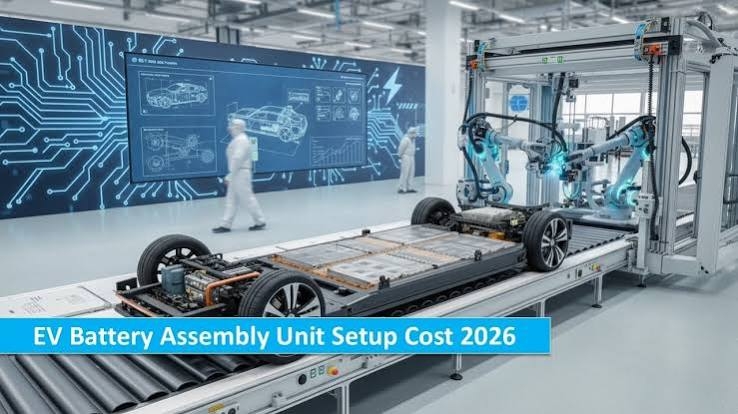
EV Battery Assembly Unit Cost: Machinery, Infrastructure, Investment and Profitability Analysis

IMARC Group’s “EV Battery Assembly Unit Project Report 2026: Industry Trends, Plant Setup, Machinery, Raw Materials, Investment Opportunities, Cost and Revenue” report provides a comprehensive guide on how to successfully set up an EV battery assembly unit. The report offers clarifications on various aspects, such as unit operations, raw material requirements, utility supply, infrastructural needs, machinery models, labour necessities, transportation timelines, packaging requirements, and other essential requirements.
The report also provides detailed insights into EV battery assembly unit cost, covering capital investments (CapEx), operating expenses (OpEx), project funding, income and expenditure projections, fixed and variable costs, direct and indirect costs, expected return on investment (ROI), net present value (NPV), profit and loss accounts, and financial analysis. It serves as a valuable resource for investors, automotive manufacturers, battery technology companies, entrepreneurs, and businesses evaluating the feasibility of establishing an electric vehicle battery assembly facility. The report also covers machinery requirements, battery pack assembly line cost considerations, production capacity planning, and infrastructure requirements for an industrial battery material EPC project.
What is EV Battery Assembly?
EV battery assembly is the industrial process of integrating lithium-ion cells into complete battery packs that safely and efficiently power electric vehicles. The process begins with cell inspection, grading, and matching, followed by module or cell-to-pack assembly, electrical interconnection through busbars, installation of the battery management system (BMS), thermal management components, sensors, wiring harnesses, protective casing, sealing, and end-of-line testing. The assembled battery pack undergoes electrical, thermal, vibration, insulation, and safety validation before final packaging. Modern EV battery assembly facilities increasingly utilize automated robotics, laser welding, machine vision inspection, and digital quality monitoring to ensure product consistency and traceability.
EV battery packs serve as essential power storage systems for passenger electric vehicles, commercial vehicles, electric buses, two-wheelers, three-wheelers, and industrial mobility applications. They are also increasingly used in battery energy storage systems (BESS), off-highway equipment, and marine electrification. The EV battery assembly process generally involves cell sorting, module formation, welding, BMS integration, thermal management installation, pack enclosure assembly, electrical connections, testing, and final packaging. The selection of battery chemistry, cell configuration, pack design, and thermal management technology depends on vehicle specifications, energy density requirements, operating conditions, and safety standards.
Market Trend and Drivers of EV Battery Assembly:
The global EV battery assembly market was valued at USD 2,715.59 Million in 2025 and is projected to reach USD 15,898.30 Million by 2034, exhibiting a CAGR of 21.7% during 2026–2034. Market growth is supported by increasing electric vehicle adoption, rising demand for longer driving ranges, improvements in battery safety, and the expansion of battery manufacturing and assembly facilities.
The rapid expansion of electric mobility represents an important demand driver, as automotive manufacturers are increasingly investing in advanced battery pack assembly capabilities to support passenger and commercial electric vehicle production. The growing adoption of fast-charging technologies, cell-to-pack architectures, and advanced battery management systems is further strengthening demand for modern EV battery assembly lines. Additionally, the localization of battery supply chains is encouraging manufacturers to establish regional assembly facilities to reduce logistics expenses and improve supply chain resilience. The expansion of gigafactories, investments in energy storage systems, and supportive government policies promoting electric mobility are also creating opportunities for battery assembly manufacturers. Furthermore, technological advancements in robotic assembly, laser welding, automated inspection, and thermal management systems are improving production efficiency and battery reliability.
Request a Sample Report: https://www.imarcgroup.com/ev-battery-assembly-unit-project-report/requestsample
How to Setup an EV Battery Assembly Unit?
Setting up an EV battery assembly unit requires careful planning of production technology, raw material procurement, machinery selection, infrastructure, and quality control. The following considerations are important when establishing a commercially viable EV battery assembly facility:
- Detailed Process Flow: Establish a production sequence covering lithium-ion cell inspection, grading, matching, module or cell-to-pack assembly, electrical interconnection, busbar welding, BMS integration, thermal management installation, protective casing, sealing, electrical testing, safety validation, and packaging. Maintain appropriate process controls to achieve the required battery performance, energy density, reliability, and safety standards.
- Site Selection: Select an industrial location with access to lithium-ion cells, battery management systems (BMS), cell holders and modules, thermal management components, casing materials, electrical utilities, and transportation facilities. Consider proximity to automotive manufacturers, battery suppliers, and target markets to manage procurement and distribution expenses.
- Plant Layout Optimization: Design separate areas for raw material storage, cell inspection, cell grading, module assembly, welding, BMS integration, thermal management installation, battery pack testing, quality control, and finished goods storage. Provide suitable arrangements for material movement, equipment maintenance, worker safety, battery storage, and future expansion.
- Equipment Selection: Procure suitable cell grading and sorting systems, robotic pick-and-place units, module assembly stations, laser welding machines, busbar welding equipment, BMS programming systems, thermal interface material dispensers, cooling plate assembly systems, leak testing equipment, insulation testing units, end-of-line electrical testing systems, battery cyclers, vision inspection systems, sealing machines, and automated packaging equipment. Equipment selection should reflect production capacity, battery chemistry, pack configuration, and automation requirements.
- Raw Material Sourcing: Establish reliable supply arrangements for lithium-ion cells, battery management systems (BMS), cell holders, modules, busbars, thermal management components, cooling plates, wiring harnesses, protective casings, connectors, and packaging materials. Evaluate material quality, cell performance, supplier reliability, procurement costs, and delivery timelines to maintain uninterrupted production.
- Safety and Environmental Compliance: Install appropriate battery storage arrangements, fire detection and suppression systems, thermal monitoring equipment, ventilation, electrical safety systems, emergency response facilities, and personal protective equipment. Implement suitable procedures for handling damaged cells, defective battery packs, and manufacturing waste in accordance with applicable environmental and industrial safety requirements.
- Quality Assurance Systems: Implement testing procedures to monitor cell capacity, voltage consistency, internal resistance, insulation resistance, battery pack performance, thermal behaviour, electrical connections, and BMS functionality. Conduct vibration, leak, thermal, and end-of-line electrical testing to ensure product reliability. Maintain batch records, traceability systems, and quality checks throughout the assembly process.
Requirements to Setup an EV Battery Assembly Unit:
- Funds
- Machinery
- Lands
Types of Costs to Setup an EV Battery Assembly Factory:
- Land, Location and Site Development Cost
- Plant Layout Cost
- EV Battery Assembly Plant Machinery Cost
- Raw Material Requirements and Costs
- Packaging Requirements and Costs
- Transportation Requirements and Costs
- Utility Requirements and Costs
- Human Resource Requirements and Costs
Project Economics:
- Capital Investments
- Operating Costs
- Expenditure Projections
- Revenue Projections
- Taxation and Depreciation
- Profit Projections
- Financial Analysis
EV Battery Assembly Plant Profit Margins:
The profitability of an EV battery assembly unit depends on lithium-ion cell procurement, battery pack design, production efficiency, automation levels, capacity utilization, and selling prices. According to the project report, the estimated gross profit margin ranges between 12–20%, while the net profit margin is approximately 4–10% under the stated project assumptions. These margins are influenced by battery component costs, technological requirements, product quality, and demand from electric vehicle manufacturers.
EV Battery Assembly Unit Cost Analysis:
Raw material consumption represents the largest share of operating expenditure in EV battery assembly. According to the report, raw materials, particularly lithium-ion cells, battery management systems (BMS), cell holders and modules, thermal management components, and protective casings, account for approximately 70–80% of total OpEx. Utilities contribute around 5–8% of operating expenditure. Consequently, efficient cell sourcing, supplier management, automated assembly, production optimization, and energy management are important factors in controlling overall manufacturing costs.
When evaluating EV battery assembly unit cost, investors should also consider machinery installation, testing infrastructure, battery pack assembly line cost, material handling systems, and safety equipment. Businesses planning an industrial battery material EPC project should assess equipment procurement, plant engineering, infrastructure development, installation, and commissioning requirements. These cost components are also important when evaluating the broader electric vehicle manufacturing plant cost, although a complete EV manufacturing facility involves additional investments beyond battery assembly.
Ask Analyst for Customized Report: https://www.imarcgroup.com/request?type=report&id=39672&flag=C
How IMARC Can Help?
IMARC Group provides comprehensive support to businesses planning to establish or expand EV battery assembly facilities. Its services include detailed project feasibility studies, manufacturing process evaluation, machinery and raw material assessments, battery pack assembly line planning, plant layout development, capital and operating cost analysis, financial modelling, and investment advisory. The company also assists investors in evaluating market demand, identifying suitable battery technologies, assessing production capacity, estimating infrastructure requirements, and preparing bankable Detailed Project Reports (DPRs) to support informed investment decisions. These services help businesses evaluate EV battery assembly unit cost, machinery procurement, industrial project requirements, and investment feasibility.
Services:
- Plant Setup
- Factory Auditing
- Regulatory Approvals, and Licensing
- Company Incorporation
- Incubation Services
- Recruitment Services
- Marketing and Sales
Contact Us:
IMARC Group
134 N 4th St. Brooklyn, NY 11249, USA
Email: [email protected]
Tel No: (D) +91 120 433 0800
United States: (+1–201971–6302)



