

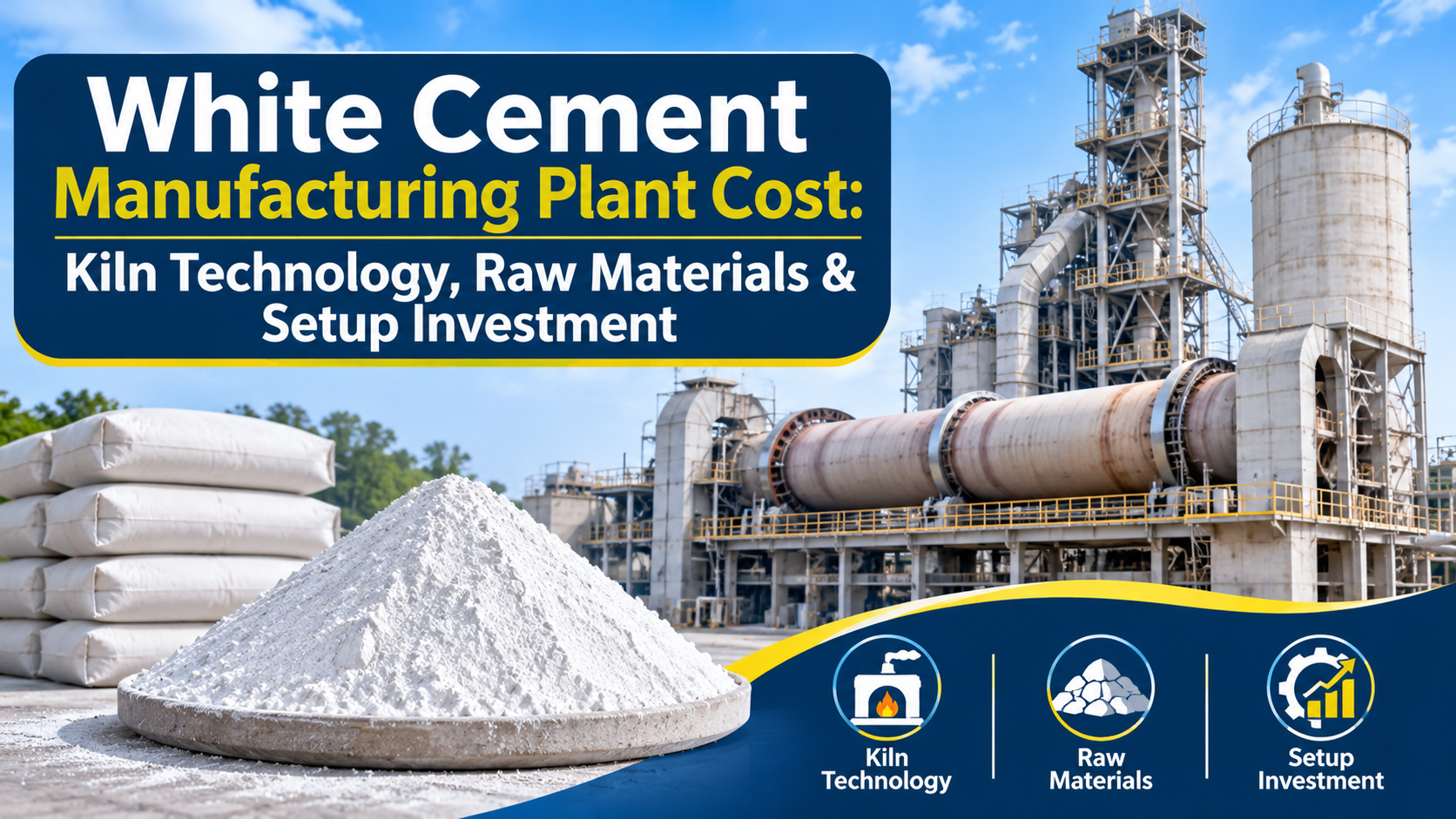
White Cement Manufacturing Plant Cost: Kiln Technology, Raw Materials & Setup Investment

IMARC Group's report, "White Cement Manufacturing Plant Project Report 2026: Industry Trends, Plant Setup, Machinery, Raw Materials, Investment Opportunities, Cost and Revenue", offers a comprehensive guide for establishing a manufacturing plant. The white cement manufacturing plant cost report offers insights into the manufacturing process, financials, capital investment, expenses, ROI, and more for informed business decisions.
White Cement Manufacturing Plant Project Report Summary: -
- Comprehensive guide for setting up white cement manufacturing plant.
- Covers market trends and industry outlook for 2026.
- Detailed project setup, including unit operations and processes.
- Raw material and utility requirements.
- Infrastructure and machinery specifications.
- Workforce and staffing requirements.
- Packaging and transportation details.
- Financial aspects: investment opportunities, cost analysis, and revenue projections.
In addition to covering operational aspects, the report offers detailed insights into the white cement manufacturing plant process and project economics.
- Detailed insights into the white cement manufacturing plant
- In-depth project economics and financial metrics.
- Covers capital investments and project funding.
- Analysis of operating expenses and income projections.
- Breakdown of fixed and variable costs, direct and indirect expenses.
- Evaluation of ROI (Return on Investment) and NPV (Net Present Value).
- Profit and Loss account analysis.
- Comprehensive financial analysis for decision-making.
- Provides a roadmap for successfully establishing a white cement manufacturing plant.
Request for a Sample Report: https://www.imarcgroup.com/white-cement-manufacturing-plant-project-report/requestsample
What is white cement?
White cement is a specialized type of cement manufactured from raw materials containing very low levels of iron oxide, manganese oxide, and other coloring impurities, giving it a distinctive white appearance. It is primarily produced using limestone, kaolin, silica, and other carefully selected minerals, which undergo high-temperature processing to achieve the desired whiteness and strength. White cement is widely used in architectural applications, decorative concrete, wall finishes, terrazzo flooring, tile grouting, precast elements, and ornamental structures. Its smooth finish, aesthetic appeal, and compatibility with mineral pigments make it suitable for producing colored concrete and decorative surfaces. Unlike ordinary grey cement, white cement requires stringent control over raw material composition, manufacturing conditions, and processing techniques to maintain consistent color quality. It is available in different grades and formulations to meet various construction and design requirements. With its versatility, durability, and superior finishing capabilities, white cement serves as an important material in modern construction, renovation, landscaping, and premium architectural projects.
Market Trends and Drivers:
The global white cement market is primarily driven by increasing construction activities, rising urbanization, and growing demand for aesthetically appealing building materials. The expansion of residential, commercial, and infrastructure projects is encouraging the adoption of white cement in decorative facades, flooring, wall finishes, and architectural elements. According to IMARC Group, the global white cement market size was valued at USD 6,264.8 Million in 2025. The market is expected to reach USD 8,829.0 Million by 2034, exhibiting a CAGR of 3.56% from 2026 to 2034.
Furthermore, increasing investments in luxury housing, hospitality facilities, commercial complexes, and premium real estate developments are supporting product demand. The growing popularity of contemporary architectural designs and customized interior finishes is also contributing to market expansion. Additionally, rising renovation and remodeling activities are creating opportunities for white cement manufacturers, particularly in decorative coatings, tile grouts, and repair applications. Technological advancements in cement manufacturing, improved product consistency, and the development of specialized formulations are further enhancing application possibilities. Moreover, expanding construction markets in emerging economies, coupled with increasing consumer preference for durable and visually attractive building materials, is expected to support the continued growth of the white cement industry.
Kiln Technology and Manufacturing Process
The white cement manufacturing process relies on specialized kiln technology and carefully controlled production conditions to maintain high whiteness, purity, and consistent product quality. The process involves raw material crushing, grinding, proportioning, homogenization, clinkerization, cooling, gypsum addition, final grinding, and packaging. A white cement manufacturing plant with an annual production capacity of 1,00,000–5,00,000 MT requires suitable machinery, including crushers, raw material mills, proportioning and blending systems, homogenization units, rotary kilns, clinker coolers, cement grinding mills, separators, storage silos, and packaging machines. The selection of kiln technology should consider production capacity, fuel and energy requirements, process efficiency, and product quality specifications. Efficient temperature control, consistent raw material blending, and effective clinker cooling are essential for minimizing discoloration and ensuring the required whiteness of the finished cement.
Raw Materials and Procurement Requirements
The selection of high-quality white cement manufacturing raw materials is essential for maintaining product brightness, strength, and consistency. According to the IMARC Group report, the principal raw materials include high-purity limestone, kaolin clay, silica sand or quartz, gypsum, and fluorite. These materials are processed through crushing, grinding, proportioning, and homogenization before entering the kiln for clinker production. The raw material composition must be carefully controlled to limit iron and other coloring oxides that can affect the final product's whiteness. Raw materials account for approximately 30–38% of total operating expenses (OpEx), making procurement planning an important part of cost management. Establishing dependable supplier relationships, assessing material purity, monitoring input prices, and optimizing transportation arrangements can help manufacturers maintain a consistent supply while controlling production costs.
White Cement Plant Setup Investment and Cost Analysis
The white cement manufacturing plant setup investment depends on production capacity, plant location, kiln technology, machinery selection, infrastructure requirements, and the level of automation. Capital expenditure (CapEx) includes land acquisition, site development, civil construction, machinery installation, and other infrastructure costs. Major equipment investments cover rotary kilns, crushers, grinding mills, blending systems, clinker coolers, separators, storage silos, and packaging machinery. Operating expenditure includes raw materials, utilities, transportation, packaging, salaries and wages, maintenance, depreciation, and taxes. According to IMARC Group, utilities account for approximately 30–38% of total OpEx, alongside raw material costs of 30–38%. The project demonstrates potential gross profit margins of 22–30% and net profit margins of 8–14% under normal operating conditions. A comprehensive investment assessment should evaluate production capacity utilization, projected revenues, operating costs, break-even requirements, return on investment (ROI), net present value (NPV), and internal rate of return (IRR) to determine the financial feasibility of establishing a white cement manufacturing plant.
Ask Analyst for Customization: https://www.imarcgroup.com/request?type=report&id=8606&flag=C
Customization Options Available:
- Plant Location: Selection of optimal location for the plant.
- Plant Capacity: Customization based on desired production capacity.
- Machinery: Choice between automatic, semi-automatic, or manual machinery.
- List of Machinery Providers: Identification of suitable machinery suppliers.
Key Questions Addressed in This Report:
- How has the white cement market performed so far and how will it perform in the coming years?
- What is the market segmentation of the global white cement market?
- What is the regional breakup of the global white cement market?
- What are the price trends of various feedstocks in the white cement industry?
- What is the structure of the white cement industry and who are the key players?
- What are the various unit operations involved in a white cement manufacturing plant?
- What is the total size of land required for setting up a white cement manufacturing plant?
- What is the layout of a white cement manufacturing plant?
- What are the machinery requirements for setting up a white cement manufacturing plant?
- What are the raw material requirements for setting up a white cement manufacturing plant?
- And more...
How IMARC Can Help?
IMARC Group is a global management consulting firm that helps the world's most ambitious changemakers to create a lasting impact. The company provide a comprehensive suite of market entry and expansion services. IMARC offerings include thorough market assessment, feasibility studies, company incorporation assistance, factory setup support, regulatory approvals and licensing navigation, branding, marketing and sales strategies, competitive landscape and benchmarking analyses, pricing and cost research, and procurement research.
Services:
- Plant Setup
- Factoring Auditing
- Regulatory Approvals, and Licensing
- Company Incorporation
- Incubation Services
- Recruitment Services
- Marketing and Sales
Contact Us:
IMARC Group
134 N 4th St. Brooklyn, NY 11249, USA
Email: [email protected]
Tel No:(D) +91 120 433 0800 / 7827100593
United States: +1-201971-6302



