

Indonesia E-Commerce Market 2026 | Growth, Trends, and Demand by 2034

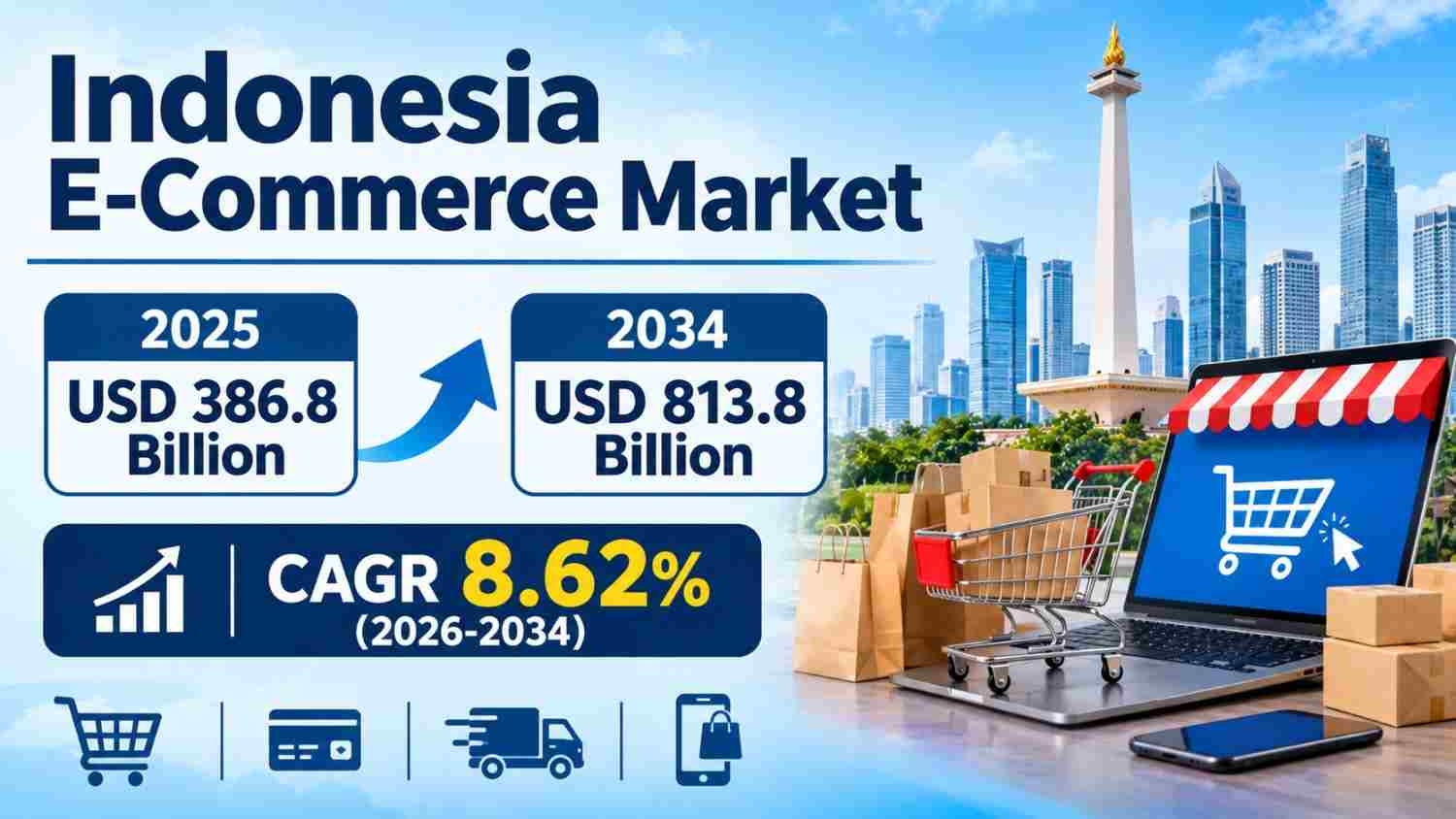
IMARC Group, a leading global market research and management consulting firm, has published its latest market intelligence report on the Indonesia E-Commerce Market. The Indonesia e-commerce market size was valued at USD 386.8 Billion in 2025 and is projected to reach USD 813.8 Billion by 2034, exhibiting a CAGR of 8.62% during 2026-2034. Growth is being driven by rapid internet and smartphone penetration, a growing young and tech-savvy population, rising digital transactions via mobile devices, and supportive government digital initiatives, with innovations in logistics and payments and the rise of social commerce further fueling expansion.
Online shopping has become a mainstream habit across Indonesia, as low-cost smartphones, wider connectivity and an expanding middle class bring millions of new consumers and small businesses onto digital platforms. Marketplaces such as Shopee and the combined TikTok Shop and Tokopedia ecosystem are blending discovery, entertainment and checkout through live commerce and short video, while mobile wallets and buy-now-pay-later options are making transactions easier and more secure. At the same time, the government is tightening and modernizing the rulebook through digital transformation programs, seller registration requirements and marketplace tax collection, aiming for a more formal and transparent digital economy. Logistics networks, local brand enablement and AI-powered tools for sellers and shoppers are improving reach and efficiency beyond Java into Sumatra, Kalimantan, Sulawesi, and other regions. Combined with deepening B2B digitization among small and medium enterprises, these forces are reshaping the competitive landscape and supporting Indonesia ecommerce growth, setting the stage for durable, long-term expansion across the archipelago.
Indonesia E-Commerce Market at a Glance:
- Market Size (2025): USD 386.8 Billion
- Market Forecast (2034): USD 813.8 Billion
- Growth Rate (2026-2034): CAGR of 8.62%
- Base Year: 2025 | Historical Period: 2020-2025 | Forecast Period: 2026-2034
- Leading Regional Market: Java, driven by its dense population, high internet usage and advanced logistics, while Sumatra, Kalimantan and Sulawesi show strong growth potential as connectivity improves
How AI is Reshaping the Future of the Indonesia E-Commerce Market
- TikTok's Agentic Commerce Push: TikTok, which operates Shop | Tokopedia in Indonesia, announced a conversational AI Shopping Assistant and an in-app Buy Direct checkout on 5 October 2026. The assistant offers real-time guidance on product details, shipping, sizing and availability, while Buy Direct lets users purchase from brands without leaving the app, although both features are still being rolled out to selected users and brands.
- Shopee's AI Tools for Sellers and Shoppers: At its Brands Summit in 2026, Shopee introduced Brand Max, an AI-powered branding solution, expanded AI LiveStream features rolling out across Southeast Asia, including an AI Script Generator, AI Comment Assistant and AI Stream Manager, and announced a virtual fitting room, helping brands engage shoppers around the clock.
- AI-Driven Advertising Automation: Ahead of the Q4 2026 shopping season, TikTok expanded AI-based advertising solutions such as Smart+ and GMV Max, an automated advertising tool for TikTok Shop sellers, and launched an MCP connection in May 2026 that lets AI agents plan, launch and optimize campaigns directly on its ad platform.
Grab a sample PDF of this report: https://www.imarcgroup.com/indonesia-e-commerce-market/requestsample
Indonesia E-Commerce Market Trends and Drivers:
Demand for e-commerce across Indonesia is being underpinned by rising internet and smartphone penetration. The widespread availability of low-cost smartphones and improved connectivity have made online shopping accessible to a much wider audience, with the Indonesian Internet Service Providers Association (APJII) reporting that internet penetration rose from 78.1% in 2023 to 79.5% in 2024, in a country of about 277.5 million people. Java accounts for almost 40% of internet users, followed by Sumatra at about 30%, according to Green Data Centre Indonesia, giving platforms a large base in the main island while newer regions open up.
The market's structural differentiator is the fusion of social media, entertainment and shopping. Live streaming, short video and creator-led selling are moving from add-on to core, and TikTok's acquisition of 75.01% of Tokopedia, completed in January 2024, created a combined social and marketplace ecosystem that Indonesia's competition commission (KPPU) approved with conditions in June 2025. Industry estimates suggest video commerce accounted for roughly 20% of online GMV in 2025, up from under 5% in 2022, according to SellerCraft data cited by Digital in Asia, while platforms continue to improve personalized recommendations and faster delivery.
A third driver is a growing middle class and easier digital payments. According to the World Bank, about 1 in 5 Indonesians, or 53.6 million people, belong to the middle class, which is growing faster than other groups and increasingly turns to e-commerce for convenience, variety and competitive pricing. User-friendly payment options such as mobile wallets and buy-now-pay-later services, along with government programs such as Making Indonesia 4.0, are strengthening trust and digital infrastructure, a dynamic that is set to intensify over the coming decade.
Government Schemes and National Digital Economy Programs Driving Demand:
- Making Indonesia 4.0 and Digital Transformation Regulation: The Making Indonesia 4.0 program aims to enhance digital infrastructure and promote e-commerce adoption, supported by Presidential Regulation No. 82 of 2023 on the acceleration of digital transformation and integration of national digital services, which designated nine priority super apps for public services.
- Trade Ministry Regulation No. 19 of 2026: In force since 8 June 2026, the regulation requires all businesses selling through electronic platforms to hold a business identification number (NIB), with 18 months for existing sellers and six months for new sellers to comply, and obliges platforms to verify seller legality and disclose fees through written electronic contracts.
- Marketplace Income Tax Collection (PMK 37/2025): The Finance Ministry regulation designates major marketplaces as collectors of 0.5% Article 22 income tax on domestic sellers' gross turnover, with individual sellers earning up to Rp500 million a year exempt upon declaration. The start of collection has been postponed more than once, with recent reports pointing to 1 November 2026.
- MSME Support and Fee Relief: Indonesia's Ministry of MSMEs is preparing a regulation that would require marketplaces to give service fee discounts of up to 50% to local small sellers, while platform partnerships such as Igloo and Tokopedia aim to reach over 14 million micro, small and medium enterprises in 99% of districts.
- Competition Oversight of Platform Consolidation: KPPU's conditional approval of TikTok's Tokopedia acquisition, issued on 17 June 2025, requires open access for payment and logistics services, bans predatory pricing and discrimination, and protects sellers' freedom to promote outside the platform, with monitoring until 17 June 2027.
Indonesia E-Commerce Market Industry Segmentation:
The report has segmented the market into the following categories:
Breakup By Type:
- B2C E-Commerce (Beauty and Personal Care, Consumer Electronics, Fashion and Apparel, Food and Beverage, Furniture and Home, Others)
- B2B E-Commerce
B2C e-commerce is driven by rising internet and platform usage and increasing disposable income across beauty and personal care, consumer electronics, fashion and apparel, food and beverage, and furniture and home, with social media influence and digital marketing boosting engagement, while B2B e-commerce is supported by business digitization and the preference of small and medium enterprises for online procurement.
Breakup By Region:
- Java
- Sumatra
- Kalimantan
- Sulawesi
- Others
Java leads digital activity thanks to dense population, urbanization, high smartphone penetration and efficient logistics, followed by Sumatra, while Kalimantan and Sulawesi are gaining from improving connectivity, expanding logistics networks, government digitalization initiatives and a rising middle class.
Competitive Landscape:
The Indonesia e-commerce market is highly competitive, led by large marketplaces and supported by a wide ecosystem of enablers. Key players include:
- Shopee
- Lazada
- Tokopedia
- Blibli
- Bukalapak
- Amazon
- Alibaba
Shopee, Lazada and Tokopedia offer exclusive product ranges and robust logistics, local players such as Blibli and Bukalapak hold significant shares, and global entrants such as Amazon and Alibaba intensify competition and push innovation and customer service. Tokopedia now operates together with TikTok Shop, and partnerships such as Lazada with Aha Commerce and Shopee with YouTube show how platforms are widening reach through local brands and social channels.
Market Concentration Analysis:
- The Indonesia e-commerce market is moderately concentrated at the top, with Shopee and the TikTok Shop and Tokopedia combination leading marketplace activity. Momentum Works estimated that, in 2024, Shopee held about 46% of Indonesian marketplace GMV while Tokopedia and TikTok Shop together held about 34%, reflecting the scale needed for logistics, payments and marketing.
- Fragmentation increases among sellers, brands and enablers, where millions of micro, small and medium enterprises, brand-owned stores, social and live commerce operators, and B2B procurement platforms compete across categories, creating a structure where large marketplaces dominate reach and traffic while smaller players focus on niches, content-led selling and local brands.
- Consolidation and regulatory oversight are intensifying, exemplified by TikTok's acquisition of a 75.01% stake in Tokopedia from GoTo for about USD 840 million, which KPPU approved with conditions in June 2025, and by AnyMind Group's acquisition of Digital Distribusi Indonesia in 2023 to build live e-commerce services.
What Does The Full Report Cover?
- Historical, current, and forecast market size for the Indonesia e-commerce market from 2020 to 2034
- Market breakup by type and region
- Regional analysis covering Java, Sumatra, Kalimantan, Sulawesi, and Others
- Key growth drivers, challenges, and opportunities shaping the market
- Porter's Five Forces analysis and value chain assessment
- Competitive landscape, market structure, and player positioning
- Detailed profiles of major e-commerce companies in Indonesia
Recent News and Developments in the Indonesia E-Commerce Market
- October 2026: TikTok announced its AI Shopping Assistant and Buy Direct in-app checkout as part of an agentic commerce push, with the features being tested with selected brands and users ahead of the Q4 shopping season.
- June 2026: Trade Ministry Regulation No. 19 of 2026 came into force on 8 June, making a business identification number mandatory for all sellers on e-commerce platforms and requiring marketplaces to disclose fees through electronic contracts.
- September 2025: KPPU fined TikTok Nusantara Rp15 billion for late notification of its acquisition of Tokopedia shares, while confirming that the conditions attached to the merger approval continue to apply.
- June 2025: KPPU granted conditional approval to TikTok's acquisition of 75.01% of Tokopedia, requiring open access for payment and logistics services, a ban on predatory pricing and discrimination, and freedom for sellers to promote outside the platform.
- March 2025: Korean baby products brand Moyuum appointed AnyMind Group as its exclusive e-commerce distributor in Indonesia, while Jayud Global Logistics completed the first flight of its contracted air cargo service between Jakarta and Fuzhou, China, to serve Southeast Asia's growing e-commerce trade.
Note: If you require specific details, data, or insights that are not currently included in the scope of this report, we are happy to accommodate your request. As part of our customization service, we will gather and provide the additional information you need, tailored to your specific requirements. Please let us know your exact needs, and we will ensure the report is updated accordingly to meet your expectations.
Key Questions This Report Answers
- How big is the Indonesia e-commerce market and what is its growth outlook through 2034?
- What are the key growth drivers, challenges, and opportunities in the Indonesia e-commerce market?
- How is the market split by type and region?
- How are mobile-first shopping, social commerce, and live commerce shaping demand?
- How are government digital initiatives, seller regulations, and tax rules influencing the market?
- Who are the key players in the Indonesia e-commerce market, and how is the competitive landscape evolving?
- What role are AI, payments innovation, and logistics playing in the future of Indonesian e-commerce?
About Us
IMARC Group is a global management consulting firm that helps the world's most ambitious changemakers to create a lasting impact. The company provides a comprehensive suite of market entry and expansion services. IMARC offerings include thorough market assessment, feasibility studies, company incorporation assistance, factory setup support, regulatory approvals and licensing navigation, branding, marketing and sales strategies, competitive landscape and benchmarking analyses, pricing and cost research, and procurement research.
Media and Sales Contact
IMARC Group
Email: [email protected]
United States: +1-201-971-6302
India: +91-120-433-0800
United Kingdom: +44-753-714-6104



