

Indonesia Co-Working Office Space Market Report 2026 | Size, Growth, and Forecast by 2034

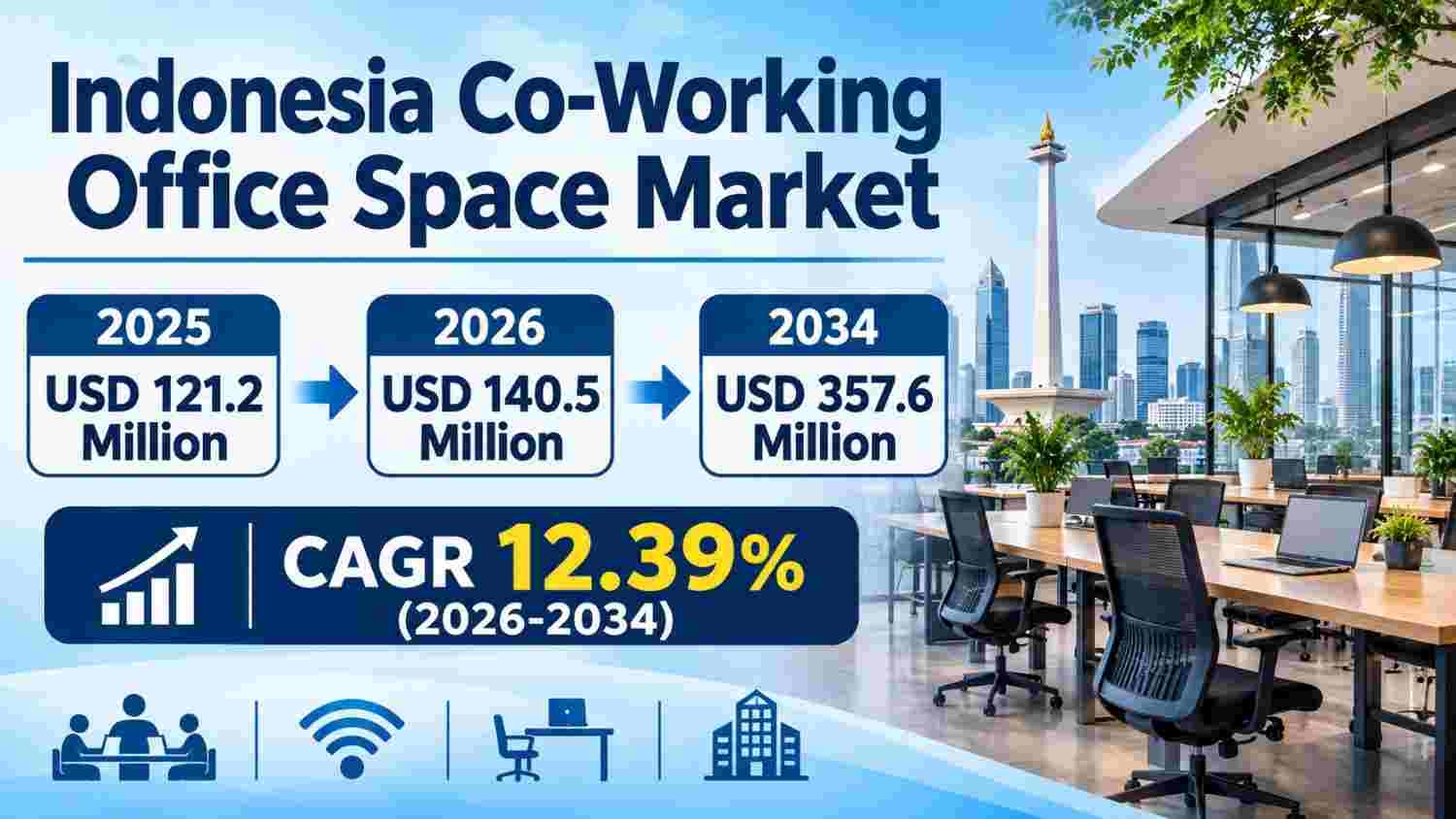
IMARC Group, a leading global market research and management consulting firm, has published its latest market intelligence report on the Indonesia Co-Working Office Space Market. The Indonesia co-working office space market grew from USD 121.2 Million in 2025 to USD 140.5 Million in 2026. Looking forward, IMARC Group expects the market to reach USD 357.6 Million by 2034, exhibiting a growth rate (CAGR) of 12.39% during 2026-2034. Growth is being driven by remote and hybrid work, a growing startup ecosystem, government digital-economy policy, foreign direct investment and demand for flexible, affordable scale-up options.
Co-working office space covers flexible managed offices and serviced offices that let startups, freelancers and companies rent desks or floors without long-term leases. In Jakarta, Colliers reported CBD office occupancy of about 76.3% in Q3 2026, and its July 2026 research noted growing demand for semi-fitted, fully fitted and furnished space and shorter lease terms with options to expand or contract. These forces are reshaping the market across Java, Sumatra, Kalimantan, Sulawesi and the rest of Indonesia.
Indonesia Co-Working Office Space Market at a Glance:
- Market Size (2025): USD 121.2 Million
- Market Estimate (2026): USD 140.5 Million
- Market Forecast (2034): USD 357.6 Million
- Growth Rate (2026-2034): CAGR of 12.39%
- Segments Covered: Type, Application, End User and Region
- Base Year: 2025 | Historical Period: 2020-2025 | Forecast Period: 2026-2034
How AI is Reshaping the Future of the Indonesia Co-Working Office Space Market
- IWG on AI and Hybrid Working: On 29 June 2026, Republika interviewed Lars Wittig, Senior Vice President of IWG Asia Pacific, who said AI's impact will be larger than the personal computer, the internet and the mobile phone combined, and that hybrid work and uncertain headcount are pushing companies toward flexible space. He said IWG has 56 business centers in Indonesia, targeting 62 by year-end. The one-third flexible-space forecast and other figures are the executive's own and the article gives no independent source.
- AI Training Among Indonesian Workers (Related, Not a Co-Working Application): JLL's 2 March 2026 Workforce Preference Barometer found 76% of Indonesian workers receive AI training, the highest in the region. The Indonesia sample was 150 corporate employees within 3,100 workers across nine APAC markets, and the findings are about workplaces generally, not flexible space.
- AI and Robotics Lab at Nusantara's Smart City Center (Related, Not a Co-Working Application): On 19 June 2026, Detik reported a groundbreaking in Nusantara for a South Korean-funded smart city center, a grant of KRW 9.9 billion (about Rp 115.94 billion), with a second-floor AI and Robotics Lab and construction targeted for completion by end-2027.
- SETTER Smart Office Network in Bali (Related, Not Described as AI): The report page notes that in 2025 Nuanu, a Bali creative hub, partnered with SETTER, described as a Bali co-working and smart office network, on an architecture contest for a co-working space. No AI application is described.
Grab a sample PDF of this report: https://www.imarcgroup.com/indonesia-co-working-office-space-market/requestsample
Indonesia Co-Working Office Space Market Trends and Drivers:
The report names remote and hybrid work as the leading driver, with demand for short-term flexible space rising among startups, SMEs and freelancers. IWG says large companies now use flexible space too, and a September 2026 JournalArta article attributes to IWG roughly 1.5 times higher demand for flexible workspace through 2026, with BSD and PIK as expansion targets. The article's savings claim of 30-40% of annual real estate budgets has no source.
The startup ecosystem is a second driver. Co-working spaces offer low-cost, scalable setups, mentorship and networking, and the report cites StartupBlink saying Jakarta holds about 80% of Indonesia's startups. Government programs such as the 100 Smart Cities program and the 100 Start-up Movement support growth, and the report cites the International Trade Administration expecting the digital economy to reach USD 146 billion by 2025.
Office-market conditions cut both ways. JLL said average Jakarta office vacancy peaked above 37%, while demand in Q4 2025 was the strongest since Q3 2019. Its survey found 87% of Indonesian corporate employees face a return-to-office mandate or structured hybrid program, the highest share of any market surveyed, and Colliers noted some Chinese occupiers moved from serviced offices into conventional space, a dynamic that is set to shape the market over the coming years.
Government Schemes and Policy Frameworks Driving the Market:
- 100 Smart Cities Program: Cited by the report as supporting the digital economy and demand for flexible workspace.
- 100 Start-up Movement: Cited by the report as encouraging startup formation, a key user base for co-working spaces.
- Nusantara Smart City Center: Otorita IKN head Basuki Hadimuljono said at the 19 June 2026 groundbreaking that the building is hoped to serve as a smart city laboratory for education, with South Korea's Ministry of Land, Infrastructure and Transport collaborating on smart city technology.
Indonesia Co-Working Office Space Market Industry Segmentation:
The report has segmented the market into the following categories:
Breakup By Type:
- Flexible Managed Office
- Serviced Office
Breakup By Application:
- Information Technology (IT and ITES)
- Legal Services
- BFSI
- Consulting
- Others
Breakup By End User:
- Personal User
- Small Scale Company
- Large Scale Company
- Others
Breakup By Region:
- Java
- Sumatra
- Kalimantan
- Sulawesi
- Others
Competitive Landscape:
Companies active in Indonesian co-working and flexible space, drawn from public reports and the report page, include:
- IWG
- SETTER
IWG says it has operated in Indonesia for two decades with 56 business centers, a company statement.
What Does The Full Report Cover?
- Historical, current, and forecast market size for the Indonesia co-working office space market from 2020 to 2034, in USD Million
- Market breakup by type, application, end user and region
- Regional analysis covering Java, Sumatra, Kalimantan, Sulawesi, and Others
- Key growth drivers, challenges, and opportunities shaping the market
- Porter's Five Forces analysis and value chain assessment
- Competitive landscape, market structure, and company profiles
- 10% free customization and 10-12 weeks of post-sale analyst support
Recent News and Developments in the Indonesia Co-Working Office Space Market
- March 2026: JLL published its Indonesia workforce survey, with 87% of corporate employees facing an RTO mandate or structured hybrid program.
- June 2026: IWG's Asia Pacific executive outlined AI and hybrid working trends, and Nusantara broke ground on a smart city center.
- July 2026: Colliers reported rising Jakarta demand for fitted and furnished space and shorter leases.
- October 2026: Colliers' Q3 2026 data showed Jakarta CBD occupancy of about 76.3% and non-CBD occupancy of about 68%.
Note: If you require specific details, data, or insights that are not currently included in the scope of this report, we are happy to accommodate your request. As part of our customization service, we will gather and provide the additional information you need, tailored to your specific requirements. Please let us know your exact needs, and we will ensure the report is updated accordingly to meet your expectations.
Key Questions This Report Answers
- How big is the Indonesia co-working office space market, and how did it move from 2025 to 2026?
- What is the expected CAGR and 2034 value of the market?
- What are the key growth drivers, including startups, freelancers, FDI and flexible leasing?
- What is the market breakup by type, application, end user and region?
About Us
IMARC Group is a global management consulting firm that helps the world's most ambitious changemakers to create a lasting impact. The company provides a comprehensive suite of market entry and expansion services. IMARC offerings include thorough market assessment, feasibility studies, company incorporation assistance, factory setup support, regulatory approvals and licensing navigation, branding, marketing and sales strategies, competitive landscape and benchmarking analyses, pricing and cost research, and procurement research.
Media and Sales Contact
IMARC Group
Email: [email protected]
United States: +1-201-971-6302
India: +91-120-433-0800
United Kingdom: +44-753-714-6104



