

Recycled Aluminium Plant Setup Cost and Financial Planning for Industrial Investors

IMARC Group’s “Recycled Aluminium Manufacturing Plant Project Report 2026: Industry Trends, Plant Setup, Machinery, Raw Materials, Investment Opportunities, Cost and Revenue” report provides a comprehensive guide on how to successfully set up a recycled aluminium manufacturing plant. The report offers clarifications on various aspects, such as unit operations, raw material requirements, utility supply, infrastructural needs, machinery models, labour necessities, transportation timelines, packaging costs, and other essential requirements.
The report also provides detailed insights into recycled aluminium manufacturing plant setup, covering capital investments (CapEx), operating expenses (OpEx), project funding, income and expenditure projections, fixed and variable costs, direct and indirect costs, expected return on investment (ROI), net present value (NPV), profit and loss accounts, and financial analysis. It serves as a valuable resource for investors, metal manufacturers, entrepreneurs, and businesses evaluating the feasibility of establishing a recycled aluminium manufacturing facility.
What is Recycled Aluminium?
Recycled aluminium refers to aluminium produced by collecting, processing, and remelting aluminium scrap obtained from industrial waste, consumer products, and end-of-life materials. Common sources include beverage cans, automotive components, construction materials, electrical wires, and industrial aluminium residues. The material retains most of the physical and chemical properties of primary aluminium, including its lightweight characteristics, corrosion resistance, strength, and electrical and thermal conductivity. It is widely used as a sustainable alternative to primary aluminium across several manufacturing industries.
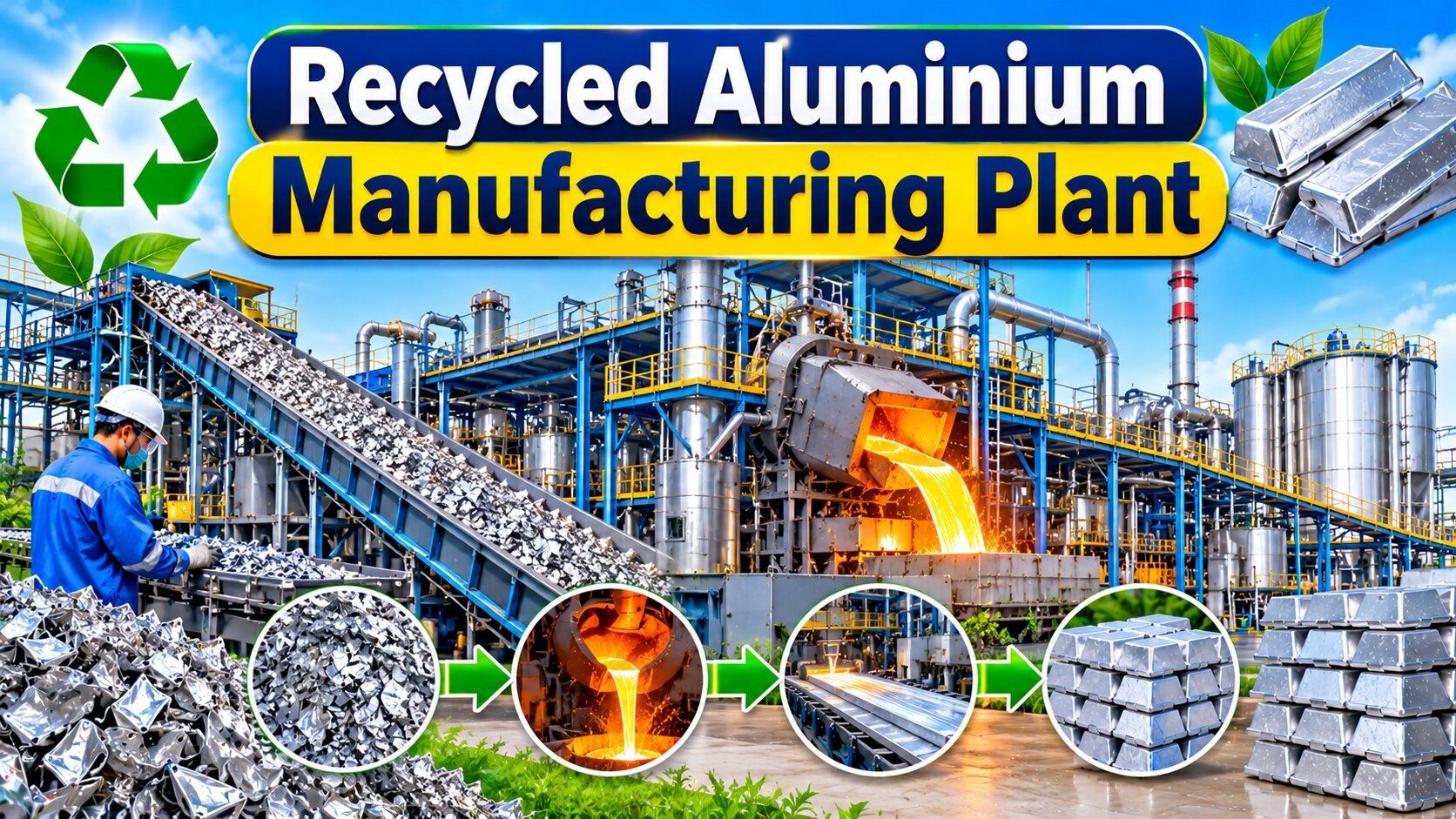
Recycled aluminium serves as an important raw material for automotive components, construction products, packaging materials, electrical equipment, consumer goods, and industrial applications. It is commonly processed into aluminium ingots, billets, sheets, extrusions, and secondary alloy products. The manufacturing process generally involves scrap collection, sorting, shredding, cleaning, decoating, melting, alloying, refining, casting, cooling, quality inspection, and packaging. Recycling aluminium also supports resource conservation and reduces energy consumption compared with primary aluminium production.
Market Trend and Drivers of Recycled Aluminium:
The global recycled aluminium market was valued at USD 54.46 Billion in 2025 and is projected to reach USD 94.39 Billion by 2034, exhibiting a CAGR of 6.3% during 2026–2034. Market growth is supported by increasing sustainability regulations, rising demand from automotive and construction sectors, and the growing preference for low-carbon footprint materials.
The automotive sector represents an important demand driver, as manufacturers increasingly use recycled aluminium to develop lightweight vehicle components and improve fuel efficiency. The expansion of electric vehicle production is further supporting demand for secondary aluminium alloys. Additionally, the construction and infrastructure industries are contributing to market growth through the use of recycled aluminium in windows, doors, roofing, structural components, and other building materials. The growing consumption of aluminium beverage cans, foils, and food containers is also supporting recycling activities. Furthermore, environmental regulations, carbon reduction targets, extended producer responsibility frameworks, and investments in scrap collection infrastructure are creating opportunities for recycled aluminium manufacturers.
Minimum Cost Required to Set Up a Recycled Aluminium Manufacturing Plant:
- Small-Scale Recycled Aluminium Manufacturing Plant (USD 1–3 Million): Capacity: 3,000–6,000 tonnes per year. Includes aluminium scrap sorting equipment, basic shredders, manual or semi-automatic material handling systems, small rotary melting furnaces, flux treatment equipment, basic casting machines, weighing systems, and emission-control facilities.
- Medium-Scale Recycled Aluminium Manufacturing Plant Setup Cost (USD 10–25 Million): Capacity: 30,000–60,000 tonnes per year. Includes automated scrap sorting and shredding systems, decoating equipment, industrial melting furnaces, degassing units, alloying systems, filtration equipment, casting machines, spectrometers, dross-handling systems, and advanced emission-control infrastructure.
- Large-Scale Recycled Aluminium Manufacturing Plant Cost (USD 60–120 Million): Capacity: 100,000–200,000 tonnes per year. Features high-capacity scrap processing lines, automated decoating systems, large industrial melting and holding furnaces, advanced refining and degassing systems, continuous casting machinery, automated material-handling equipment, sophisticated quality testing laboratories, and comprehensive environmental management infrastructure.
Request a Sample Report: https://www.imarcgroup.com/recycled-aluminium-manufacturing-plant-project-report/requestsample
How to Setup a Recycled Aluminium Manufacturing Plant?
Setting up a recycled aluminium manufacturing plant requires careful planning of production technology, raw material procurement, machinery selection, infrastructure, and quality control. The following considerations are important when establishing a commercially viable recycled aluminium production facility:
- Detailed Process Flow: Establish a production sequence covering aluminium scrap collection, sorting, shredding, cleaning, decoating, melting, flux treatment, degassing, alloying, filtration, casting, cooling, quality inspection, and packaging. Maintain appropriate process controls to achieve the required metal recovery rate, alloy composition, and product specifications.
- Site Selection: Select an industrial location with access to aluminium scrap, fluxes, alloying elements, furnace fuel, electricity, water, and transportation facilities. Consider proximity to scrap suppliers, automotive manufacturers, construction companies, and metal processing industries to manage procurement and distribution expenses.
- Plant Layout Optimization: Design separate areas for scrap receiving, sorting, shredding, decoating, raw material storage, melting, refining, casting, quality control, and finished goods storage. Provide suitable arrangements for material movement, equipment maintenance, worker safety, dust management, and future expansion.
- Equipment Selection: Procure suitable scrap shredders, sorting machines, decoating systems, rotary or reverberatory furnaces, melting and holding furnaces, flux injection systems, degassing units, filtration equipment, casting machines, spectrometers, and emission-control systems. Equipment selection should reflect production capacity, scrap characteristics, alloy specifications, and automation requirements.
- Raw Material Sourcing: Establish reliable supply arrangements for aluminium scrap, fluxes, alloying elements, and furnace fuel. Evaluate scrap grades, contamination levels, metal recovery rates, procurement costs, and supplier consistency. Develop long-term sourcing arrangements with industrial scrap dealers, automotive dismantlers, fabrication units, and recycling networks.
- Safety and Environmental Compliance: Install appropriate ventilation, dust collection systems, furnace safety equipment, emission monitoring systems, personal protective equipment, and waste-handling facilities. Manage aluminium dross, process residues, and industrial emissions in accordance with applicable environmental and safety requirements.
- Quality Assurance Systems: Implement testing procedures to monitor aluminium purity, alloy composition, metal recovery, inclusions, impurities, and product specifications. Use spectrometers and other analytical instruments to maintain consistent quality. Maintain batch records and establish quality checks throughout melting, refining, casting, and final packaging.
Requirements to Setup a Recycled Aluminium Plant:
- Funds
- Machinery
- Lands
Types of Costs to Setup a Recycled Aluminium Factory:
- Land, Location and Site Development Cost
- Plant Layout Cost
- Recycled Aluminium Plant Machinery Cost
- Raw Material Requirements and Costs
- Packaging Requirements and Costs
- Transportation Requirements and Costs
- Utility Requirements and Costs
- Human Resource Requirements and Costs
Project Economics:
- Capital Investments
- Operating Costs
- Expenditure Projections
- Revenue Projections
- Taxation and Depreciation
- Profit Projections
- Financial Analysis
Recycled Aluminium Plant Profit Margins:
The profitability of a recycled aluminium manufacturing plant depends on scrap procurement, metal recovery rates, production efficiency, alloy quality, capacity utilization, and selling prices. According to the project report, the estimated gross profit margin ranges between 15–25%, while the net profit margin is approximately 5–10% under the stated project assumptions.
Recycled Aluminium Plant Cost Analysis:
Raw material consumption represents the largest share of operating expenditure in recycled aluminium manufacturing. According to the report, aluminium scrap accounts for approximately 80–85% of total OpEx. Utilities contribute around 10–15% of operating expenditure. Consequently, efficient scrap sourcing, metal recovery, furnace efficiency, process optimization, and energy management are important factors in controlling overall production costs.
Ask Analyst for Customized Report: https://www.imarcgroup.com/request?type=report&id=8427&flag=C
How IMARC Can Help?
IMARC Group provides comprehensive support to businesses planning to establish or expand recycled aluminium manufacturing facilities. Its services include detailed project feasibility studies, manufacturing process evaluation, machinery and raw material assessments, plant layout planning, capital and operating cost analysis, financial modelling, and investment advisory. The company also assists investors in evaluating market demand, identifying operational requirements, assessing recycling technologies, and preparing bankable project reports to support informed investment decisions.
Services:
- Plant Setup
- Factory Auditing
- Regulatory Approvals, and Licensing
- Company Incorporation
- Incubation Services
- Recruitment Services
- Marketing and Sales
Contact Us:
IMARC Group
134 N 4th St. Brooklyn, NY 11249, USA
Email: [email protected]
Tel No: (D) +91 120 433 0800
United States: (+1–201971–6302)



