

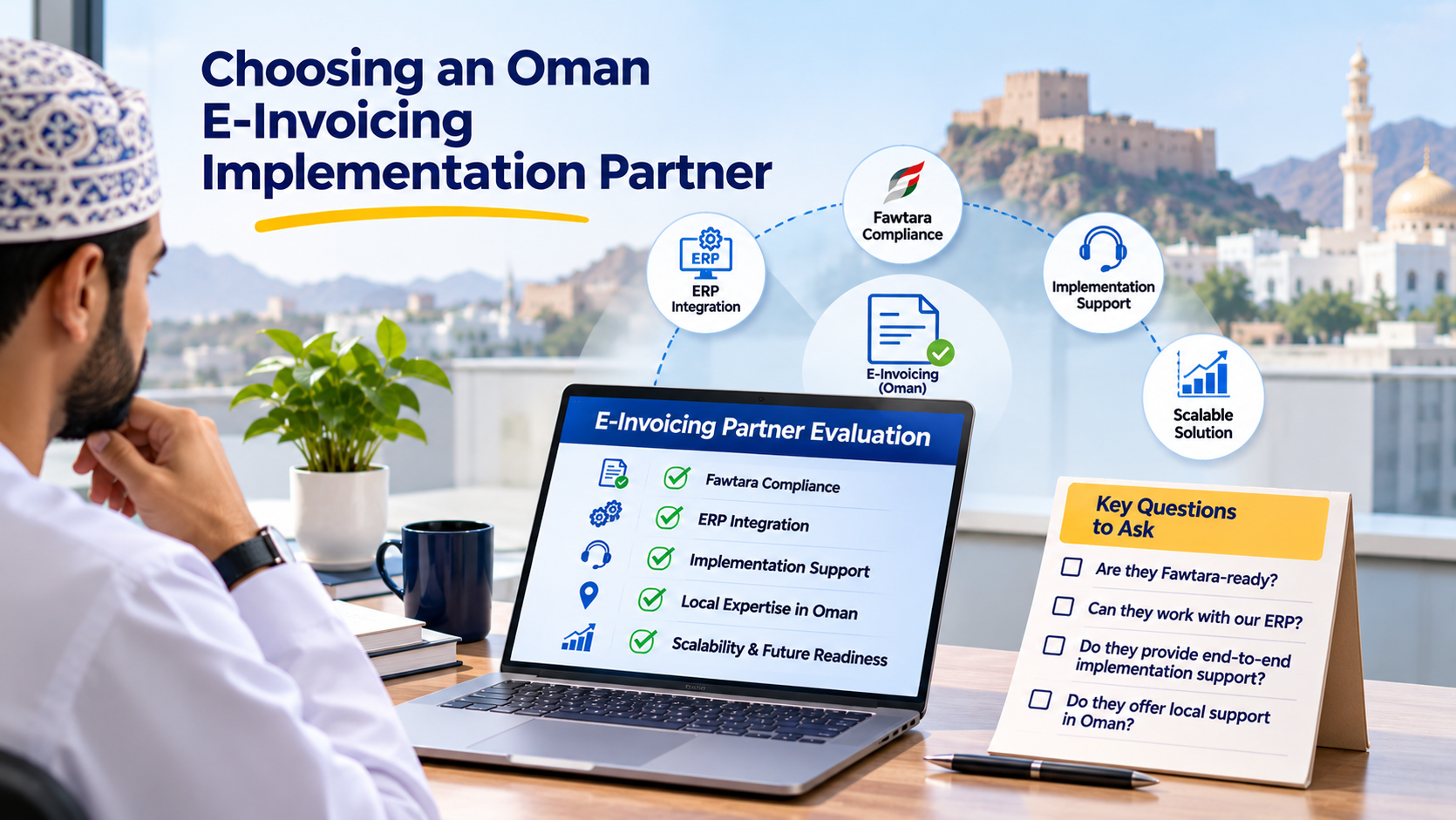

Preparing for Oman's Fawtara programme involves more than selecting an e-invoicing application. Businesses need to connect their existing systems with the required electronic invoice exchange process, review their data and prepare employees for changes in daily operations.
Choosing the right Oman e-invoicing implementation partner can help businesses organise these activities and manage the technical work involved. The partner should understand the company's ERP environment, invoice workflows, data requirements and responsibilities under the Oman Tax Authority's e-invoicing framework.
A structured selection process helps finance and IT teams identify a partner that can support the project from initial assessment through testing and go-live.
Understand the Difference Between an Implementation Partner and an Accredited Service Provider
Before evaluating vendors, businesses should understand two different roles involved in Fawtara.
An implementation partner helps a company prepare its systems and processes for electronic invoicing. This work may include reviewing ERP configurations, mapping invoice data, coordinating integrations, testing transactions and training employees.
An Accredited Service Provider (ASP), on the other hand, has a specific role in Oman's five-corner e-invoicing model. According to the Oman Tax Authority, service providers validate and exchange electronic invoices between taxpayers and report relevant tax data to the Authority.
A business should not assume that every software vendor or implementation consultant is automatically an accredited service provider. Verify the ASP's current status through the official Fawtara directory and establish which organisation will perform each responsibility.
This distinction helps prevent confusion when negotiating contracts and assigning project responsibilities.
1. Assess Your Existing Invoicing and ERP Environment
The first step should be an assessment of the systems currently used to create and manage invoices.
Businesses may generate invoices through ERP platforms, accounting applications, billing systems or customised internal software. Each environment can have different data structures and integration requirements.
Ask the implementation partner to review:
-
The ERP or accounting software currently in use.
-
The version and configuration of the system.
-
Sales and purchase invoice workflows.
-
Customer and supplier master records.
-
Existing VAT and tax configurations.
-
Custom invoice fields and approval processes.
-
Current data export and integration methods.
The assessment should identify which parts of the existing system can be retained and which may need modification.
The Oman Tax Authority's published guidance states that existing ERP systems can be retained depending on the arrangement with the accredited service provider. Businesses should therefore explore integration options before considering a complete system replacement.
2. Check Knowledge of Oman's Fawtara Requirements
An implementation partner should understand the technical and operational requirements relevant to the Fawtara programme.
This includes the five-corner model, structured invoice exchange, applicable invoice specifications and the role of accredited service providers.
Businesses should ask how the partner approaches:
-
PINT-OM invoice and credit note requirements.
-
Structured XML invoice preparation.
-
Supplier and buyer information mapping.
-
VAT details and transaction classifications.
-
Invoice validation and error correction.
-
Exchange acknowledgements and invoice statuses.
-
Relevant reporting and record-management processes.
The partner should be able to explain these requirements in practical terms and demonstrate how they affect the company's existing invoicing workflow.
Avoid selecting a vendor based only on general statements such as "Fawtara-ready". Request a technical explanation or demonstration using representative business transactions.
3. Evaluate ERP Integration Capabilities
ERP integration is one of the most important parts of an e-invoicing implementation project.
The objective is to transfer invoice information between existing business systems and the e-invoicing environment without creating unnecessary manual work.
Discuss the following areas with the implementation partner:
Data mapping: How will existing ERP fields correspond to the required invoice fields?
Integration method: Will the connection use APIs, file exchange or another supported method?
Invoice workflow: How will invoice information move from creation and approval to validation and exchange?
Status updates: How will users access acknowledgements or identify invoices that require attention?
Customisation: Will existing ERP modifications affect the integration process?
Businesses should also clarify who will manage technical changes, investigate data-transfer problems and coordinate with the accredited service provider.
Companies evaluating Oman ERP integration should consider how these activities fit into their wider accounting and operational systems.
4. Review Testing and Error-Handling Procedures
A system should be tested before it becomes part of the company's regular invoicing process.
An implementation partner should provide a clear testing approach that covers different invoice scenarios and identifies problems before go-live.
Testing may include:
-
Standard sales invoices.
-
Credit notes and adjustment documents.
-
Different VAT treatments.
-
Customer and supplier information.
-
Invoice numbering and required identifiers.
-
Data transfer between the ERP and e-invoicing solution.
-
Validation responses and error handling.
Ask how testing results will be documented and who will approve the system before production use.
The partner should also explain how employees will identify errors, correct source information and follow the appropriate resubmission process.
Technical validation is important, but it does not replace the company's responsibility to ensure that invoice information and tax treatment are correct.
5. Examine Data Security and Record Management
Electronic invoices contain commercially sensitive information, including customer details, supplier records, transaction values and tax data.
Before signing an agreement, understand how the implementation partner and accredited service provider manage this information.
Review:
-
User permissions and access controls.
-
Data transmission and storage security.
-
Hosting location and data-residency arrangements.
-
Backup and recovery procedures.
-
Invoice history and record retrieval.
-
Data ownership and export options.
-
Support during system interruptions.
Ask which organisation is responsible for storing invoice records and how the business can retrieve them if it changes providers.
These details should be documented rather than accepted as informal assurances.
6. Check Training and Post-Implementation Support
The implementation process does not end when the system goes live. Employees must understand how their daily work will change.
Finance teams may need to review invoice statuses, resolve data errors and follow revised approval procedures. IT teams may need to monitor integrations and coordinate technical support.
Ask whether the partner provides:
-
Training for finance and accounts teams.
-
Technical documentation.
-
User guides for common activities.
-
Go-live assistance.
-
A defined support contact.
-
An escalation process for technical issues.
-
Assistance with future system or specification changes.
Also clarify the support hours, response expectations and charges for additional work.
A clear support arrangement helps businesses manage issues after the initial implementation project is completed.
7. Compare Project Costs and Contract Responsibilities
Implementation costs should be evaluated against the actual scope of work.
Depending on the project, charges may include system assessment, ERP integration, data mapping, customisation, testing, employee training and ongoing support.
Before finalising an agreement, ask for a breakdown of:
-
Initial implementation charges.
-
ERP integration and development costs.
-
Accredited service-provider fees.
-
Invoice-volume or transaction charges.
-
Maintenance and support costs.
-
Additional training or customisation fees.
The contract should also define project milestones, responsibilities, deliverables, data ownership and arrangements for ending or transferring the service.
Comparing vendors using the same requirements makes it easier to identify the most suitable option.
Questions to Ask Before Selecting an Implementation Partner
Use these questions during vendor discussions:
-
How much experience does the team have with ERP and e-invoicing implementations?
-
Which ERP platforms and versions can it support?
-
How will existing invoice data be mapped to PINT-OM requirements?
-
Which accredited service provider will handle invoice validation and exchange?
-
What testing will be completed before go-live?
-
How will invoice errors and integration failures be handled?
-
What data-security and record-retrieval arrangements are available?
-
What training and ongoing support are included?
-
What is the complete implementation cost?
Documenting the answers helps finance and IT teams compare proposals consistently.
Choose a Partner That Supports Your Long-Term Requirements
Choosing an Oman e-invoicing implementation partner should involve more than comparing software demonstrations or initial pricing. Businesses need to assess technical knowledge, ERP compatibility, Fawtara readiness, testing procedures and ongoing support.
A suitable partner should clearly explain its responsibilities and coordinate effectively with the company's internal teams and accredited service provider.
By assessing existing systems, documenting project requirements and agreeing on responsibilities before implementation, businesses can prepare for Fawtara with a clearer and more manageable transition plan.



