

Consistency is one of the most important considerations in carbonated beverage manufacturing. Consumers generally expect their preferred soft drink to deliver a familiar taste, carbonation level and packaging quality every time they purchase it. For beverage manufacturers, achieving this consistency requires coordination between processing equipment, carbonation systems and filling machinery.
A well-planned Carbonated Soft Drink Plant provides the production infrastructure needed to manage these operations. Instead of treating syrup preparation, carbonation and bottling as separate activities, manufacturers can consider how the entire production line works together. This is particularly important for Indian beverage businesses planning to serve distributors, retailers and institutional customers.
Product Specifications
A CSD production line combines several processing and packaging stages. The exact configuration depends on the beverage, container type and production requirements.
Water treatment equipment: Water is an important input in soft drink manufacturing. Its treatment requirements should be established according to the beverage formulation and applicable production standards.
Syrup preparation equipment: This section supports the preparation and mixing of syrup used in the beverage. Buyers should understand the mixing arrangement and its suitability for their planned product range.
Carbonation system: Carbonation introduces carbon dioxide into the beverage under controlled conditions. Temperature, pressure and process coordination are important considerations when planning this section.
Bottle rinsing equipment: Containers are prepared before entering the filling stage. The selected equipment should match the intended packaging format.
Filling and capping machinery: Carbonated beverages require appropriate filling arrangements to help retain carbonation during packaging. Counter-pressure filling is an important consideration for these applications.
Labelling and packaging: After filling and closure, products move through the labelling and packaging stages before distribution.
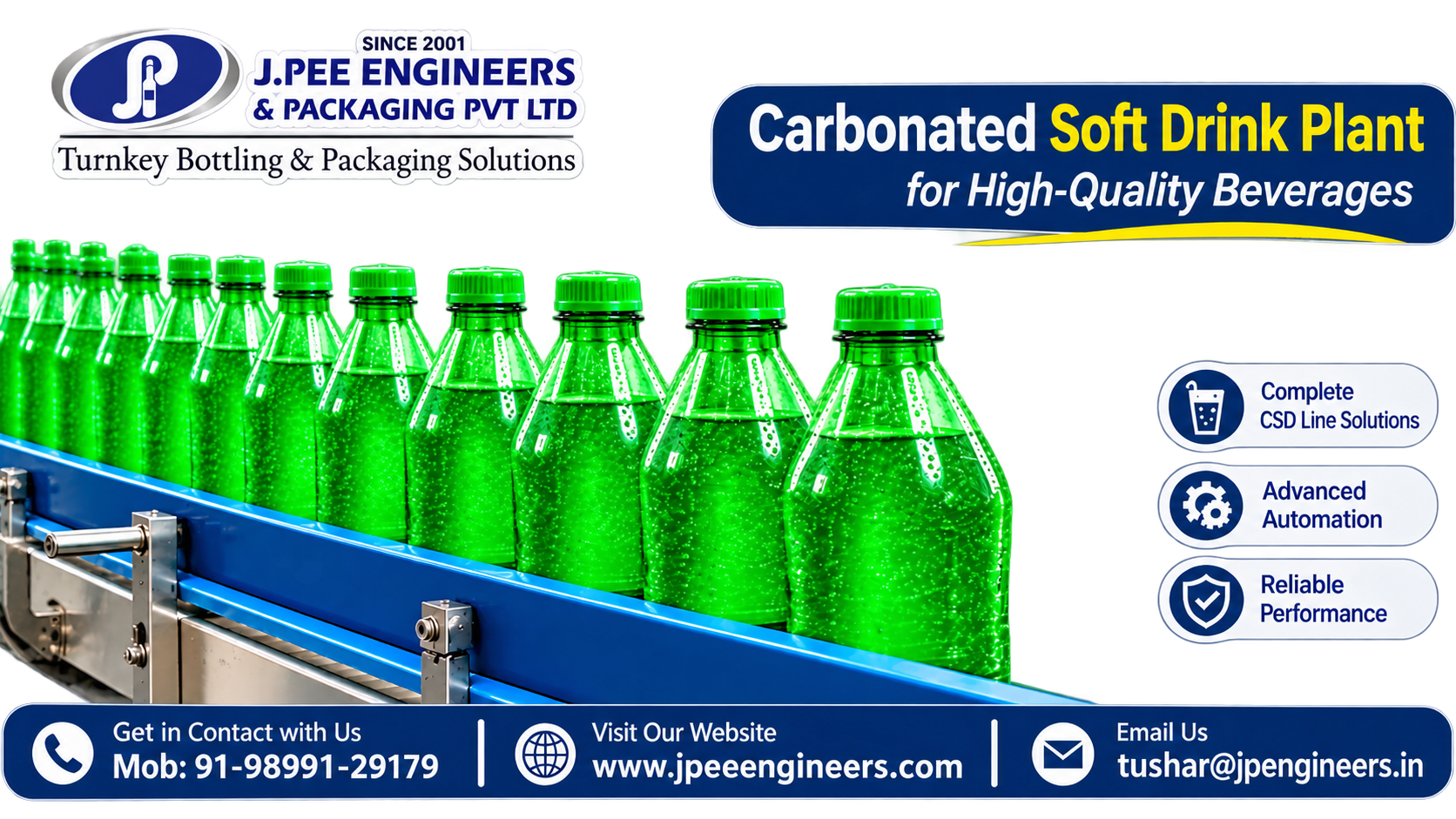
The Carbonated Soft Drink Plant solutions presented by JPEE Engineers cover these important production stages. The company describes integrated systems with PLC-based automation, stainless steel and food-grade materials, and configurations for PET bottles, glass bottles and cans.
Actual construction materials, automation features and equipment specifications should be confirmed for the selected project.
Objective
The objective of an integrated CSD production line is to maintain a coordinated workflow from beverage preparation to finished packaging.
In a manufacturing facility, problems in one section can influence other operations. For example, an interruption in syrup preparation may affect the availability of beverage for carbonation and filling. Similarly, an unsuitable filling arrangement can create difficulties in maintaining the intended carbonation characteristics.
Therefore, buyers should evaluate the complete production process rather than selecting individual machines without considering their integration.
A project assessment should cover the proposed beverage formulation, expected output, container specifications, production space, utilities and packaging requirements. This information helps equipment suppliers understand the intended application before recommending a configuration.
Benefits
Better process coordination: An integrated arrangement connects processing and packaging stages, helping manufacturers organise their production workflow.
Controlled beverage preparation: Properly planned syrup mixing and carbonation stages support the objective of maintaining consistent beverage characteristics.
Suitable packaging configurations: Depending on the machinery selected, production can accommodate PET bottles, glass bottles and cans.
Automation and monitoring: PLC-based automation can assist with coordinated equipment operation and process monitoring. The extent of automation should match the buyer's requirements.
Improved production planning: An integrated plant allows businesses to consider processing capacity, filling operations and packaging requirements together.
Scope for business expansion: Selecting machinery with future requirements in mind can help manufacturers plan upgrades and production changes more effectively.
When assessing CSD Plant Manufacturers, businesses should examine technical specifications, equipment compatibility, service arrangements and the supplier's understanding of carbonated beverage production.
Availability
The Indian beverage market includes businesses with different production models. Some manufacturers focus on regional distribution, while others develop larger facilities for wider markets. Their machinery requirements can differ considerably.
Businesses researching CSD Line Suppliers should compare the complete equipment configuration instead of relying only on the advertised production speed.
When approaching CSD Line Suppliers in India, buyers should discuss container handling, filling arrangements, carbonation requirements, automation and installation planning.
Companies considering overseas projects may also evaluate CSD Line Exporters. In such cases, equipment documentation, packing methods, transportation arrangements and commissioning support deserve attention.
Similarly, businesses comparing CSD Line Exporters in India should verify export experience, destination requirements, technical documentation and the availability of support after delivery. These checks can help buyers understand the practical responsibilities involved in an international machinery purchase.
About Us
JPEE Engineers & Packaging Pvt. Ltd. offers machinery and integrated systems for beverage processing, bottling and packaging applications. Its CSD line solutions address important stages of carbonated drink manufacturing, including water treatment, syrup preparation, carbonation, bottle rinsing, filling, capping and packaging.
The company describes PLC-based automation and configurations for different container formats. Its machinery planning approach can be discussed according to the buyer's production objectives and packaging requirements.
Call to Action
A successful beverage production project begins with a clear understanding of the manufacturing process. Before purchasing machinery, prepare your product requirements, preferred packaging format, expected output and factory infrastructure details.
Conclusion
Consistent carbonated beverage production depends on the coordination of processing, carbonation, filling and packaging operations. Manufacturers should assess equipment compatibility, automation requirements and technical support before selecting a plant configuration. A careful comparison of CSD Plant Manufacturers can help buyers make a more informed machinery investment.
FAQs
1. What equipment is included in a CSD production line?
A typical arrangement may include water treatment, syrup preparation, carbonation, bottle rinsing, filling, capping, labelling and packaging equipment.
2. How does carbonation influence soft drink quality?
Carbonation contributes to the fizz and sensory characteristics of a carbonated beverage. Maintaining suitable process conditions is important for consistency.
3. What is counter-pressure filling?
Counter-pressure filling is a filling approach used for carbonated beverages. It helps manage pressure differences during filling to support carbonation retention.
4. Can manufacturers choose between PET and glass bottles?
Yes, CSD line configurations can be planned for different container formats, including PET bottles and glass bottles. The specific equipment compatibility should be confirmed.
5. What role does PLC automation play?
PLC-based automation helps coordinate machine operations and provides process monitoring capabilities, depending on the installed configuration.
6. How should a buyer estimate the required plant capacity?
Buyers should consider expected market demand, working hours, packaging format, distribution plans and future production requirements before finalising capacity.
7. What should be discussed with the supplier before installation?
Confirm the factory layout, utility requirements, equipment connections, installation responsibilities, commissioning procedure, operator training and after-sales arrangements.



