

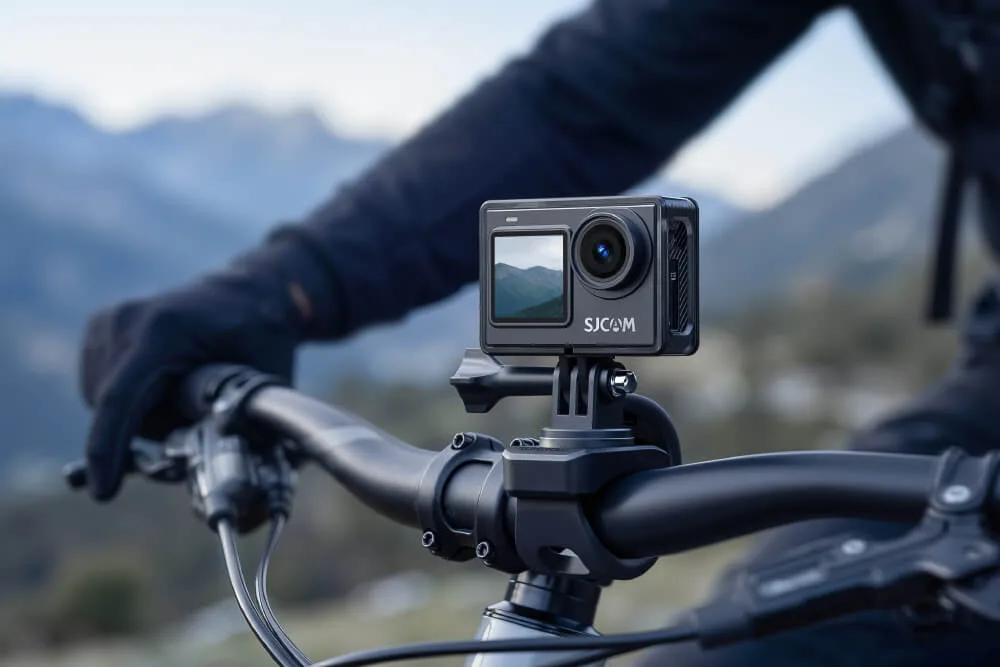

Helmet cameras have become essential gear for cyclists and motorcyclists alike. Whether you want to record your daily commute for safety, capture scenic rides for social media, or document close calls on the road, a helmet-mounted 4K action camera offers a first-person perspective that no handlebar mount can match. But choosing the right camera and setting it up correctly is not as simple as sticking any camera to your helmet. You need to consider mounting options, stabilization performance, weight distribution, and legal considerations.
In this guide, we will explore the top 4K action cameras for bikers, explain how to choose the best mounts, discuss why stabilization matters more than ever, and share practical tips for getting the most out of your setup. At the end, we will recommend a budget-friendly option that delivers excellent value: the SJCAM SJ6 Ultra.
Why Use a Helmet Camera?
A helmet camera provides a point-of-view (POV) perspective that mirrors what you see as a rider. This is invaluable for several reasons. First, it captures incidents exactly as they happen, which can be useful evidence in the event of an accident or dispute. Second, it allows you to record your rides hands-free, so you can focus on the road. Third, for content creators, helmet cameras offer an immersive angle that viewers love.
When shopping for 4K action cameras for bikers, helmet compatibility should be a top priority. Not every action camera is well-suited to helmet mounting. Weight, shape, and mount compatibility all play a role.
Understanding Helmet Mounts
The mount you choose can make or break your helmet camera experience. Here are the most common types:
1. Adhesive Mounts
Adhesive mounts are the most popular option for helmet cameras. They use a strong 3M adhesive pad to attach a mounting base directly to the helmet shell. You then clip the camera or a mounting bracket onto the base. Adhesive mounts are secure, low-profile, and work with most action cameras. However, they are semi-permanent; removing them can leave residue or damage the helmet finish.
2. Clamp Mounts
Clamp mounts attach to the edge of the helmet, often on the side or visor. They are easy to install and remove, making them a good choice if you use multiple helmets. However, they can be less secure on rough roads and may interfere with helmet aerodynamics.
3. Chin Mounts
Chin mounts are popular with motorcyclists because they place the camera at eye level, capturing a natural POV without adding weight to the top of the helmet. They are typically adhesive or strap-based and work best with full-face helmets. Chin mounts are aerodynamic and reduce wind drag.
4. Side and Top Mounts
Side mounts are common for cyclists, while top mounts are popular for vloggers. Top mounts can make the helmet feel top-heavy and may increase wind resistance, so they are less ideal for high-speed motorcycling.
When choosing a mount, consider the weight of the camera. A heavy camera on a lightweight helmet can cause discomfort and fatigue. Look for compact, lightweight 4K action cameras for bikers that won’t unbalance your helmet.
Stabilization: The Make-or-Break Feature
Helmet cameras are subjected to constant movement. Your head bobs and turns, the road vibrates, and wind buffets the camera. Without effective stabilization, your footage will be shaky and unwatchable.
Modern action cameras use electronic image stabilization (EIS) to counteract movement. Premium systems like GoPro’s HyperSmooth, DJI’s RockSteady, and Insta360’s FlowState use advanced algorithms and gyroscopes to smooth out bumps and vibrations. For helmet mounting, you want the best stabilization you can afford.
Some cameras also offer horizon lock, which keeps the horizon level even when you tilt your head. This is especially useful for motorcyclists who lean into turns.
If you are shopping on a budget, look for cameras with built-in gyro stabilization. It may not be as refined as premium systems, but it will make a noticeable difference.
Top 4K Helmet Cameras for Bikers
Here are some of the best 4K helmet cameras available today, ranging from premium to budget-friendly.
GoPro HERO12 Black
The GoPro HERO12 Black is the gold standard for action cameras. It offers 5.3K video, HyperSmooth 6.0 stabilization, and excellent low-light performance. It is compact, rugged, and works with a vast ecosystem of mounts. The downside is the price, which may be prohibitive for casual riders.
DJI Osmo Action 4
The DJI Osmo Action 4 is a strong competitor to GoPro. It offers 4K/120fps recording, RockSteady 3.0 stabilization, and a dual touchscreen design. It is waterproof without a case and has excellent battery life. It is slightly cheaper than the GoPro but still a premium option.
Insta360 Ace Pro
The Insta360 Ace Pro features a large sensor co-engineered with Leica, delivering excellent image quality. It offers 4K/120fps, FlowState stabilization, and a flip-up touchscreen. It is a great choice for vloggers and riders who want high-quality footage.
SJCAM SJ6 Ultra
The SJCAM SJ6 Ultra is a budget-friendly alternative that punches above its weight. It offers 4K/30fps recording, built-in gyro stabilization, and a 2.0-inch touchscreen. It is compact and lightweight, making it ideal for helmet mounting. It supports external microphones, which is a big plus for vloggers. While it may not match the stabilization of premium cameras, it delivers solid performance for daylight riding at a fraction of the price.
Tips for Using a Helmet Camera
Once you have chosen your camera and mount, follow these tips to get the best results:
- Test the angle before you ride. Mount the camera, turn it on, and check the field of view. You want to capture the road ahead and a bit of your handlebars or surroundings for context.
- Keep the lens clean. Dust, bugs, and rain can ruin footage. Carry a microfiber cloth and clean the lens regularly.
- Manage battery life. Helmet cameras typically last 60–90 minutes at 4K. Carry spare batteries or a power bank. Some cameras support USB-C power while recording.
- Reduce wind noise. Wind noise is a major issue at speed. Use a foam windscreen or an external microphone if your camera supports one. Some cameras have built-in wind noise reduction.
- Check local laws. In some regions, helmet cameras are restricted or require specific mounts. Always verify the legal requirements before riding.
- Prioritize safety. Never let the camera distract you from the road. Mount it securely and set it to record before you start riding.
Final Recommendation: SJCAM SJ6 Ultra
After reviewing the options, we believe the SJCAM SJ6 Ultra is an excellent choice for bikers who want a reliable 4K helmet camera without spending a fortune. It offers native 4K recording, gyro stabilization, a responsive touchscreen, and support for external microphones. Its compact, lightweight design makes it easy to mount on any helmet, and it comes with a range of accessories to get you started. While it may not match the stabilization of premium cameras, it delivers solid results for daylight riding and everyday use. For riders looking for affordable 4K action cameras for bikers, the SJCAM SJ6 Ultra is a smart, practical investment.
No matter which camera you choose, remember that the best helmet camera is the one you will actually use. Mount it securely, keep it charged, and enjoy capturing your rides in stunning 4K.



