


Picture the back office of a growing solar company in the middle of a busy season. A spreadsheet tracks forty active jobs. Eleven are waiting on drawings, nine are stuck in plan review, six came back with comments nobody has answered yet, and the rest are waiting on the utility. Sales keeps closing deals, crews are free next week, and yet nothing can be scheduled because the paperwork is a step behind.
That situation is not a people problem. It is usually a process problem, and it often starts when design and permitting are treated as separate tasks handled by different teams who never quite talk to each other. At PTOEdge, we built our workflow around the opposite idea: when the same team understands both the drawings and the approval process, projects move with fewer stalls. In this guide, we explain how design and permitting services fit together, what to expect at each stage, and how to choose a partner who actually shortens your timeline.
Got projects waiting on approvals right now? Discuss your next project with our team and find out where the delays are coming from.
What Are Solar Design and Permitting Services?
Solar design and permitting services cover the technical and administrative work required to get a solar system approved for construction and, later, approved to operate. Design is the engineering and drafting side: layouts, electrical diagrams, structural information, and equipment details. Permitting is the process side: assembling the application, submitting it to the local authority, answering reviewer comments, and tracking the file until a permit is issued.
On paper, these sound like two separate jobs. In practice, they are tightly linked. A drawing is only good if it satisfies the specific reviewer who will read it, and an application is only complete if the drawings inside it match the equipment, the utility requirements, and the local code. When the two are handled by different vendors, small mismatches creep in. A module count changes in one document but not another. A label required by the local fire department is missing. A form references an inverter model that was swapped during design. Each of these tiny gaps becomes a rejection, and every rejection adds days.
A complete package usually includes several elements. There is the plan set, which contains the site plan, roof layout, single-line diagram, notes, labels, and equipment sheets. There may be structural documentation, such as calculations or a letter confirming that the roof can carry the load. There are application forms, which differ from city to city and sometimes from department to department within the same city. And there are utility-related documents that connect the project to the grid.
Think of it as a chain. The sales proposal sets expectations, the design turns those expectations into a buildable plan, the permit application proves the plan is safe and compliant, and the utility process allows the finished system to switch on. Weakness at any link slows everything after it. That is why many contractors now prefer solar construction plan sets that are prepared with the permit process in mind from the very first sheet, rather than drawn first and adjusted later when comments arrive.
It also helps to remember who reads these documents. A plan checker may review dozens of solar submissions in a day. They are not looking for creativity. They are looking for the required items, in the expected places, with numbers that agree. A package that makes their job easy gets approved faster than one that forces them to hunt for information or ask questions.
Types of Solar Design and Permitting Services
Different projects call for different levels of support, and providers usually organize their offerings around a few categories.
Residential Rooftop Packages
These are the bread and butter of the industry. A typical residential package includes a roof layout, electrical diagram, labeling, and the forms needed for the local building department. Because homes vary widely, from simple gable roofs to complicated multi-plane layouts, even this category requires careful attention to setbacks, access paths, and electrical service details.
Commercial and Industrial Packages
Larger buildings add layers of complexity: flat roofs with ballast or penetrating mounts, existing rooftop equipment, three-phase electrical systems, and often stricter review processes. Commercial submissions may involve structural calculations, fire department coordination, and more detailed electrical documentation.
Ground-Mount and Carport Packages
Ground arrays and canopies behave more like small construction projects. They involve foundations, trenching, soil conditions, and sometimes zoning or site-plan review. Documentation typically needs engineering support, and approvals may involve more than one department.
Engineering Review and Sealed Documents
Many jurisdictions require a licensed engineer to review and seal certain documents, especially for structural or electrical elements. Depending on local rules, that may take the form of a letter, a calculation package, or fully sealed drawings. Having PE sealed solar drawings available from the same team that prepares the design removes one of the most common sources of delay, which is waiting on a third party who has never seen the project.
Battery Storage Packages
Energy storage adds new questions about location, fire separation, clearances, ventilation, and backup circuit design. Reviewers often look at these systems more closely, so the documentation must be thorough and consistent with the rest of the plan set.
Revisions and Resubmittals
Even a well-prepared package can come back with comments. Resubmittal services handle the corrections, update the documents, and send everything back for another review. The speed and quality of this step often matter as much as the original submission.
Utility Interconnection Support
After a project is built and inspected, the utility must approve the system before it can operate. This stage involves its own applications, documentation, and timelines, and it is where many otherwise finished systems end up waiting.
Benefits of Combining Design and Permitting
Bundling these services is not just about convenience. The advantages show up in measurable ways across the business.
Fewer disconnects between documents. When the same team prepares the drawings and the application, details stay consistent. Equipment models, module counts, wire sizes, and labels match from the first page to the last, which cuts down on the small errors that trigger rejections.
Shorter back-and-forth cycles. If a reviewer asks a question, the team that drew the plans can answer it immediately instead of passing messages between vendors. That alone can save days on every correction round.
Local knowledge that compounds. Every submission teaches a team something about a particular jurisdiction: which reviewers want extra detail, which forms are outdated, which labels are always required. A team that handles both design and permitting for the same areas builds that knowledge faster and applies it to future projects.
Better scheduling for crews. Predictable approvals mean you can book installation dates with confidence. That reduces idle crew time, last-minute rescheduling, and the awkward conversations with customers who were promised a date and cannot get one.
Lower administrative load. Your staff spends less time chasing status updates, filling out forms, and answering reviewer questions. That frees them for work that actually grows the business.
A stronger sales promise. When your salespeople can tell customers that design and approvals are handled by a dedicated team, they can speak with more confidence about timelines. Support such as accurate solar proposal support also helps ensure that what is promised in the proposal matches what can actually be built and approved.
More predictable cash flow. Installers get paid at milestones, and approvals are often the gate to the next one. Faster, more reliable permitting shortens the time between signing a contract and collecting revenue.
Key Features and Factors That Matter
When you compare providers, a handful of qualities separate dependable partners from risky ones.
Jurisdiction Experience
Local rules vary dramatically. One city may accept a simple checklist for a small rooftop system, while the neighboring one demands full structural documentation. Ask which areas the provider handles most often and how they keep track of changing requirements.
Accuracy of Inputs and Outputs
Everything downstream depends on good measurements and reliable data. A provider should have a clear process for verifying roof dimensions, electrical service details, and equipment specifications before drawings are finalized. Equally important is internal quality control, so inconsistencies are caught before submission.
Electrical and Structural Competence
Design is not just drawing. It requires an understanding of busbar ratings, breaker sizing, conductor selection, load paths, and attachment spacing. Providers who know these details can spot problems, such as a panel upgrade requirement, before they become inspection failures.
Technology and Workflow
The tools a provider uses influence speed, consistency, and how smoothly information moves between teams. If your company already works with specific design platforms, ask whether the provider can integrate with them. Access to practical solar design app tools can also help standardize layouts, reduce manual entry, and keep documents aligned.
Submission and Tracking
Permitting is not finished when the application is sent. Someone needs to monitor the status, respond to questions, and push the file forward when it stalls. Ask how the provider tracks submissions and how often you receive updates.
Revision Handling
Corrections are a normal part of the process. Understand whether revisions are included in the price, how quickly updated documents are returned, and who communicates with the reviewer.
Communication
You want a partner who flags problems early, answers questions clearly, and treats your deadlines as real. A responsive contact person is often worth more than a slightly lower price.
Transparent Pricing
Unclear fees for rush work, extra sheets, or resubmittals can erode trust quickly. Look for straightforward terms that explain what is included and what is not.
How the Process Works, and How to Choose a Partner
Although each company has its own workflow, most reliable processes follow a similar sequence.
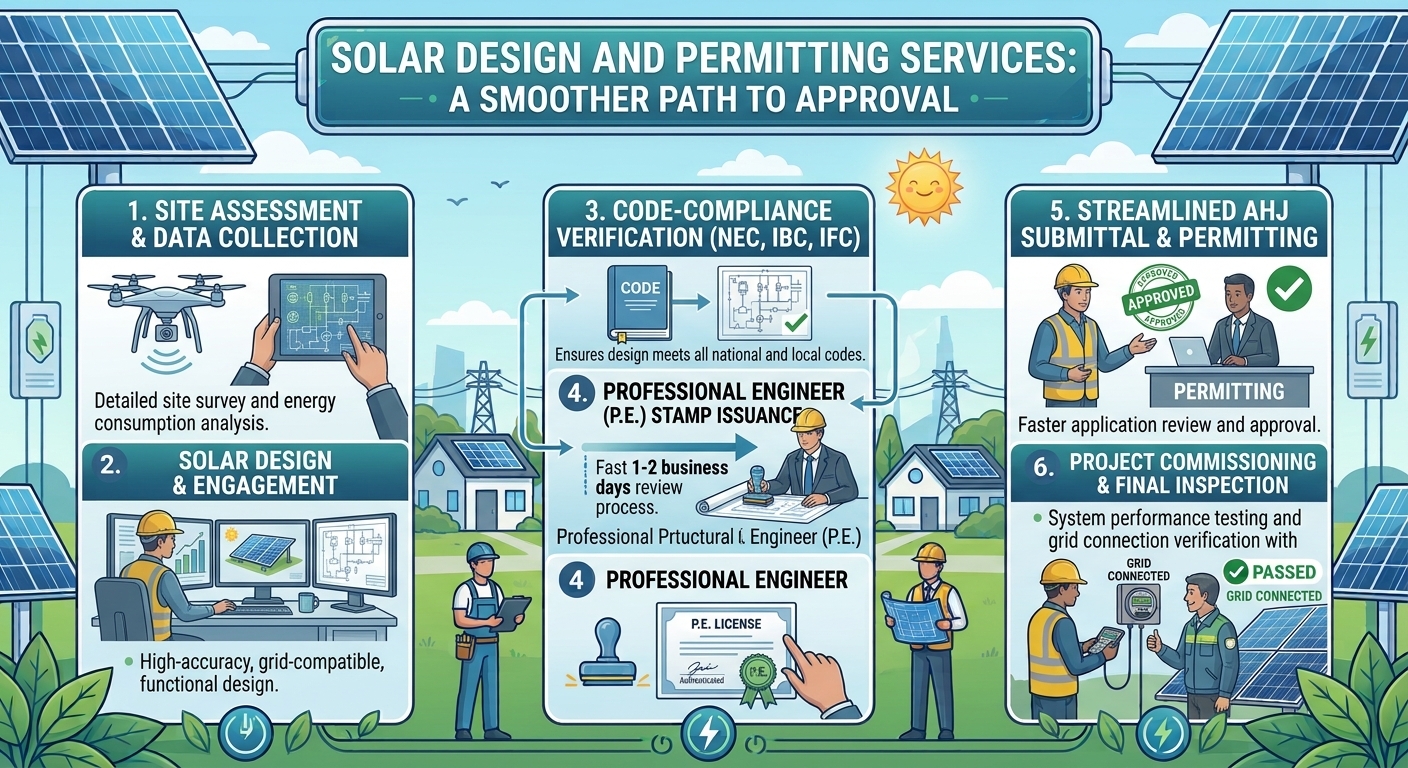
1. Project intake. You submit the basic project information: address, utility, equipment choices, roof photos, measurements, and electrical details. The more complete this is, the faster everything else moves.
2. Site and requirements review. The team checks the roof, the electrical service, and the requirements of the local jurisdiction and utility. This is where potential issues, such as a small main panel or an unusual setback rule, should be flagged.
3. Design development. The layout and electrical design are created, balancing production, practicality, and code compliance. Equipment selections are confirmed and documented.
4. Engineering where needed. If the jurisdiction requires structural or electrical engineering, calculations are completed and documents are sealed.
5. Package assembly. Drawings, forms, and supporting documents are compiled into a submission-ready package. Consistency checks catch mismatches before anything goes out.
6. Submission and tracking. The package is filed with the authority having jurisdiction, and the status is monitored. With reliable solar permit approval support, someone owns the follow-up instead of assuming the reviewer will reach out.
7. Comments and corrections. If the reviewer requests changes, the documents are updated and resubmitted as quickly as possible.
8. Permit issuance and handoff. Once approved, the permit goes to the installer so construction can begin, and the team prepares for the later utility steps.
Choosing the Right Partner
Start by measuring your current situation. How long do projects typically wait between contract and permit? How often do submissions come back with comments? Where do the delays happen most? Those answers reveal whether you need more capacity, better quality, or simply better coordination.
Then test candidates with real projects. Send a small batch that includes a few easy jobs and a few complicated ones, and watch how the provider handles each. Pay attention to accuracy, communication, and how they respond when something goes wrong. A strong sales pitch tells you little; a handful of real submissions tells you a lot.
Finally, think about where your business is going. If you plan to enter new regions or take on larger projects, choose a partner who can grow with you. Changing vendors in the middle of expansion creates exactly the kind of disruption you are trying to avoid.
Applications and Real-World Uses
Integrated design and permitting support shows up in many everyday situations.
Busy-season overflow. When contracts pile up faster than your internal team can draw and file them, an outside partner absorbs the surge without forcing you to hire temporary staff.
New market entry. Expanding into a new county or state means learning unfamiliar rules. A provider who already works there gives you a head start and reduces costly early mistakes.
Complex residential projects. Steep roofs, tile surfaces, older electrical panels, and battery additions all benefit from careful design and well-prepared documentation.
Commercial rooftops and carports. Larger systems involve more reviewers, more calculations, and more coordination. Professional support keeps these projects organized and moving.
Recovering rejected submissions. When a package comes back with a long list of comments, an experienced team can sort through them, correct the documents, and resubmit efficiently.
Smaller installers without in-house design. Companies that do not employ designers or permit coordinators can still deliver professional, compliant projects by relying on a dedicated partner.
Final utility approval. After construction and inspection, the system still needs authorization to operate. Reliable solar PTO application support helps move finished systems onto the grid instead of leaving them idle while paperwork catches up.
Why Choose PTOEdge for Solar Design and Permitting Services?
Contractors do not need another vendor that hands over drawings and moves on. They need a partner who stays with the project until it is approved. That is the approach behind PTOEdge.
We support the full path from planning to energization. Our team prepares the drawings, coordinates engineering when it is required, assembles and files the applications, tracks the review, and helps projects through the utility stage. Because the same people understand each step, information stays consistent and problems get caught earlier. If a design detail changes, it is updated everywhere, not just in one document.
Here is what that looks like in practice:
- One team across the process. Design, permitting, and utility support work together instead of passing files between disconnected vendors.
- Documentation built for reviewers. Our engineered solar drawing packages are organized so plan checkers can find what they need quickly, which helps reduce avoidable comments.
- Honest communication. If something will cause trouble, such as a roof that cannot support the planned layout or a panel that needs an upgrade, you hear about it early.
- Attention to follow-up. We do not submit a package and hope for the best. Someone keeps track of the file and responds when reviewers ask questions.
- Flexibility for different business sizes. Whether you complete a few projects a month or manage a large pipeline, the process can adapt to your volume.
PTOEdge exists to take the paperwork burden off installers so they can focus on selling and building. When design and approvals are handled by people who work together, projects move faster, crews stay busy, and customers stay happy.
Conclusion
Solar design and permitting are two halves of the same job. Good drawings without good permitting stall at the counter, and good permitting without accurate drawings produces endless corrections. When the two are handled together, the result is cleaner submissions, fewer surprises, and a more predictable path from contract to energization.
The best way to choose a partner is to focus on practical questions. Do they know your jurisdictions? Are their documents accurate and consistent? Do they follow up on submissions? Can they support you through the utility stage? Test them with real projects, look at the results, and choose the team that makes your business easier to run.
Ready to stop losing weeks to paperwork? Request a project review and let PTOEdge take a look at your next submission.
Frequently Asked Questions (FAQs)
What is included in solar design and permitting services?
These services typically include preparing the plan set, handling engineering requirements, assembling application forms, submitting the package to the local authority, responding to reviewer comments, and supporting the utility approval process. The exact scope varies by provider and project type.
Why is it better to handle design and permitting together?
When one team handles both, the drawings and applications stay consistent, and questions from reviewers are answered faster. Separate vendors often introduce mismatches between documents, which can lead to rejections and delays.
How long does solar permitting usually take?
Timelines depend on the jurisdiction, the project type, and the quality of the submission. Some areas approve simple residential systems quickly, while others take much longer. Complete and accurate documentation is the best way to avoid unnecessary delays.
What happens if my submission is rejected or receives comments?
The reviewer will list the items that need correction. Your design and permitting provider then updates the documents, addresses each comment, and resubmits the package. It is worth confirming in advance whether corrections are included in the service price.
Do I need engineering documents for every solar project?
Not always. Some jurisdictions accept standard documents for typical rooftop systems, while others require engineering letters, calculations, or sealed drawings, especially for ground mounts, commercial systems, or battery installations. Always check the local requirements before submitting.



