


Quick Summary
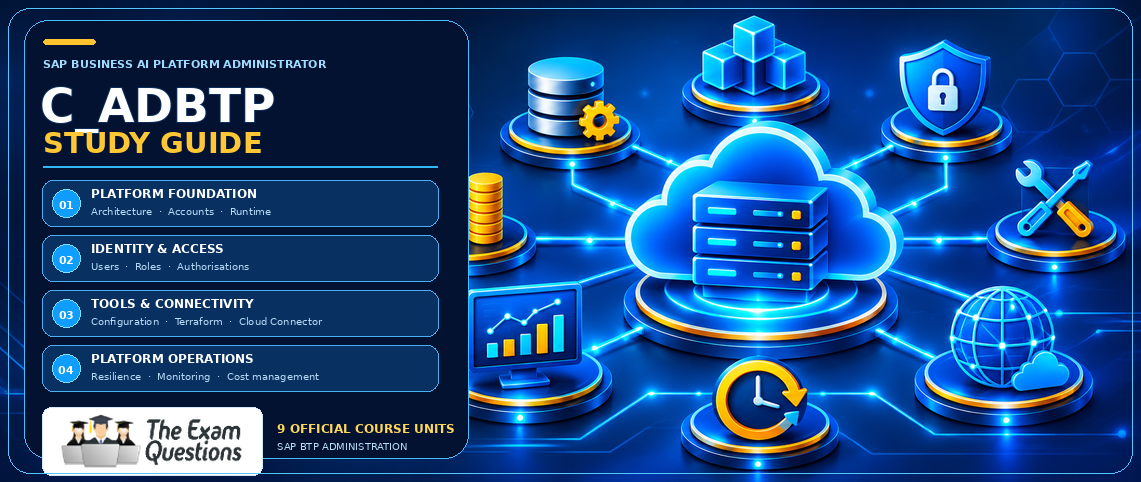
The C_ADBTP certification covers practical SAP BTP administration, including account management, runtime environments, identity, connectivity, configuration, and platform operations. This study guide organises the key technical concepts into manageable sections so you can revise effectively and see how administration functions work together.
Introduction to the SAP Business AI Platform Administrator study plan
Managing SAP Business Technology Platform (SAP BTP) environments takes technical knowledge and administrative skill. Professionals responsible for these environments need to understand account structures, user permissions, runtime configurations, connectivity, and operational monitoring.
The C_ADBTP Study Guide supports candidates preparing for the SAP Certified – SAP Business AI Platform Administrator certification. It offers a structured way to review the main technical subjects and understand the relationships between platform components.
SAP's recommended Operating SAP Business AI Platform course contains nine units covering the major administration responsibilities. Study these areas with an emphasis on practical application, and treat definitions as supporting material.
A good understanding of the platform also makes it easier to identify configuration problems, interpret system behaviour, and complete administrative tasks accurately.
Essential concepts to understand
SAP BTP architecture and administration
Begin with the foundation of SAP BTP. Understand how the platform supports application development, integration, extension, and business operations.
Important concepts to review include:
- SAP BTP architecture and administration responsibilities.
- Global accounts, directories, and subaccounts.
- Service entitlements and quotas.
- Runtime environments and service subscriptions.
- Platform governance and operational management.
Pay attention to how account structures influence the availability of services and administrative permissions. This relationship helps when working with larger SAP environments.
Account structure and service management
Account management covers creating subaccounts and also how platform services are allocated and governed.
Revise the differences between global accounts, directories, and subaccounts. Understand how entitlements control the availability of services and how quotas affect their consumption.
A useful way to study this topic is to picture a company with separate development, testing, and production environments. Consider how administrators organise these environments and manage service access while keeping responsibilities clearly separated.
Runtime environments
SAP BTP supports different runtime environments for application execution.
Focus on Cloud Foundry, Kyma, and ABAP environment concepts. Understand their purposes, how applications operate within them, and what administrators manage. Go beyond their names and understand the differences in their operating models and configuration requirements.
Identity and access management
Identity and access management is a major component of platform administration.
Revise these concepts:
- User and role administration.
- Role collections and authorisations.
- Authentication and identity providers.
- SAP Cloud Identity Services.
- User provisioning.
- Identity federation and access management.
Understand the difference between authentication and authorisation. Authentication establishes who a user is, and authorisation determines which actions that user can perform.
Also examine how role assignments affect access to applications and services. This knowledge helps when investigating permission errors or managing access across multiple subaccounts.
Setup and configuration tools
Administrators use different tools to configure and maintain SAP BTP environments. Important areas include SAP BTP Cockpit, command-line interfaces, automation tools, and Terraform.
Understand the purpose of infrastructure as code and how automated configuration supports consistent administration. Review the roles of Cloud Foundry CLI, Kubernetes CLI, and SAP BTP command-line capabilities, and focus on when each tool is useful so that commands connect to a clear purpose.
Platform connectivity and Cloud Connector
Connectivity allows SAP BTP applications to communicate with external services and on-premise systems.
Study destinations, connectivity configuration, and SAP Cloud Connector. Understand how secure connections are established and why administrators configure communication paths with care.
For revision, consider an application that cannot communicate with an internal business system. Identify the connection settings and components that could cause the problem.
High availability and disaster recovery
High availability and disaster recovery help organisations maintain operational continuity.
Understand the purpose of availability planning, recovery procedures, and disaster preparedness. Focus on how administrators reduce the impact of interruptions and why recovery planning is an important part of cloud operations.
Observability and monitoring
Observability provides information about platform behaviour and helps administrators investigate operational problems.
Revise SAP BTP's observability strategy, monitoring capabilities, logs, and troubleshooting concepts. Understand how operational information helps identify unusual behaviour and narrow down the possible cause of an issue.
A useful revision exercise is to list the information an administrator would inspect when investigating an application or service problem.
Cost and usage management
The final major area concerns platform consumption and cost governance.
Understand account consumption, service usage, entitlements, quotas, and cost monitoring. Administrators review platform usage and recognise when service consumption needs attention. Also understand how service allocation and account governance influence overall platform management.
How to connect the technical concepts
The administration subjects become clearer when you study them together.
Consider an organisation that wants to deploy an application in a new SAP BTP subaccount. The administrator understands the account structure, assigns the necessary entitlements, configures the runtime environment, establishes user permissions, and confirms connectivity with the required systems.
Once the application is running, monitoring helps identify operational issues, and consumption information provides visibility into service usage.
This example connects several areas of the syllabus and shows why administrators need a broad understanding of the platform.
A structured revision framework
Use this framework to organise your revision:
- Platform fundamentals: architecture, accounts, and administration.
- Environment management: runtime environments and configuration.
- Security: identity, authentication, and authorisations.
- Connectivity: destinations and Cloud Connector.
- Operations: availability, disaster recovery, and monitoring.
- Governance: cost, consumption, and service management.
For every subject, make sure you can explain the concept, identify its administrative purpose, locate the relevant configuration, and recognise common problems.
Prioritise areas where you still need help performing tasks independently. Identity management, account configuration, and connectivity work well for connected practical revision.
Preparing for the system-based assessment
The SAP official certification page currently lists a two-hour duration, one system-based activity, and a 100% passing score.
Since the assessment involves practical work, familiarity with the examination environment is valuable. SAP's recommended administration course includes access to a practice system. Use it to become comfortable with the available interfaces and administrative activities.
During revision, practise navigating the platform, understanding task requirements, making appropriate configuration changes, and checking the resulting system state.
Remembering a procedure is a useful start, and understanding the purpose of each action takes you further. Learn how to recognise whether the expected result has been achieved.
Before the actual assessment, review the technical readiness instructions, verify your SAP Universal ID, and check your available examination attempts.
Frequently asked questions about SAP BTP administrator revision
What subjects should candidates revise?
Review SAP BTP architecture, account management, runtime environments, identity and access management, configuration tools, connectivity, disaster recovery, monitoring, and cost management.
Is the recommended SAP administration course mandatory?
SAP recommends completing the associated courses and practical exercises. Its practical examination guidance states that completing the entire course is optional for attempting the assessment.
How much time does the recommended course require?
The current Operating SAP Business AI Platform course has an estimated duration of 17 hours and 39 minutes across nine units.
Can candidates use SAP documentation during the assessment?
SAP's practical examination approach allows candidates to consult permitted publicly available information, subject to the assessment instructions.
What is the best way to revise practical administration concepts?
Use an authorised practice environment, repeat relevant configuration activities, and check the results. Focus on understanding how different platform settings interact.
Conclusion
A strong understanding of SAP BTP administration grows from seeing technical terminology in action. Candidates should understand account structures, runtime environments, identity, connectivity, configuration tools, monitoring, and cost management as connected parts of platform operations.
This study guide provides a structured revision framework for reviewing those subjects and developing practical confidence. Concentrate on administrative responsibilities, practise relevant configurations, and investigate common problems before attempting the certification.
Strengthen your certification preparation
Use this study guide alongside the recommended SAP administration course and practical exercises. Review areas where your technical understanding needs improvement, practise working with SAP BTP configurations, and build confidence in handling administrative tasks independently. For more C_ADBTP practice material, visit The Exam Questions.



