

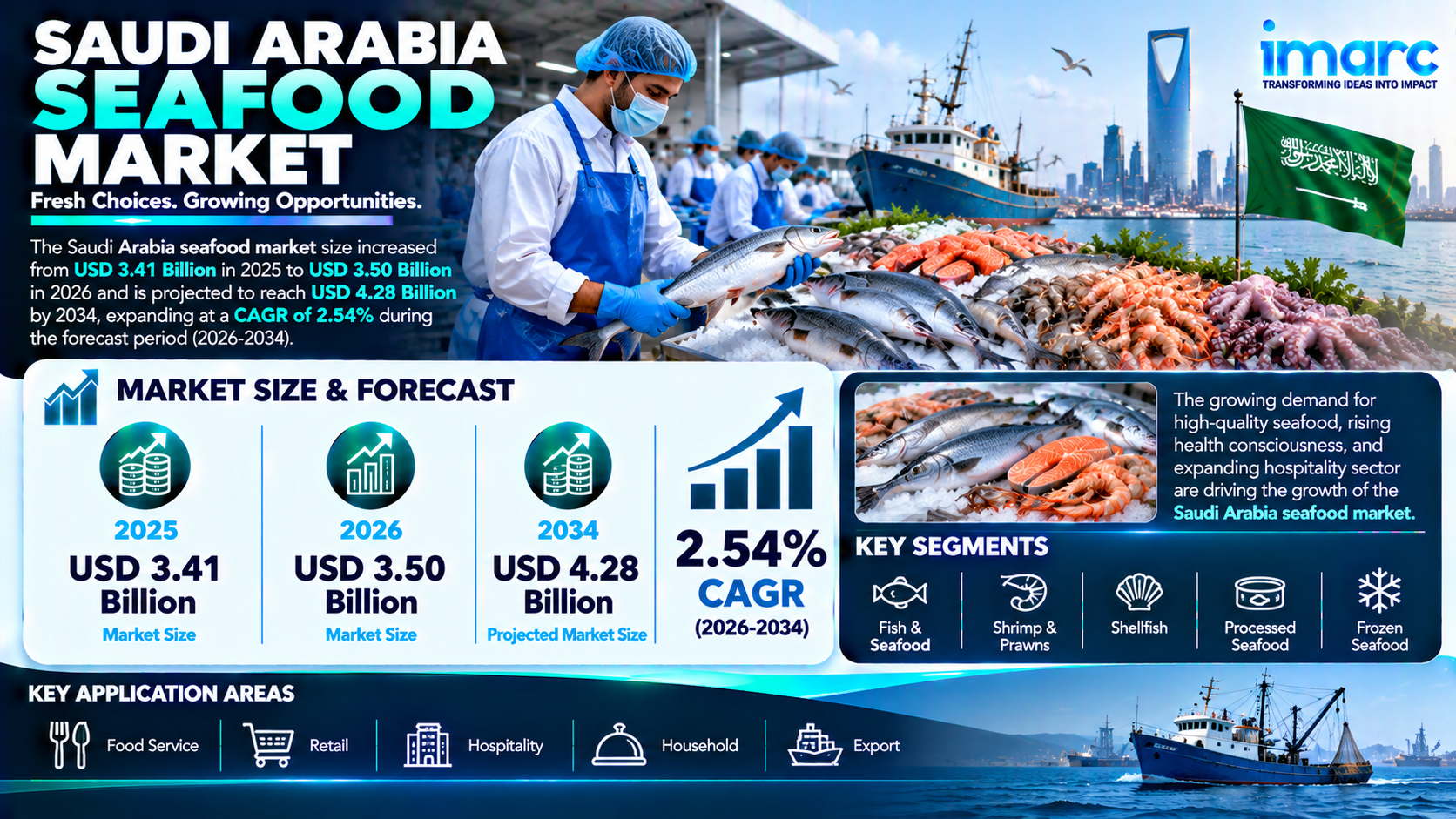

IMARC Group, a leading global market research and management consulting firm, has published its latest market intelligence report on the Saudi Arabia seafood market. The Saudi Arabia seafood market size increased from USD 3.41 Billion in 2025 to USD 3.50 Billion in 2026, and is projected to reach USD 4.28 Billion by 2034, exhibiting a CAGR of 2.54% during 2026-2034, driven by Vision 2030 food security and aquaculture investments, rising health consciousness, and rapid tourism and hospitality sector expansion.
Seafood benefits from the deep cultural tradition of fish consumption across the Kingdom, with Saudi Arabia's 7,572 km coastline across the Red Sea and the Arabian Gulf, of which approximately 2,400 km is suitable for aquaculture development, anchoring both wild-catch supply and domestic farming ambitions. The market is forecast to add USD 0.78 Billion in incremental value between 2026 and 2034, with three structural forces shaping this trajectory: the Vision 2030 aquaculture scale-up toward 600,000 tons of domestic production, a premiumization shift toward sustainable and value-added seafood, and the mainstreaming of online and dark kitchen seafood delivery.
Saudi Arabia Seafood Market at a Glance:
- Market Size (2025): USD 3.41 Billion
- Market Size (2026): USD 3.50 Billion
- Forecast Market Size (2034): USD 4.28 Billion
- CAGR (2026-2034): 2.54%
- Leading Type (2025): Fish, 48.6% share
- Leading Distribution Channel (2025): Off-Trade, 63.5% share
How AI is Reshaping the Future of the Saudi Arabia Seafood Market
- IoT-Enabled Cold Chain and Freshness Monitoring: IoT temperature sensors, smart refrigeration systems, and blockchain-based provenance tracking are being deployed to maintain 0-2°C conditions across the supply chain, protecting product quality and reducing spoilage as domestic aquaculture output scales toward Vision 2030 targets.
- Recirculating Aquaculture Systems (RAS): Closed-loop water management technology has become the foundation of the Kingdom's desert aquaculture expansion, enabling efficient fish and shrimp farming in an arid climate with high water recycling efficiency.
- AI-Driven Last-Mile Seafood Delivery: GPS-tracked refrigerated delivery, AI-driven demand forecasting integrated with fish souks, and customer-facing freshness scoring apps displaying catch date, origin, and storage time are emerging as online seafood purchasing gains traction among urban Saudi consumers.
Grab a sample PDF of this report: https://www.imarcgroup.com/saudi-arabia-seafood-market/requestsample
Saudi Arabia Seafood Market Trends and Drivers:
Vision 2030's food security strategy is the foundational driver behind the market's long-term outlook, with national projects aiming to expand aquaculture production from 80,000 tons in 2018 to 600,000 tons by 2030, while seafood consumption is projected to rise approximately 7.4% annually through 2030. Fish leads the type mix at 48.6% share in 2025, reflecting the deep cultural significance of hamour and other Red Sea species alongside growing demand for imported Norwegian salmon and tilapia, while Shrimp, at 32.4% share and growing at approximately 3.1% CAGR, is the fastest-growing type on the back of the National Aquaculture Group's Red Sea shrimp farming expansion.
Tourism and hospitality expansion is compounding this supply-side transformation with rising institutional demand. Saudi Arabia welcomed 116 million domestic and inbound tourists in 2024, driving commensurate growth in hotel and restaurant seafood procurement, while a national obesity rate of 35.5% is accelerating the dietary shift toward lean protein sources. Almunajem Foods Co. received regulatory approvals in May 2025 to commence operations of its logistics subsidiary, Optimal Solution for Logistics Services Co. (Loadly), while National Aquaculture Group announced plans in November 2023 to increase seafood output by more than 400% over seven years, both reinforcing the supply chain investment race underway across the Kingdom.
Retail modernization and consumer lifestyle change are reshaping distribution economics on top of these demand drivers. The Western Region's dominant 29.6% share in 2025 reflects Jeddah's status as the Kingdom's seafood capital and primary import gateway, while the Eastern Region, though second at 26.3% share, is the fastest-growing region at approximately 2.9% CAGR, supported by its large expatriate community and industrial workforce. The working women population rising from 17% in 2015 to 36.2% in Q3 2024 is simultaneously accelerating demand for marinated, portion-cut, and ready-to-cook seafood across supermarket categories.
Government Schemes and Vision 2030 Initiatives Driving Demand:
- National Aquaculture Strategy: A core Vision 2030 food security program targeting 600,000 tons of domestic aquaculture and fisheries production by 2030, backed by investment incentives and MEWA technology transfer partnerships that are steadily reducing the Kingdom's import dependence.
- Aquaculture Industrial Licensing: The Ministry of Industry and Mineral Resources issued 158 industrial licenses in October 2023 covering shrimp, fish, oyster, and pearl oyster operations, expanding the domestic production base across both coasts.
- Agricultural Development Fund and SALIC Investment: MEWA's Agricultural Development Fund and the Saudi Agricultural and Livestock Investment Company are actively evaluating upstream aquaculture partnerships, attracting growing venture and institutional capital into the sector.
- SFDA Halal and Food Safety Framework: Mandatory Halal certification and end-to-end traceability requirements for all processed seafood are driving investment in RFID-tagged crates, electronic catch certificates, and blockchain-based supply chain verification systems.
- Jizan Economic City Food Processing Zone: Jizan Economic City's food processing zone is attracting Indian and Thai operators seeking halal-certified processing capacity for GCC distribution, positioning the Southern Region as an emerging export-oriented seafood hub.
Saudi Arabia Seafood Industry Segmentation:
The report has segmented the market into the following categories:
Breakup By Type:
- Fish
- Shrimp
- Others
Fish commands a 48.6% majority share in 2025, reflecting deep cultural resonance across the Red Sea and Arabian Gulf coastal communities and the growing availability of premium imported species. Shrimp holds 32.4% and grows at approximately 3.1% CAGR, driven by domestic aquaculture expansion and rising restaurant and hospitality demand, while Others at 19.0% cover crab, squid, octopus, lobster, and shellfish served predominantly in premium restaurants and hotels.
Breakup By Form:
- Fresh / Chilled
- Frozen / Canned
- Processed
Breakup By Distribution Channel:
- Off-Trade
- Convenience Stores
- Online Channel
- Supermarkets and Hypermarkets
- Others
- On-Trade
Off-Trade channels dominate at 63.5% share in 2025 and grow at approximately 2.7% CAGR, as dedicated fresh fish counters become standard in hypermarkets and frozen seafood aisles expand across modern retail. On-Trade holds 36.5% and grows at approximately 2.3% CAGR, supported by large-scale catering for NEOM and giga-project workforce camps alongside restaurant and hotel demand.
Breakup By Region:
- Northern and Central Region
- Western Region
- Eastern Region
- Southern Region
The Western Region commands 29.6% share in 2025, driven by Jeddah's Islamic Port, the Kingdom's primary seafood import gateway, and extraordinary Hajj and Umrah demand spikes across Makkah and Madinah. The Eastern Region follows at 26.3% and is the fastest-growing at approximately 2.9% CAGR on its large expatriate community and industrial workforce, while the Northern and Central Region holds 24.1% on Riyadh's metropolitan population exceeding 8 million, and the Southern Region's 20.0% share benefits from the Jizan coastal fishing tradition and emerging agri-food investment.
Competitive Landscape:
The Saudi Arabia seafood market is moderately fragmented, with integrated food distributors competing alongside domestic aquaculture producers and specialist seafood importers. The report provides detailed profiles of all major companies, including:
- Almunajem Foods
- National Aquaculture Group (NAQUA)
- Arab Fisheries CO.
- IZAFCO LLC
- Shell Fisheries
Almunajem Foods leads through its integrated import, distribution, and retail model, while NAQUA anchors domestic production as the Kingdom's largest aquaculture producer and a Vision 2030 strategic partner. Arab Fisheries and IZAFCO maintain strong positions in commercial fishing and frozen seafood distribution respectively, while Shell Fisheries serves the upscale restaurant and hotel segment. The top five players collectively account for approximately 40% of market revenue, and competitive differentiation is increasingly driven by cold chain ownership, import supplier relationships, and brand recognition in modern retail.
Market Concentration Analysis:
- Fragmentation: The market is moderately fragmented; the top five companies collectively account for approximately 40% of total revenue, with hundreds of regional importers, souk operators, and artisanal fishing cooperatives sharing the remainder
- Segment Leadership: Almunajem Foods and NAQUA lead as market leaders, with NAQUA anchoring domestic shrimp and barramundi production and Almunajem dominating integrated import and distribution
- Structural Trend: Domestic aquaculture scale-up is expected to reshape brand and pricing dynamics, with Saudi-branded shrimp and fish commanding price premiums over imports, while the informal fish souk sector gradually formalizes under Vision 2030 modernization
What Does The Full Report Cover?
If you are tracking the Saudi Arabia seafood market for investment decisions, market entry planning, competitive benchmarking, or strategic advisory, IMARC Group's report gives you everything in one place:
- Complete market sizing in value terms with forecasts covering the full 2026-2034 projection period
- Quantified analysis of market drivers, restraints, challenges, and opportunities across type, form, distribution channel, and regional markets
- Sub-segment breakdowns for three types, three forms, two distribution channel groups, and four regions, each with individual share and CAGR data
- Competitive profiles of Almunajem Foods, National Aquaculture Group, Arab Fisheries, IZAFCO, and Shell Fisheries with strategic positioning analysis
- Value chain analysis, market concentration assessment, Porter's five forces, and technology landscape coverage across aquaculture, cold chain, and traceability innovation
- Latest trends covering premium and sustainable seafood, dark kitchen delivery, ready-to-cook products, and giga-project hospitality demand shaping market competition across the Kingdom
Recent News and Developments in Saudi Arabia Seafood Market
- May 2025: Almunajem Foods Co. received the necessary approvals from the relevant authorities to commence operations of its previously approved limited liability subsidiary, Optimal Solution for Logistics Services Co. (Loadly), strengthening its logistics and cold chain capabilities.
- November 2023: National Aquaculture Group (NAQUA) announced plans to increase its seafood output by more than 400% over the next seven years, supporting the Kingdom's Vision 2030 domestic aquaculture scale-up.
- October 2023: Saudi Arabia's Ministry of Industry and Mineral Resources issued 158 industrial licenses covering shrimp, fish, oyster, and pearl oyster operations, broadening domestic aquaculture capacity across the Kingdom.
Note: If you require specific details, data, or insights that are not currently included in the scope of this report, we are happy to accommodate your request. As part of our customization service, we will gather and provide the additional information you need, tailored to your specific requirements. Please let us know your exact needs, and we will ensure the report is updated accordingly to meet your expectations.
Key Questions This Report Answers
- What is the current Saudi Arabia seafood market size and what is its projected value?
- Which type and distribution channel hold the largest share in the Saudi Arabia seafood market?
- What are the key drivers of Saudi Arabia seafood market growth?
- Which region dominates the Saudi Arabia seafood market and which is growing fastest?
- How is Vision 2030's aquaculture program reshaping the Saudi Arabia seafood industry?
- Who are the top companies in the Saudi Arabia seafood market and what are their competitive strategies?
- What are the investment and market entry opportunities across RAS aquaculture, processed seafood, e-commerce delivery, and halal-certified export processing in Saudi Arabia?
About Us
IMARC Group is a global management consulting firm that helps the world's most ambitious changemakers to create a lasting impact. The company provides a comprehensive suite of market entry and expansion services. IMARC offerings include thorough market assessment, feasibility studies, company incorporation assistance, factory setup support, regulatory approvals and licensing navigation, branding, marketing and sales strategies, competitive landscape and benchmarking analyses, pricing and cost research, and procurement research.
Media and Sales Contact
IMARC Group
Email: sales@imarcgroup.com
United States: +1-201-971-6302
India: +91-120-433-0800
United Kingdom: +44-753-714-6104



