

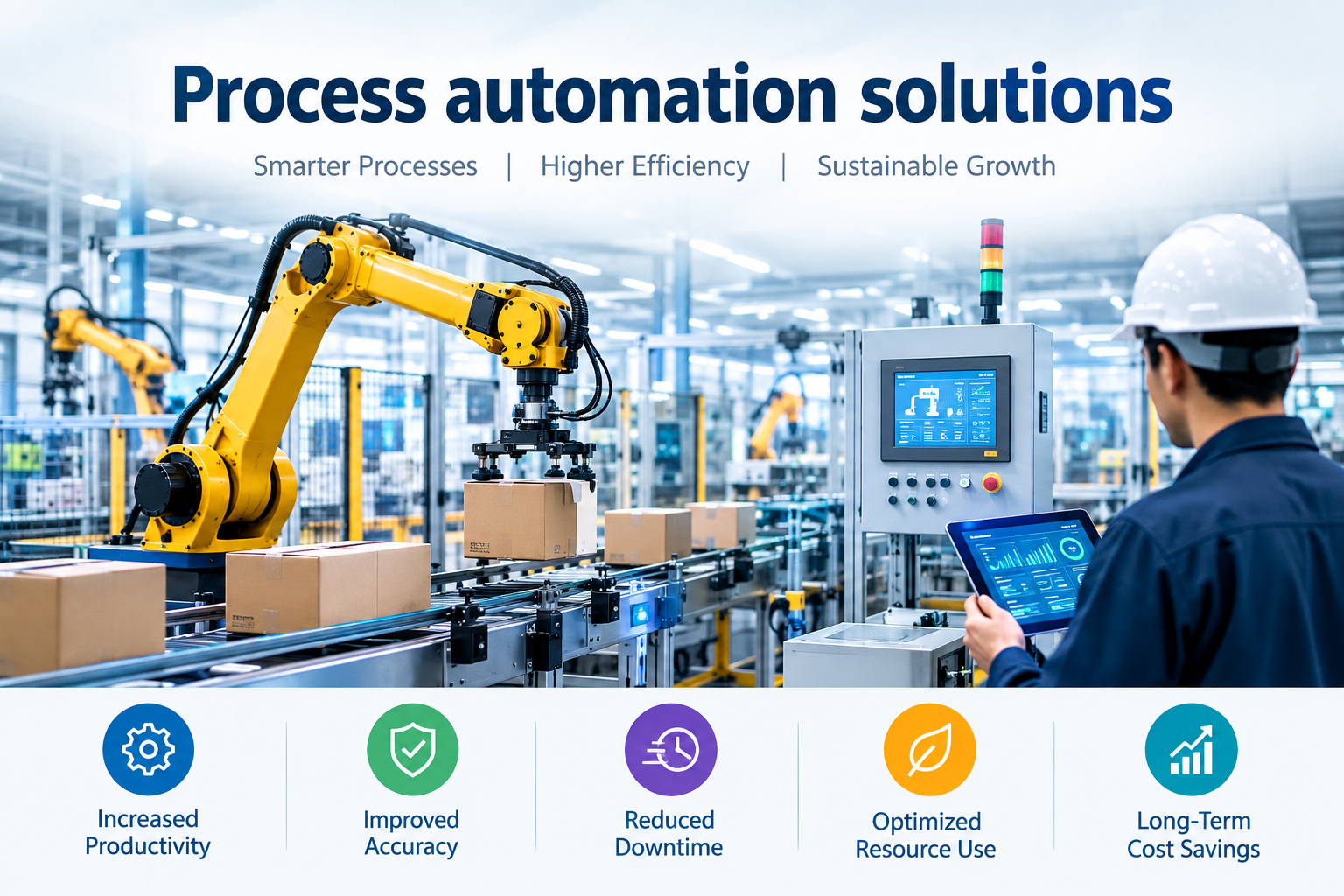
Process Automation Solutions: Creating Smarter and Safer Industrial Workplaces

Industries are continuously evolving as businesses look for better ways to improve productivity, maintain product quality, and manage complex operations. Traditional working methods can involve repetitive tasks, manual monitoring, and processes that require considerable time and effort. Modern Process Automation Solutions help businesses improve these activities by combining intelligent control systems, industrial equipment, and software technologies.
Process automation enables machines and control systems to perform predefined operations with reduced manual intervention. Depending on the application, it can help organizations monitor equipment, coordinate production activities, manage operating conditions, and respond to unexpected changes. When implemented correctly, automation can support more organized, efficient, and safer industrial workplaces.
Understanding the Role of Process Automation
Process automation involves using technology to control and monitor activities that would otherwise require continuous manual operation. These activities may include machine control, material handling, production monitoring, packaging, and equipment inspection.
For example, a manufacturing facility may use sensors to measure temperature and pressure during production. A programmable controller processes the sensor information and manages equipment according to established operating parameters. If a measured value moves outside an acceptable range, the system can generate an alert or initiate a predefined response.
This approach allows employees to monitor operations instead of manually controlling every individual activity. It also helps technical teams identify potential problems and make informed decisions.
Supporting Workplace Safety
Workplace safety is an important consideration in industrial environments, particularly where employees work around heavy machinery, high temperatures, moving equipment, or hazardous materials.
Automation can help reduce employees' exposure to certain repetitive or hazardous activities. Industrial robots, automated material-handling equipment, and remote monitoring systems can perform selected tasks in environments where direct human involvement may be difficult.
Automated monitoring can also identify abnormal operating conditions. Depending on the system design, alarms and protective controls may help operators respond when equipment operates outside predefined limits.
However, automation alone does not guarantee workplace safety. Businesses must implement suitable machine guards, emergency stops, interlocks, risk assessments, employee training, and maintenance procedures. Safety systems should be designed and validated according to the requirements of the specific application.
Improving Productivity and Workflow Coordination
Production efficiency depends on how effectively different activities work together. Delays in one stage can affect the entire production process, resulting in reduced output or unnecessary waiting time.
Process automation can coordinate equipment and production sequences through programmed instructions. For example, an automated assembly line can move components between workstations according to a defined sequence. Sensors can confirm whether a component is correctly positioned before the next operation begins.
Automation can also improve workflow visibility by providing information about machine status, cycle times, and production interruptions. Managers and technical teams can use this information to identify bottlenecks and evaluate possible improvements.
The overall benefit depends on how well the automated system matches the production process and how consistently it is maintained.
Applications in Smart Manufacturing
Smart manufacturing combines automation, connected equipment, operational data, and digital technologies to improve industrial performance.
Automated Assembly
Robotic equipment and automated machinery can support repetitive assembly operations. These systems are useful when tasks require consistent movement, accurate positioning, or repeatable production sequences.
Quality Inspection
Automated inspection technologies can identify certain defects, measure components, and compare results with defined quality requirements. Their effectiveness depends on the inspection method, equipment capabilities, and testing conditions.
Material Handling
Conveyors, robotic arms, and automated handling systems can move materials between different production stages. Appropriate integration helps improve material flow and reduce unnecessary movement.
Process Monitoring
Sensors and industrial control platforms can track important operating parameters. Monitoring information helps operators understand system performance and investigate unusual conditions.
These applications demonstrate how automation can improve coordination across different stages of industrial production.
Essential Technologies Used in Automation
A reliable automation system often combines several technologies.
Programmable Logic Controllers (PLCs): PLCs control machines and equipment by executing programmed instructions based on input signals.
Sensors and Instrumentation: These devices measure physical parameters such as temperature, pressure, speed, flow, and position.
Supervisory Control and Data Acquisition (SCADA): SCADA platforms help operators monitor industrial processes, review operating data, and respond to system alerts.
Human-Machine Interface (HMI): HMI systems provide visual information about equipment status and allow authorized operators to interact with the control system.
Industrial Robotics: Robots can perform tasks such as welding, packaging, assembly, and material transportation when suitable equipment and safeguards are provided.
Industrial Communication Systems: Communication networks allow compatible controllers, machines, and monitoring platforms to exchange information.
The correct combination depends on production requirements, existing infrastructure, operating conditions, and future expansion plans.
Planning for Successful Implementation
Businesses should carefully evaluate their needs before introducing automation. The first step is to identify the processes that require improvement and understand the problems associated with existing workflows.
Next, organizations should establish clear objectives. These may include improving production consistency, reducing unnecessary manual tasks, increasing equipment visibility, or strengthening process control.
Technical teams should assess the existing machinery, software, communication protocols, and safety requirements. This assessment helps determine whether current equipment can be integrated with new technologies or whether additional modifications are necessary.
Testing is another essential stage. Before introducing an automated system into regular operation, engineers should verify its functionality, check alarm responses, review safety measures, and confirm that equipment performs as expected.
Employees should also receive appropriate training. Operators need to understand system controls, maintenance teams need access to technical documentation, and authorized personnel should know how to respond to abnormal operating conditions.
Preparing for the Future of Industrial Automation
Industrial automation continues to develop as businesses explore connected systems, advanced analytics, machine vision, and artificial intelligence. These technologies can support more detailed process monitoring and help organizations identify patterns in operational data.
Predictive maintenance is one example. By analyzing equipment condition and performance information, suitable systems may help identify signs of developing faults before equipment failure occurs. The effectiveness of this approach depends on data quality, system design, and the equipment being monitored.
Businesses should adopt new technologies according to their actual needs rather than implementing them simply because they are available. A practical automation strategy should consider cost, compatibility, cybersecurity, maintenance, and long-term operational goals.
Conclusion
Modern industries need reliable processes, effective coordination, and appropriate safety measures to remain competitive. Process Automation Solutions can help businesses streamline workflows, improve production monitoring, reduce selected manual tasks, and support more consistent operations.
Successful automation requires careful planning, compatible technologies, trained employees, and continuous system evaluation. By focusing on real operational challenges and choosing suitable solutions, organizations can build smarter industrial workplaces and prepare for future manufacturing requirements.



