

South Africa Tin Market Size, Growth Trends & Research Forecast 2026-2034

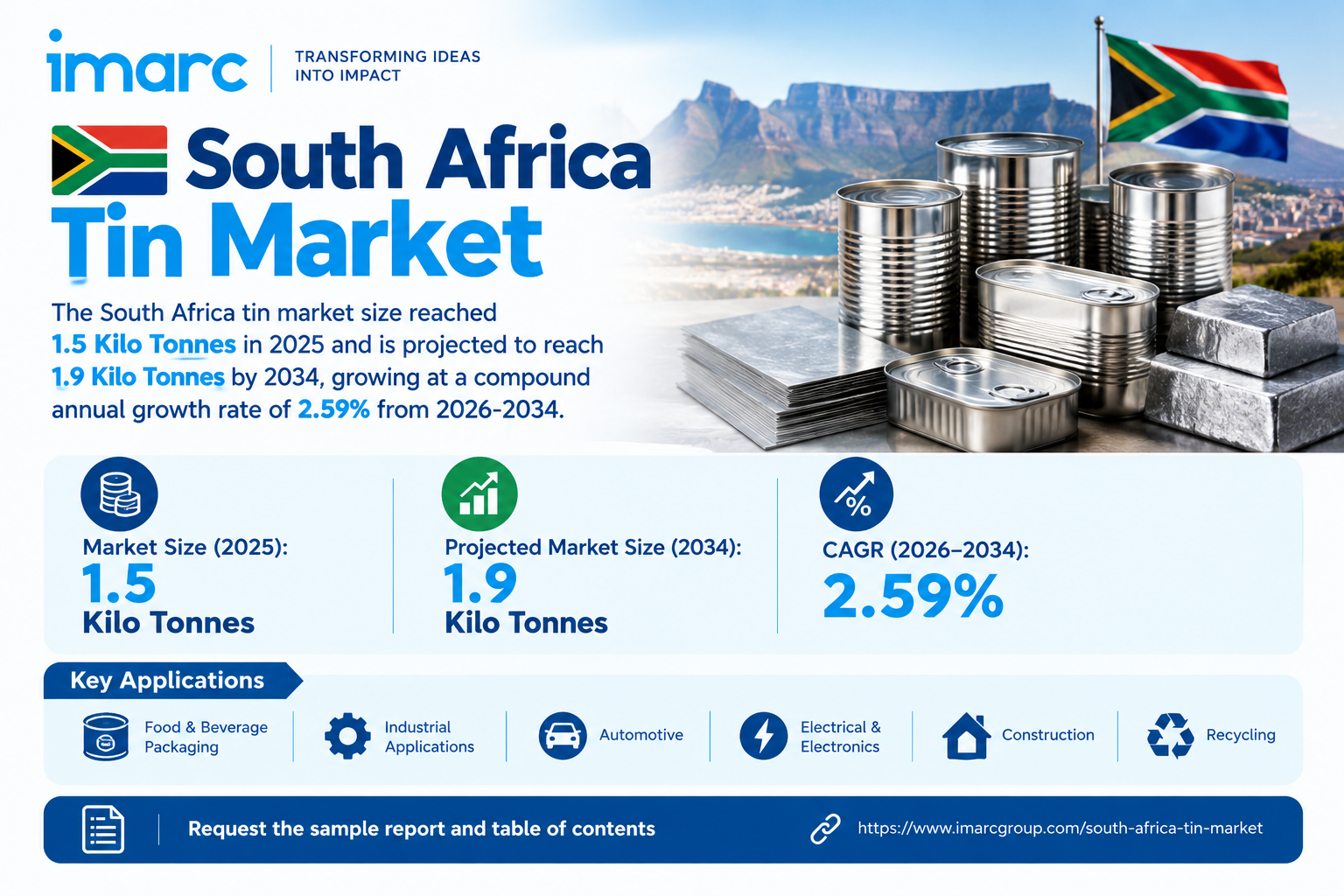
IMARC Group, a leading global market research and management consulting firm, has published its latest market intelligence report on the South Africa tin market. The South Africa tin market size reached 2.97 Kilo Tonnes in 2025 and is projected to reach 3.74 Kilo Tonnes by 2034, exhibiting a CAGR of 2.59% during 2026-2034, driven by expanding electronics manufacturing, automotive sector electrification, and rising demand for corrosion-resistant packaging in the food and beverage industry.
The market is riding sustained structural momentum as South Africa cements its position as the continent's largest importer and consumer of tin, absorbing the bulk of regional demand even as domestic mining and smelting capacity remains limited. Electronics assembly, automotive component manufacturing, and tinplate packaging are widening the addressable market across industrial, consumer, and export-facing sectors. Tin metal keeps the product mix dominant at 60% share, used across soldering, alloying, and electroplating lines, while Gauteng anchors national demand as the country's principal manufacturing base, hosting the Automotive Supplier Park in Rosslyn and a dense cluster of electronics assemblers, together creating a tin demand base built on import-led industrial consumption rather than a single commodity cycle.
South Africa Tin Market at a Glance:
- Market Size (2025): 97 Kilo Tonnes
- Forecast Market Size (2034): 74 Kilo Tonnes
- CAGR (2026-2034): 2.59%
- Leading Product Type (2025): Metal, 60% share
- Leading Application (2025): Tin Plating, 28% share
- Leading End Use Industry (2025): Electronics, 35% share
- Dominant Province (2025): Gauteng, 30% share
How Technology and AI-Linked Investment is Reshaping the South Africa Tin Market
- AI and Cloud Infrastructure Build-Out Driving Data Center Electronics: In March 2025, Microsoft announced a further R5.4 billion investment to expand its cloud and AI infrastructure in South Africa, building on earlier data centre developments in Johannesburg and Cape Town, a build-out that is lifting demand for tin-intensive servers, networking equipment, and electronic systems.
- Electrification of Automotive Electronics Lifting Tin Intensity Per Vehicle: Advanced driver-assistance systems, infotainment units, and battery management systems are raising tin usage per vehicle, reinforced by a 150% tax incentive introduced by the South African government in January 2026 for manufacturers investing in new electric and hydrogen-powered vehicle production facilities and equipment.
- Traceability and Circularity Systems Strengthening Recycled Tin Supply: Producer responsibility organizations such as MetPac-SA are scaling up metal recycling and collection infrastructure, deploying traceability systems that are drawing higher volumes of recycled tin feedstock back into the industrial supply chain.
Grab a sample PDF of this report: https://www.imarcgroup.com/south-africa-tin-market/requestsample
South Africa Tin Market Trends and Drivers:
Electronics manufacturing is the single biggest structural pull on the market, with tin metal commanding 60% of the product type mix in 2025 as circuit board assembly and semiconductor packaging consume high-purity tin for soldering. The shift toward lead-free solder alloys is compounding this demand, with regulatory alignment to standards such as the EU's Restriction of Hazardous Substances (RoHS) Directive pushing local manufacturers toward tin-silver-copper (SAC) alloys, while tin plating remains the leading application at 28% share, anchored by tinplate packaging for canned food, beverages, and aerosols.
South Africa's position as the continent's dominant tin importer and consumer is both the market's foundation and its principal constraint. With limited domestic mining or smelting capacity, the country sources refined tin predominantly from Southeast Asian producers, exposing downstream manufacturers to rand volatility and global price swings, even as this import reliance underpins the country's role as the primary gateway for tin-based industrial inputs into the wider African market. Gauteng's concentration of manufacturing capacity, electronics assemblers, and the Rosslyn-based Automotive Supplier Park reinforces this structural centrality, commanding 30% of national tin demand in 2025.
Government-backed policy is reshaping the demand trajectory. In May 2025, the South African government approved its Critical Minerals and Metals Strategy alongside the draft Mineral Resources Development Bill, aiming to strengthen regulatory certainty across minerals value chains including tin-related industrial inputs. The South African Automotive Master Plan 2035 and the January 2026 tax incentive for electric and hydrogen vehicle manufacturing are accelerating tin consumption in battery management systems and power electronics, while Extended Producer Responsibility targets under evolving packaging regulations are pushing the tinplate segment toward higher recycling and recovery rates.
Government Schemes and Policy Initiatives Driving Demand:
- Critical Minerals and Metals Strategy: Approved in May 2025 together with the draft Mineral Resources Development Bill, the strategy aims to strengthen regulatory certainty and maximize the country's role in global minerals value chains, with implications for downstream tin processing and related industrial inputs.
- South African Automotive Master Plan 2035: Targets substantial growth in domestic vehicle production and local content, accelerating tin-intensive component manufacturing, soldering, and protective coating demand across the automotive supply chain.
- Electric and Hydrogen Vehicle Tax Incentive: Introduced in January 2026, the 150% tax incentive for manufacturers investing in new EV and hydrogen-powered vehicle production facilities is designed to accelerate local new energy vehicle output and attract investment into battery and charging-infrastructure ecosystems.
- Extended Producer Responsibility and Packaging Recycling Targets: The Metal Packaging Association of South Africa (MetPac-SA) reported progress against EPR targets in 2025, strengthening recycling and recovery of tinplate and other metal packaging as part of national circular economy goals.
South Africa Tin Industry Segmentation:
The report has segmented the market into the following categories:
Breakup By Product Type:
- Metal
- Alloy
- Compounds
Metal commands the largest product type share at 60% in 2025, driven by its extensive use in soldering, electroplating, and alloy production across the electronics, automotive, and packaging industries, and reflects the country's import-dependent, purity-sensitive industrial base.
Breakup By Application:
- Soldering
- Tin Plating
- Chemicals
- Others
Tin plating leads the application segment at 28% share in 2025, reflecting demand from the food and beverage sector for corrosion-resistant tinplate packaging, alongside industrial plating services supporting automotive components, electrical equipment, and construction materials.
Breakup By End Use Industry:
- Automotive
- Electronics
- Packaging (Food and Beverages)
- Glass
- Others
Electronics leads end-use demand at 35% share in 2025, reflecting the sector's reliance on tin-based solder materials for circuit board production, consumer device assembly, and expanding telecommunications infrastructure.
Breakup By Province:
- Gauteng
- KwaZulu-Natal
- Western Cape
- Mpumalanga
- Eastern Cape
- Others
Gauteng dominates the South Africa tin market with a 30% share in 2025, anchored by its role as the country's primary manufacturing and industrial hub, the highest concentration of electronics and automotive component manufacturers, and the Rosslyn-based Automotive Supplier Park serving major original equipment manufacturers.
Competitive Landscape:
The report provides a comprehensive analysis of the competitive landscape in the South Africa tin market, which remains fragmented across:
- International tin smelters and metal producers supplying through established distribution channels and long-term agreements
- Regional distributors and specialized metal trading companies facilitating import and in-country distribution
- Domestic industrial conglomerates incorporating tin into packaging, steel, and metal fabrication operations
- Specialized tin product manufacturers competing on supply reliability, product certification, and technical support
Market Concentration Analysis:
- Fragmentation: No single operator dominates the South Africa tin market; competition is spread across international smelters, regional distributors, and specialized processors.
- Differentiation: Market participants compete on supply reliability, certified product quality, and value-added services such as just-in-time delivery and customized alloy formulations.
- Sustainability Positioning: Buyers are increasingly favoring suppliers with responsible sourcing credentials and recycled-tin traceability, reshaping competitive dynamics across the value chain.
What Does The Full Report Cover?
If you are tracking the South Africa tin market for investment decisions, market entry planning, competitive benchmarking, or strategic advisory, IMARC Group's report gives you everything in one place:
- Complete market sizing in volume terms (Kilo Tonnes) with forecasts covering the full 2026-2034 projection period
- Quantified growth driver analysis across product type, application, end use industry, and provincial markets
- Sub-segment breakdowns for metal, alloy, and compounds; four application categories; five end-use industries; and six provinces of South Africa, each with individual share data
- Provincial data across Gauteng, KwaZulu-Natal, Western Cape, Mpumalanga, Eastern Cape, and other regions
- Competitive landscape assessment of international and regional tin suppliers and processors
- Value chain analysis, market concentration assessment, and investment and growth opportunity mapping
- Latest trends covering lead-free solder adoption, EV and renewable-energy tin applications, and sustainable/recycled tin supply chain development
Recent News and Developments in South Africa Tin Market
- January 2026: The South African government introduced a 150% tax incentive for manufacturers investing in new production facilities and equipment for electric and hydrogen-powered vehicles, aimed at accelerating local new energy vehicle output.
- November 2025: South Africa's critical minerals strategy, covering minerals including tin, drew industry scrutiny for offering limited investment incentives, with no tax holidays or royalty relief to attract exploration and development.
- May 2025: The South African government approved its Critical Minerals and Metals Strategy and the draft Mineral Resources Development Bill, aiming to strengthen regulatory certainty across minerals value chains.
Note: If you require specific details, data, or insights that are not currently included in the scope of this report, we are happy to accommodate your request. As part of our customization service, we will gather and provide the additional information you need, tailored to your specific requirements. Please let us know your exact needs, and we will ensure the report is updated accordingly to meet your expectations.
Key Questions This Report Answers
- What is the current South Africa tin market size and what is its projected volume?
- Which product type holds the largest share in the South Africa tin market?
- What are the key drivers of South Africa tin market growth?
- Which province dominates the South Africa tin market and why?
- How are electronics manufacturing growth, EV incentives, and packaging recycling regulations reshaping demand and competitive strategy in the South Africa tin industry?
- Who are the key players in the South Africa tin market and how do they compete?
- What are the investment and market entry opportunities across electronics, automotive electrification, and sustainable tin supply chains in South Africa?
About Us
IMARC Group is a global management consulting firm that helps the world's most ambitious changemakers to create a lasting impact. The company provides a comprehensive suite of market entry and expansion services. IMARC offerings include thorough market assessment, feasibility studies, company incorporation assistance, factory setup support, regulatory approvals and licensing navigation, branding, marketing and sales strategies, competitive landscape and benchmarking analyses, pricing and cost research, and procurement research.
Media and Sales Contact
IMARC Group
Email: sales@imarcgroup.com
United States: +1-201-971-6302
India: +91-120-433-0800
United Kingdom: +44-753-714-6104



