


What Is an AI X-Ray Baggage Scanner and How Does It Work?
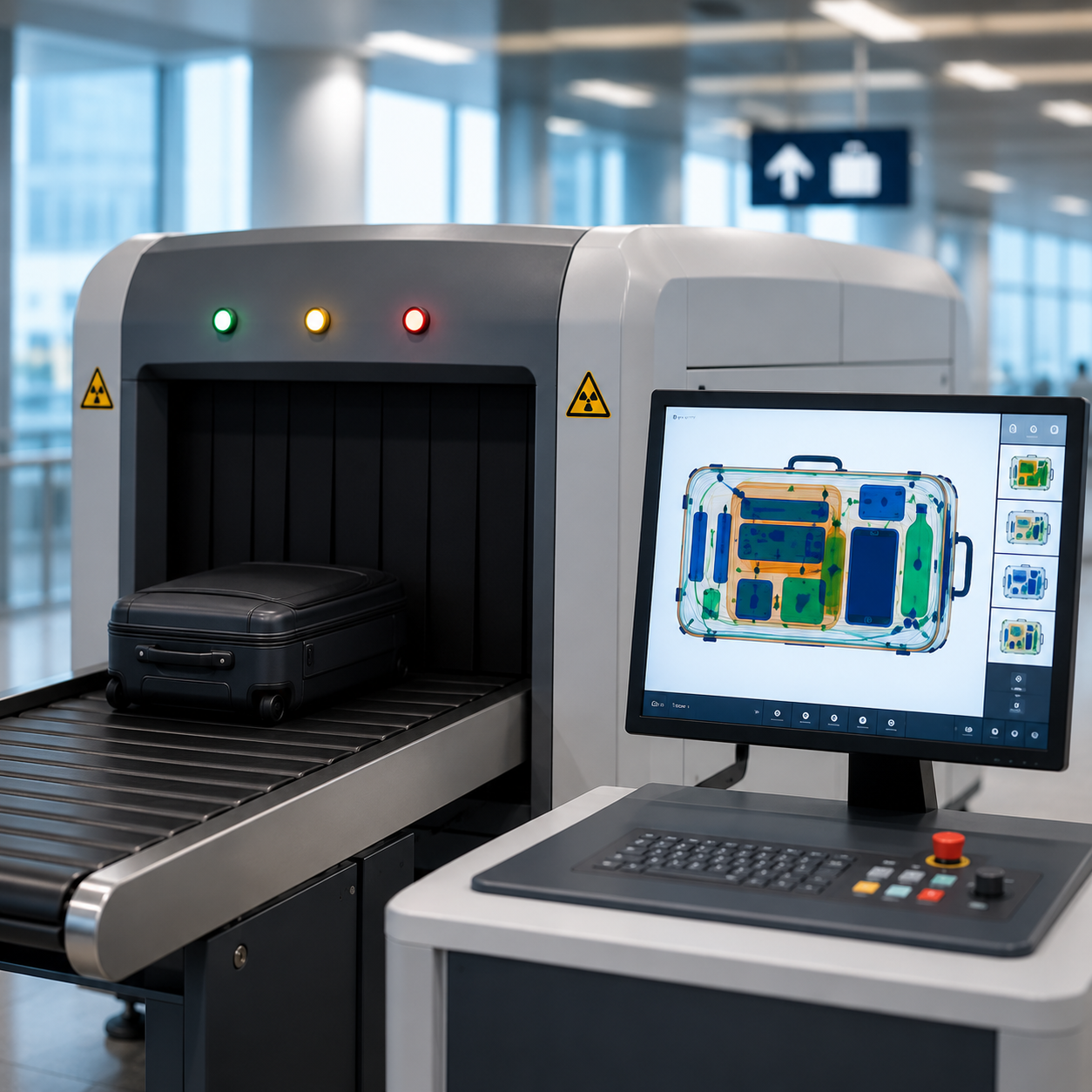
An AI X-Ray Baggage Scanner system combines traditional X-ray imaging with artificial intelligence to help security teams spot potentially concerning items inside bags faster and more consistently. Instead of relying only on a human operator's eyes, the system uses computer vision to analyse each scan in real time and flag areas that may need a closer look. As passenger volumes grow at airports, railway stations, and other busy checkpoints, security teams are turning to intelligent screening to keep pace without cutting corners. This article covers what these systems are, how they work step by step, the technologies behind them, and what buyers should consider before choosing one.
What Is an AI X-Ray Baggage Scanner?
An AI-powered baggage scanner is just a regular X-ray screening machine with software that automatically reads a bag's inside image. The goal is straightforward: enable operators to discover uncommon shapes, densities, or items without manually scanning every pixel.
Conventional X-ray screening is nearly totally dependent on the operator's training, attention span, and experience. A trained operator can catch a lot, but fatigue and large throughput volumes might compromise uniformity over a lengthy shift. AI-assisted screening offers a second layer of analysis that complements, rather than replaces, the operator.
This is why intelligent screening is becoming increasingly widespread. Checkpoints currently handle significantly more baggage per hour than they did ten years ago, and companies looking for reliable X-ray baggage Scanner makers in India are increasingly inquiring whether the equipment they are reviewing supports AI-assisted analysis.
How Does an AI X-Ray Baggage Scanner Work?
The process behind AI-assisted screening can be broken down into a simple, sequential workflow.
- Step 1: Baggage Enters the Scanner – The bag is loaded onto a conveyor belt that transports it at a predetermined pace thru a shielded tunnel, allowing the imaging system to get a clear scan.
- Step 2: X-Ray Images Are Generated – X-ray beams pass through the bag and are detected on the opposite side, resulting in a cross-sectional image depending on how different materials absorb or scatter radiation.
- Step 3: Image Processing—The raw image is cleaned and enhanced. Edges are sharpened, overlapping items become easier to detect, and colour-coding is used to help operators differentiate between organic and metallic materials. This is the primary purpose of every modern X-ray luggage scanner, with or without AI added on top.
- Step 4: AI Analyzes the Image – Machine learning models trained on enormous amounts of X-ray images examine the processed image for patterns, forms, and densities that resemble items of concern, such as weapons or forbidden materials.
- Step 5: Threat Identification – When the system identifies something that matches a previously taught pattern, it highlights the area on screen, usually with a bounding box, directing the operator's attention to that part of the bag.
- Step 6: Operator Review—The skilled security operator examines both the highlighted region and the entire image. AI is a decision-support tool, not a replacement for human judgment; the operator makes the final decision.
- Step 7: Security Decision – Based on the evaluation, the operator determines whether the bag can pass or if it requires manual inspection, a secondary scan, or additional screening procedures.
What Technologies Power AI-Based Baggage Screening?
Several technologies collaborate behind the scenes: Artificial Intelligence provides a framework for analysing data and making judgments, while Machine Learning allows the software to improve pattern recognition as it encounters more scanned photos over time. Computer Vision and Image Recognition enable the system to "see" and recognize shapes, structures, and specific object categories in the scan.
Automatic Threat Recognition (ATR) indicates items that resemble established threat categories. At the same time, Image Enhancement improves clarity and contrast, allowing both the AI and the operator to more effectively interpret the image. Material Classification distinguishes organics from metals by examining how X-rays interact with various substances. In contrast, Dual-Energy X-Ray Imaging collects more specific material composition data than a single-energy scan.
How AI Improves Baggage Screening
AI-assisted analysis offers several practical, day-to-day advantages: faster image analysis, because the system reviews the scan almost instantly alongside the operator; assistance in identifying suspicious objects, particularly in cluttered bags; reduced operator workload, as AI helps prioritise which images need the most attention; more consistent screening, because the software applies the same criteria to every scan regardless of shift length; and improved efficiency at
These are significant operational benefits, but results vary depending on the system, training data, and checkpoint conditions; avoid making promises about specific detection percentages that cannot be independently verified.
AI-Assisted Screening vs Traditional X-Ray Systems
| Factor | Traditional Screening | AI-Assisted Screening |
|---|---|---|
| Image Analysis | Manual interpretation | AI-assisted analysis |
| Operator Workload | Higher | Potentially reduced |
| Threat Assistance | Primarily operator-driven | AI can provide alerts/support |
| Processing | Conventional image processing | Intelligent image analysis |
| Scalability | Depends heavily on operators | Greater automation potential |
Both systems are based on the same basic X-ray imaging principles. The distinction is in how much analytical help the operator receives while making a choice.
Where Are AI-Powered Baggage Scanners Used?
AI-assisted screening equipment is deployed across a range of environments, each with different priorities: airports, where high passenger volume and strict regulations make consistent screening essential; railroad and metro stations, which manage large crowds with less structured queuing and require fast throughput at peak hours; government buildings, which require strict access control; hospitals, where screening must remain thorough but unobtrusive; corporate offices and ho.
The environment, estimated baggage volume, and location-specific risk profile significantly influence the optimal layout.
Key Features to Look For
Buyers of baggage screening equipment should consider image quality and detection capabilities, how well AI-assisted threat recognition fits into the existing workflow, tunnel size and conveyor capacity, material discrimination, user interface clarity, radiation safety compliance with national standards, maintenance support, software updates, and scalability over the equipment's lifespan.
Why Choosing the Right Technology Partner Matters
When choosing a screening system, it is important to consider both the company and the equipment. Organizations should consider manufacturing quality, technical competence, product reliability, and the vendor's industry experience, as well as installation support, operator training, continuing maintenance, and spare parts availability. Long-term technical support affects how well the system functions over time, rather than simply on the first day. Krystalvision operates in this sector with an emphasis on advanced security screening technologies, and businesses assessing providers should look for comparable depth in installation, training, and after-sales support rather than judging equipment solely on specifications.
Frequently Asked Questions
Q: What is an AI X-ray baggage scanner?
Answer: It is an X-ray screening system equipped with software that automatically analyses internal images of baggage to assist workers in detecting suspicious objects. It complements standard X-ray imaging by using computer-assisted pattern recognition.
Q: How does an AI baggage scanner work?
Answer: Baggage is routed in an X-ray tunnel, where imaging equipment produces an internal image that is analysed and enhanced. The AI then analyzes the image for patterns that resemble things of concern, highlighting pertinent regions for the operator to consider.
Q: Can AI detect threats inside baggage?
Answer: AI can detect shapes, densities, and patterns that resemble established threat categories, directing the operator's attention to certain portions of a picture. It encourages detection rather than making an autonomous conclusion, because the final decision rests with the trained operator.
Q: What is the difference between AI and traditional X-ray screening?
Answer: Traditional screening depends solely on manual interpretation, but AI-assisted screening incorporates automatic pattern recognition to highlight potentially problematic areas. Both use the same core imaging technique; the difference is in the amount of analytical help given.
Q: Are AI X-ray baggage scanners safe?
Answer: When produced and operated in accordance with appropriate national radiation safety requirements, this equipment is safe for use in public places. Safety depends on correct installation, calibration, and adherence to regulatory rules, not the presence of AI.
Q: Where are AI baggage scanners commonly used?
Answer: When produced and operated in accordance with appropriate national radiation safety requirements, this equipment is safe for use in public places. Safety depends on correct installation, calibration, and adherence to regulatory rules, not the presence of AI.
Q: Does AI completely replace a baggage screening operator?
Answer: No. AI serves as a decision-support tool, highlighting potential areas of concern, while trained security personnel are still responsible for examining photos and making the final decision. Human oversight remains crucial to the process.
Q: What should businesses consider before buying an AI baggage scanner?
Answer: Businesses should consider image quality, detection capabilities, tunnel size, conveyor capacity, and radiation safety compliance, as well as the vendor's maintenance, training, and long-term technical support. A skilled technological partner is as important as the machine's specifications.
- Goth Lifestyle
- Fashion & Style
- Music & Bands
- Art & Photography
- Creative Writing & Poetry
- Events & Scene
- Occult & Spirituality
- DIY & Tutorials
- Beauty & Self-Care
- Relationships & Dating
- Gaming & Media
- Tech & Gadgets
- Body Art & Piercings
- Underground Culture
- Spotlights & Interviews
- Travel & Places
- Lifestyle & Daily Life
- Fitness & Health
- Travel & Adventure
- Books & Literature
- Tech & Gaming
- Movies & TV
- Food & Drinks
- Humor & Memes
- Pets & Animals
- General Arts & Crafts

 English
 Arabic
 French
 Spanish
 Portuguese
 Turkish
 Dutch
Dutch
 Italiano
 Russian
 Romaian
 Portuguese (Brazil)
 Greek
Greek