


The Economics of AI UGC: Why Product-to-Video Beats Traditional Creator Marketplaces
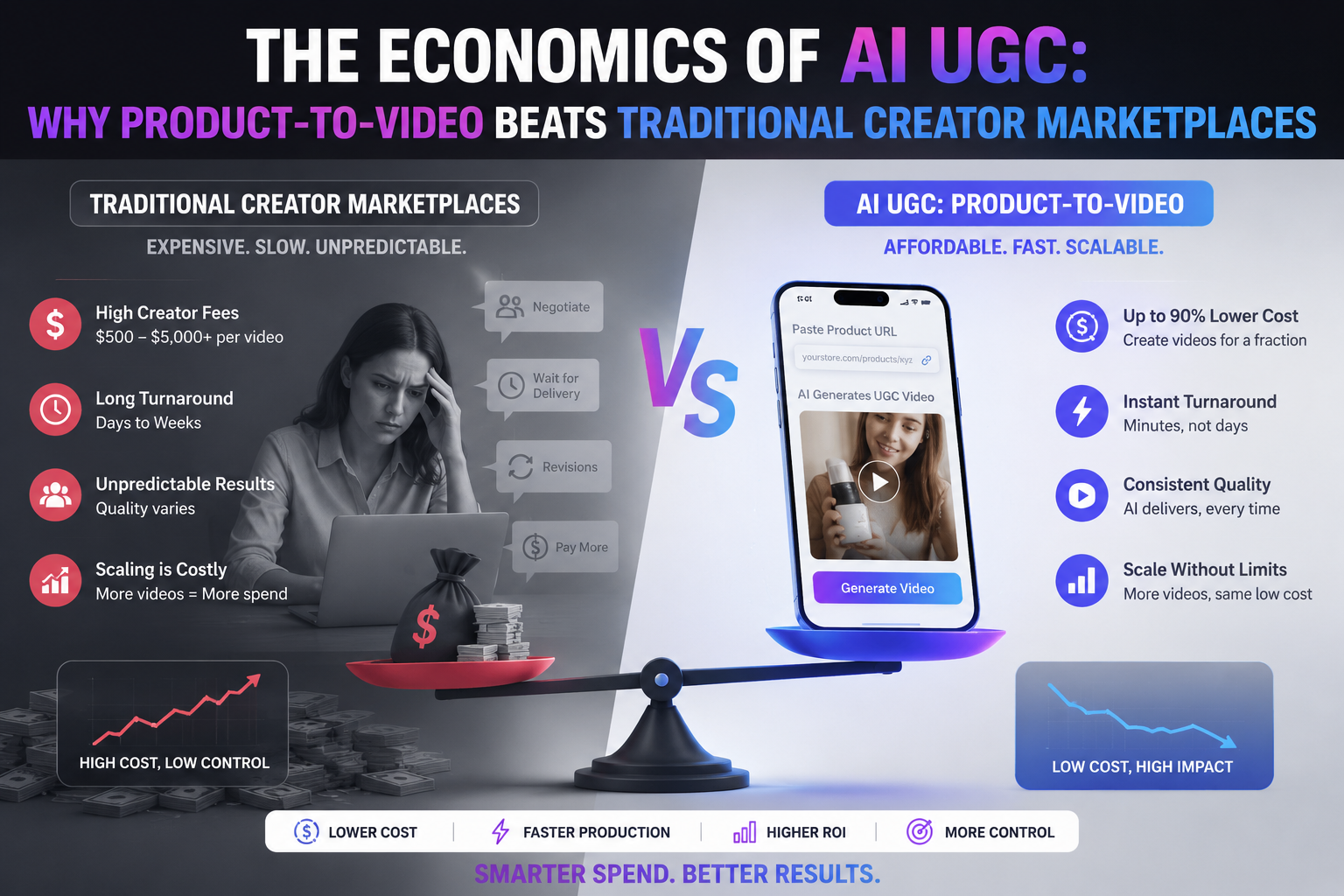
For years, brands relied on creator marketplaces to produce user-generated content at scale. The process was straightforward: find a creator, send the product, provide a brief, wait for the video, request revisions, and eventually turn the finished content into an advertisement.
The model still works.
But it becomes expensive and slow when a brand needs dozens of new creatives every month.
This is where the economics of AI UGC starts to become interesting.
An AI UGC Video generator can reduce many of the costs associated with traditional creator production by moving more of the creative workflow into software. Instead of hiring a creator for every concept, brands can start with product information and generate videos using AI avatars, scripts, voices, scenes, product visuals, captions, and automated editing.
Product-to-video workflows take this idea even further.
Rather than starting with a creator marketplace, a marketer can start with the product itself.
The product URL, product images, description, and other information become the foundation for the advertisement.
This changes the economics of creative production.
The question is no longer simply:
"How much does one UGC video cost?"
It becomes:
"How cheaply and quickly can we generate, test, learn from, and scale creative?"
That distinction is important because performance advertising depends on continuous creative testing.
In this article, we'll explore why product-to-video AI UGC workflows can outperform traditional creator marketplaces from a production-economics perspective, where creator marketplaces still have advantages, and why platforms such as Tagshop AI are becoming relevant to brands looking to scale UGC-style advertising.
What Is Product-to-Video AI UGC?
Product-to-video is a workflow where a brand starts with product information and uses AI to turn that information into a video advertisement.
Instead of manually creating every element, an AI UGC platform can potentially use:
-
Product URLs
-
Product images
-
Product descriptions
-
Product benefits
-
Brand information
-
Creative instructions
-
Target audience details
The platform can then help generate elements such as:
-
Scripts
-
Hooks
-
AI avatars
-
Voiceovers
-
Product scenes
-
B-roll
-
Captions
-
Calls to action
-
Complete video variations
This is fundamentally different from traditional creator marketplaces.
In a creator marketplace, the creator is the starting point.
In product-to-video AI UGC, the product is the starting point.
That difference has major implications for cost, speed, and scalability.
The Traditional Creator Marketplace Model
Let's look at the traditional workflow first.
A brand wants to create a UGC advertisement.
The typical process looks something like:
Find Creator → Review Profiles → Negotiate → Send Product → Brief Creator → Wait for Recording → Review → Request Revisions → Edit → Publish
Every step introduces time and cost.
Suppose a brand wants ten different creative concepts.
It may need multiple creators because one person might not be suitable for every concept.
Now the workflow becomes:
Find Multiple Creators → Manage Multiple Briefs → Ship Multiple Products → Review Multiple Videos → Coordinate Revisions
The creative production process becomes a project-management problem.
That isn't necessarily bad.
Real creators can provide authentic experiences, personalities, opinions, and unique creative styles.
But the economics become difficult when the goal is high-volume creative testing.
The Hidden Cost of Traditional UGC
The price paid to a creator is only one part of the cost.
There are several hidden costs.
Creator Discovery
Someone has to search for creators, review profiles, compare portfolios, and identify people who match the brand.
Communication
Emails, messages, contracts, briefs, reminders, and revisions all require time.
Product Shipping
Physical products may need to be shipped to creators.
For international campaigns, this can become even more complicated.
Production Delays
Creators have their own schedules.
A campaign may be delayed because a creator is unavailable or needs more time to record.
Revisions
The first video may not match the brief.
The brand may need another hook, different framing, clearer product shots, or a revised CTA.
Editing
Even after receiving the creator's footage, the marketing team may need to edit it into multiple formats.
Creative Variations
One creator might deliver one or two usable concepts.
But performance marketers often need many variations.
This is where the traditional model can become expensive.
The Economics of AI UGC
AI changes the cost structure.
Instead of paying separately for every production event, brands can pay for access to software that generates multiple creative assets.
The major economic advantage is lower marginal production cost.
Once a brand has access to an AI UGC platform, generating another script or creative variation can require significantly less coordination than hiring another creator.
This creates an important difference.
With traditional creator production:
More Videos = More Creator Costs + More Coordination
With AI UGC:
More Videos = More Generation Usage + Less Manual Coordination
The exact savings depend on the platform, pricing model, creative quality, and human editing required.
But the underlying economic principle is clear: software can make creative production more repeatable.
The important tradeoff is not simply cost versus quality. Brands are balancing production speed, creative quality, testing volume, and human involvement. AI UGC can shift that production frontier by making more creative combinations possible with the same team.
Why Product-to-Video Changes the Equation
The biggest advantage of product-to-video isn't simply that it creates a video.
It's that it eliminates several manual inputs.
Imagine an ecommerce brand has 200 products.
With a traditional creator workflow, creating UGC videos for every product could involve:
-
Creator discovery
-
Product shipping
-
Brief creation
-
Recording
-
Editing
-
Review
-
Revisions
That isn't a practical process for every product.
A product-to-video system can provide a much more scalable starting point.
The marketer can provide the product information and creative direction.
The AI can then help turn that information into a video concept.
This makes product-to-video especially attractive for ecommerce businesses.
Product-to-Video vs Creator Marketplaces
The difference becomes clearer when comparing the workflows.
|
Factor |
Creator Marketplace |
Product-to-Video AI |
|
Starting point |
Creator |
Product |
|
Creator coordination |
Required |
Reduced |
|
Product shipping |
Often required |
Not necessarily |
|
Script generation |
Manual/creator-led |
AI-assisted |
|
Video variations |
More expensive |
Easier to scale |
|
Production speed |
Days or longer |
Potentially much faster |
|
Creative testing |
More costly |
More accessible |
|
Localization |
Requires new production |
Easier to adapt |
|
Product catalog scale |
Difficult |
More scalable |
|
Human authenticity |
High |
Depends on AI creative |
|
Creative control |
Creator-dependent |
More centralized |
Neither model is universally better.
But for brands that need a large amount of performance creative, AI has a strong economic advantage.
The Real Value Is Creative Testing
One of the biggest mistakes marketers make is measuring video production by the number of finished videos.
Performance marketers should think differently.
The real output isn't:
"We created 20 videos."
The real output is:
"We tested 20 creative hypotheses."
That's a much more valuable metric.
For example, a skincare brand might test:
Hook A
"Here's what finally helped with my dry skin."
Hook B
"I wish someone had told me about this sooner."
Hook C
"I tested this for two weeks. Here's what happened."
Hook D
"If your skincare routine takes forever, watch this."
The product is the same.
But the creative angle changes.
An AI UGC Video generator can make it easier to create these variations without requiring a separate creator production cycle for every concept.
That means brands can spend more of their budget on learning, rather than simply producing.
Why Speed Has Economic Value
Speed isn't just a convenience.
It has financial value.
Suppose a brand identifies a new advertising angle that appears to be working.
With a traditional creator workflow, producing additional content around that angle may require:
-
Finding creators
-
Sending briefs
-
Recording
-
Editing
-
Reviewing
-
Publishing
By the time the new creative is ready, the campaign may have changed.
AI can shorten the distance between an idea and an advertisement.
That means marketers can respond faster to:
-
New trends
-
Winning hooks
-
Product launches
-
Seasonal campaigns
-
Customer objections
-
Competitor messaging
-
Performance data
The faster a marketing team can move from insight to creative, the more opportunities it has to capitalize on that insight.
The Role of Tagshop AI
Tagshop AI is an example of an AI-powered platform built around product and advertising creative.
Its AI UGC workflow is particularly relevant to ecommerce and performance marketers because it combines product-focused creative generation with elements such as AI avatars, scripts, voiceovers, product visuals, captions, and editing.
Its AI Video Agent adds another layer to the workflow by allowing marketers to describe what they want to create through a conversational process.
This can reduce the need to manually configure every part of a video.
For example, a marketer can start with a product and provide creative direction around:
-
Target audience
-
Advertising platform
-
Product benefit
-
Hook
-
Tone
-
CTA
-
Creative style
The AI workflow can then help transform those inputs into a UGC-style video concept.
The economic advantage is not simply fewer clicks.
It is the ability to move from product information to multiple creative possibilities without rebuilding the production process for every variation.
Why Ecommerce Brands Have the Most to Gain
Ecommerce businesses have a unique creative challenge.
They often have many products but limited creative resources.
A brand might have:
-
50 products
-
100 products
-
500 products
-
Thousands of SKUs
Creating traditional UGC for every product isn't practical.
Product-to-video AI can help solve the scalability problem.
The product already exists.
The images already exist.
The product description already exists.
The brand messaging already exists.
AI can use those assets as the foundation for new creative.
This creates an interesting economic relationship:
More products no longer have to mean proportionally more production management.
That is one of the strongest arguments for product-to-video.
AI UGC Reduces Coordination Costs
Economics isn't only about the price of inputs.
It's also about transaction and coordination costs.
Traditional UGC involves multiple participants.
The brand.
The creator.
The editor.
The marketing manager.
The fulfillment team.
Sometimes legal or compliance teams.
Every participant adds coordination.
AI UGC can consolidate many of these tasks into one software workflow.
That can reduce:
-
Communication
-
File transfers
-
Scheduling
-
Revision management
-
Creator sourcing
-
Manual editing
This doesn't mean human involvement disappears.
Instead, the human role can move upward.
Instead of spending hours coordinating production, marketers can spend more time deciding:
What should we test next?
Where Traditional Creators Still Win
It would be a mistake to say AI UGC completely replaces creator marketplaces.
Real creators still offer something AI cannot perfectly reproduce: genuine human experience.
A real creator can:
-
Actually use the product
-
Share a personal story
-
Provide authentic reactions
-
Bring a unique personality
-
Create unexpected moments
-
Build audience trust through their identity
For campaigns where authenticity and creator influence are central, real UGC remains valuable.
AI is strongest when the priority is:
-
Speed
-
Volume
-
Testing
-
Consistency
-
Localization
-
Product coverage
The most sophisticated brands may use both.
The Hybrid UGC Model
The future doesn't necessarily have to be:
AI vs Creators
It can be:
AI + Creators
A brand could use real creators for major campaigns and authentic testimonials.
Then use AI for:
-
Creative testing
-
Hook variations
-
Product catalog coverage
-
Localization
-
Additional ad versions
-
Seasonal campaigns
-
Rapid experiments
This gives brands the best characteristics of both approaches.
Real creators provide authenticity.
AI provides scale.
The Economics of Creative Variations
Let's imagine a simplified example.
A traditional creator campaign produces 10 usable videos.
Now the brand wants 50 variations.
The traditional approach may require additional creators, additional production, or additional editing.
With AI, the same base concept can potentially be adapted into many variations.
For example:
5 Hooks × 3 Avatars × 2 CTAs × 2 Product Angles = 60 Variations
Not every variation will be good.
Not every variation should be published.
But the cost of exploring the creative space becomes lower.
That changes how marketers think about production.
Instead of asking:
"Which one video should we produce?"
They can ask:
"Which creative combinations should we test?"
That is a major shift.
Why Marginal Cost Matters
The first AI-generated video may require substantial creative input.
The marketer needs to provide the product information, define the audience, choose a creative direction, and review the result.
But once the workflow is established, additional variations can become much easier to produce.
This is where software economics become powerful.
Traditional production often has a relatively high marginal cost for every new creator asset.
AI can reduce the incremental cost of generating another version.
The result is a system where creative volume can increase without requiring the marketing team to increase headcount at the same rate.
AI UGC Is Not Automatically Cheaper
There is an important caveat.
AI UGC isn't automatically more economical.
A platform may charge generation credits.
AI videos may require multiple attempts.
Human editors may still need to fix mistakes.
Some tools have expensive premium features.
And poor AI creative can waste advertising spend.
Therefore, brands should calculate cost per usable creative, not simply cost per generation.
A useful framework is:
Software Cost + Human Review + Editing + Generation Usage = Total Creative Cost
Then divide that by the number of usable videos.
This gives you a more realistic measurement.
Quality Still Matters
Cost savings mean nothing if the resulting advertisement doesn't perform.
The AI UGC Video generator must create content that meets your brand's quality standards.
Check:
-
Avatar realism
-
Voice quality
-
Script quality
-
Product accuracy
-
Visual consistency
-
Caption accuracy
-
Brand messaging
-
CTA quality
The cheapest video isn't necessarily the best video.
The best creative is the one that generates useful results relative to its production cost.
The New Creative Production Equation
Traditional advertising often followed:
Budget → Production → Finished Ad
AI UGC changes this into:
Budget → Creative Volume → Testing → Learning → Optimization
This is a much more performance-oriented model.
The value of AI isn't simply cheaper production.
It is the ability to create a larger number of experiments.
And experiments create information.
That information can improve future advertising decisions.
How Brands Should Measure AI UGC Economics
Don't evaluate an AI UGC program only on subscription cost.
Track:
Cost per usable video
How much does it actually cost to create a video worth testing?
Production time
How long does it take from idea to finished creative?
Creative volume
How many useful variations can your team produce?
Testing velocity
How quickly can new concepts reach the market?
Performance
Which AI-generated concepts actually perform?
Learning rate
How quickly does the team identify winning creative patterns?
Reuse
Can successful scripts, hooks, or structures be adapted to new products?
These metrics provide a much better picture of the economic value.
The Future of Product-to-Video Advertising
Product-to-video is likely to become increasingly important as ecommerce catalogs grow and advertising becomes more creative-intensive.
Imagine uploading a new product.
The AI understands its features.
It generates several customer problems.
It creates multiple hooks.
It selects different creator styles.
It produces different versions.
The marketing team reviews them.
The best concepts go into testing.
Performance data comes back.
The next generation of ads is informed by those results.
This creates an almost continuous creative feedback loop.
The product becomes the input.
Creative becomes the output.
Performance data becomes the next input.
That is a much more scalable model than treating every advertisement as a separate production project.
When Should You Choose AI UGC Over a Creator Marketplace?
AI UGC is particularly attractive when:
-
You need a high volume of creative
-
You manage many products
-
You need fast production
-
You want to test many hooks
-
You need localized versions
-
You have limited production resources
-
You want more control over messaging
-
You need frequent creative refreshes
Traditional creator marketplaces may be better when:
-
Authentic personal experience is essential
-
Influencer reach matters
-
The creator's identity is part of the campaign
-
You need genuine testimonials
-
Your campaign depends on creator communities
The right answer depends on your marketing objective.
Final Verdict
The economics of AI UGC aren't simply about replacing a creator with an AI avatar.
The bigger opportunity is changing how advertising creative is produced.
Traditional creator marketplaces are built around individual production relationships.
Product-to-video AI is built around scalable creative generation.
That difference can reduce coordination costs, increase creative volume, accelerate testing, and make it easier for brands to cover larger product catalogs.
An AI UGC Video generator such as Tagshop AI can fit into this model by combining product-driven workflows with AI avatars, scripts, voices, product visuals, and editing.
But brands shouldn't evaluate AI UGC purely on whether it is cheaper than hiring creators.
The better question is:
Can AI help us produce more useful creative, test more ideas, and learn faster without increasing production costs at the same rate?
That's where the real economics become compelling.
Traditional creator marketplaces will continue to have an important role, particularly when authentic human experiences and creator influence are critical.
But for high-volume performance marketing, ecommerce catalogs, rapid creative testing, and frequent ad refreshes, product-to-video AI offers a fundamentally different production model.
Instead of paying for every new production event, brands can build a repeatable creative engine.
Product → AI Creative → Variations → Testing → Performance Data → Better Creative
That's the economic advantage.
AI UGC isn't just making video production faster.
It's changing the economics of how brands create, test, and scale advertising creative.
- Goth Lifestyle
- Fashion & Style
- Music & Bands
- Art & Photography
- Creative Writing & Poetry
- Events & Scene
- Occult & Spirituality
- DIY & Tutorials
- Beauty & Self-Care
- Relationships & Dating
- Gaming & Media
- Tech & Gadgets
- Body Art & Piercings
- Underground Culture
- Spotlights & Interviews
- Travel & Places
- Lifestyle & Daily Life
- Fitness & Health
- Travel & Adventure
- Books & Literature
- Tech & Gaming
- Movies & TV
- Food & Drinks
- Humor & Memes
- Pets & Animals
- General Arts & Crafts

 English
 Arabic
 French
 Spanish
 Portuguese
 Deutsch
 Turkish
 Dutch
Dutch
 Italiano
 Russian
 Portuguese (Brazil)
 Greek
Greek