


Is LLM in the UK Worth It for Indian Students in 2026?
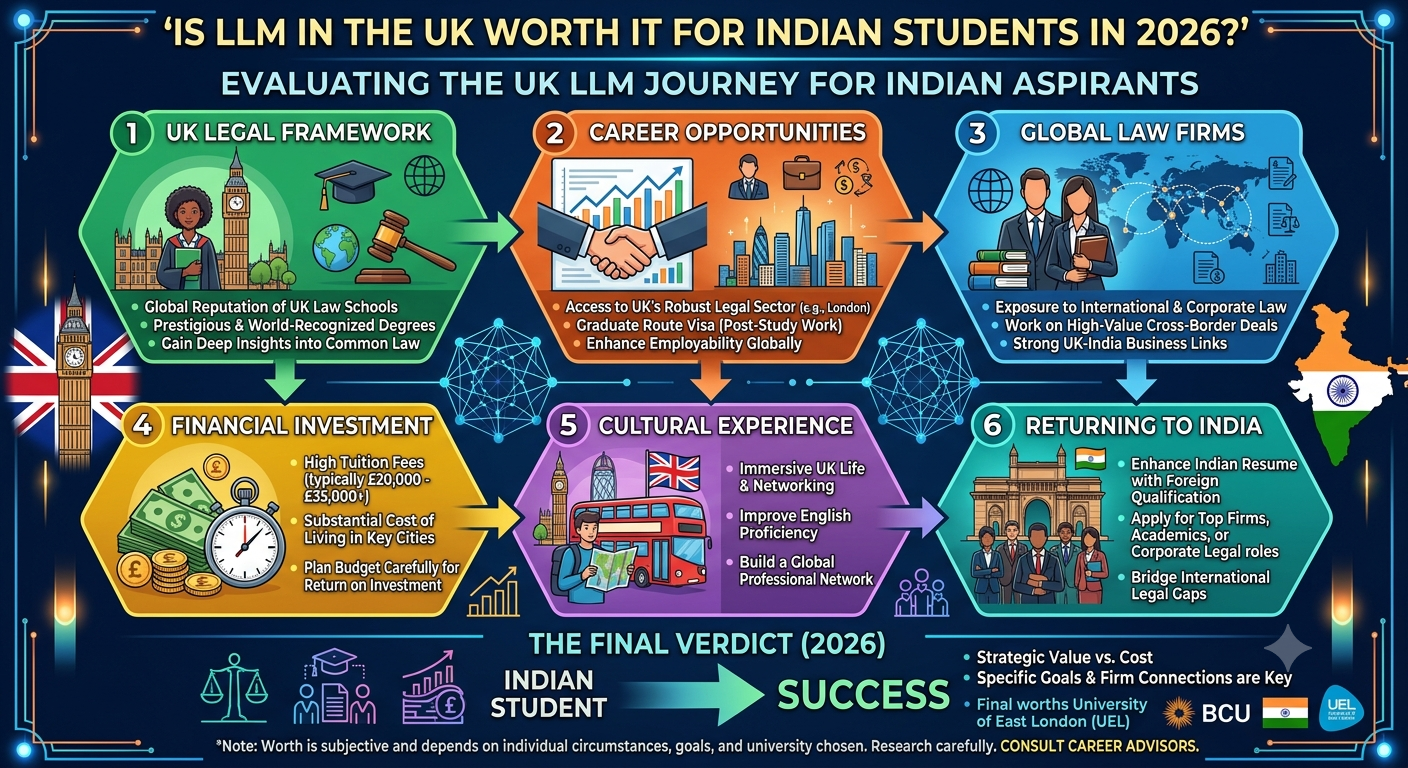
Walk into any study abroad consultation in India, and someone will eventually ask this. The one-year LLM in the UK has this almost mythic status – a golden ticket, a career accelerator, a way to escape the overcrowded Indian legal market. But after placing dozens of law graduates into UK universities over the last few years, we've seen the full picture. The wins, the struggles, and the quiet disappointments.
Let's cut through the hype. The UK LLM in 2026 is not automatically worth it. For some students, it's transformative. For others, it's an expensive lesson in misplaced expectations. The difference comes down to what you actually want from it, and whether you've done your homework.
What the UK LLM Actually Offers
First thing, get what you’re actually buying. A UK LLM is usually a nine-to-twelve-month taught programme, sort of like, yes intensive, rigorous and very research- leaning. You know how some Indian law degrees are mostly about memorising statutes, well UK options tend to push deeper critical analysis, sharper legal writing and independent thinking… more than just recall.
The biggest pull, honestly, is the global recognition. A degree from a Russell Group, or just a well respected UK university, carries real weight in international law firms, arbitration centres and multinational corporations. If you’re trying to build a path toward cross-border transactions, international arbitration, or human rights law, the UK LLM basically gives you a vocabulary plus a network that’s pretty hard to recreate elsewhere.
But here's the catch. The UK LLM is not a conversion course. It doesn't qualify you to practise English law unless you take the additional SQE (Solicitors Qualifying Examination) or BPTC (for barristers). Many Indian students arrive thinking they'll be able to work as lawyers in the UK right away – and that's simply not how it works.
The Cost Reality – Beyond Tuition Fees
Let's talk numbers because this is where dreams meet budgets. Tuition fees for an LLM in the UK for 2026 range from £18,000 to £35,000 depending on the university. London universities sit at the higher end. Living costs add another £12,000–£15,000 for the year. Total investment – roughly ₹30-45 lakhs at current exchange rates.
Now, ask yourself: what's your return timeline? Graduates from top-tier UK LLM programmes often secure roles in international law firms, with starting salaries in London ranging from £45,000–£60,000. But those roles are fiercely competitive, and they usually go to students with prior work experience and exceptional academic records. If you're fresh out of a three-year LLB with no internships, you're competing against candidates who've worked as associates for two or three years.
For Indian students planning to return home, the salary premium is real but not astronomical. A UK LLM might add ₹5-10 lakhs to your starting package in a top Indian firm – but that's not a guaranteed uplift, and it takes years to recoup your investment.
The Employability Question – UK vs India
This is the pivot point. If you want to stay and work in the UK post-LLM, you have two routes: find a sponsored job under the Skilled Worker visa, or use the Graduate Route (two-year visa) to work freely. The Graduate Route sounds fantastic, but here's the ground truth – many employers are hesitant to invest in training someone who might leave after two years. Law firms, in particular, prefer candidates on longer-term visas.
If you're targeting Indian law firms, a UK LLM is increasingly viewed as a differentiator, especially for corporate and arbitration practices. But it's not a substitute for Indian legal knowledge – you'll still need to qualify for the bar exam if you want to litigate. Many of our students have leveraged their UK LLM to move into in-house legal roles in MNCs, compliance, or legal tech, where the international perspective genuinely adds value.
The sweet spot? Indian students with 2-4 years of work experience in India before the LLM. They have practical grounding, they know what they want to specialise in, and they return with a clear career roadmap. Fresh graduates without work experience are the ones who struggle most to see a return.
Choosing the Right University – Rankings Aren't Everything
We’ve noticed students kinda obsess over QS rankings and then they miss the bigger picture, like they forget what’s actually happening. The reputation of your LLM does matter, but the specialization does too, in that same way. A place like SOAS has this serious, almost unmatched strength around human rights and international law. Bristol and Durham are powerhouses in commercial law. Warwick and Edinburgh offer strong arbitration programmes. If you apply to a university that doesn't align with your niche, you'll be fighting an uphill battle.
Also, consider the faculty, the moot court opportunities, and the alumni network in India. Some UK universities have active Indian alumni chapters that actively mentor new graduates. That's worth more than a ranking number.
Scholarships and Financial Strategies
Don’t just assume you’ll pay full freight, y’know. In 2026, a lot of UK universities are running specific scholarships for Indian students, like the GREAT Scholarships, Chevening, and also university specific awards such as the Dean’s Scholarship. We’ve had students lock in as much as 50% off tuition fees through focused applications and it’s not magic, it’s timing + fit. The main thing is to apply early, and tweak your personal statement so it clearly shows why you’re a good fit, for that exact award not just “a scholarship” in general.
Some students, meanwhile, go for education loans from Indian banks that can have fairly competitive rates for UK programmes. SBI and other public banks tend to offer loans up to ₹40 lakhs, at roughly 10–12% interest. This is a usable route, but don’t glide past the fine print—plan your repayment properly, because you shouldn’t assume you’ll clear it in just two years, even if the numbers look “manageable” at first.
The Practicalities: Visas, Accommodation, and Adaptation
The student visa route is straightforward – you need your CAS from the university, maintenance funds (£1,334 per month if in London, £1,023 outside for up to 9 months), and a valid IELTS (typically 6.5-7.0 overall). However, post-study work visas require you to secure a job that meets salary thresholds – currently £26,200 per year for most roles. In legal professions, that's achievable, but not guaranteed.
Accommodation is a major cost. University halls are convenient but expensive. We often advise students to look at private shared flats after the first semester to bring costs down. The weather, the food, the pace of life – these are small adjustments, but they add up. Students who thrive are the ones who join student societies, attend networking events, and actively build a community.
Who Should Actually Go for the UK LLM in 2026?
Based on what we've seen, the UK LLM is worth it for:
-
Law graduates with at least 1-2 years of work experience, who want to specialise in a niche area and return to India with a competitive edge.
-
Candidates aiming for international arbitration, corporate M&A, or human rights practice where UK qualifications are genuinely valued.
-
Students who secure significant scholarships, reducing the financial burden to a manageable level.
-
Those who are open to working in the UK for a few years and have researched the SQE route thoroughly.
It's probably not worth it for:
Fresh graduates, with zero work experience, kinda thinking the diploma itself will drop a high paying role instantly… like, no extra steps.
Students coming from less typical law backgrounds, who never really built solid legal English fundamentals–and then the whole academic writing pressure is just going to feel like a rude surprise.
Anyone who jumps into unsustainable debt, without a real repayment road map, or a clear idea of how it’s going to be handled.
Final Take
The LLM in UK for Indian Students is a serious professional investment, not a gap-year adventure. It can open doors, build networks, and sharpen your legal thinking like nothing else. But it's not a magic wand. The students who succeed are the ones who treat it as a career strategy, not a qualification checkbox.
Talk to alumni. Attend webinars. Read the module handbooks. Speak to study in UK consultants who've actually placed students and can give you candid feedback on university outcomes – not just rankings. Do your research, run your numbers, and be brutally honest about your career goals.
If you go in with clear eyes, the UK LLM can be one of the best decisions you make. If you go in chasing a dream without a plan, it becomes an expensive lesson. The choice is yours, but the data doesn't lie – preparation and realism are the real predictors of success.
- Goth Lifestyle
- Fashion & Style
- Music & Bands
- Art & Photography
- Creative Writing & Poetry
- Events & Scene
- Occult & Spirituality
- DIY & Tutorials
- Beauty & Self-Care
- Relationships & Dating
- Gaming & Media
- Tech & Gadgets
- Body Art & Piercings
- Underground Culture
- Spotlights & Interviews
- Travel & Places
- Lifestyle & Daily Life
- Fitness & Health
- Travel & Adventure
- Books & Literature
- Tech & Gaming
- Movies & TV
- Food & Drinks
- Humor & Memes
- Pets & Animals
- General Arts & Crafts

 English
 Arabic
 French
 Spanish
 Deutsch
 Turkish
 Dutch
Dutch
 Italiano
 Russian
 Romaian
 Portuguese (Brazil)
 Greek
Greek