


Can’t Get Rid of That Fat Pocket Above Your C-Section Scar? Here’s What Women in the Netherlands Should Know About Lipo Laser
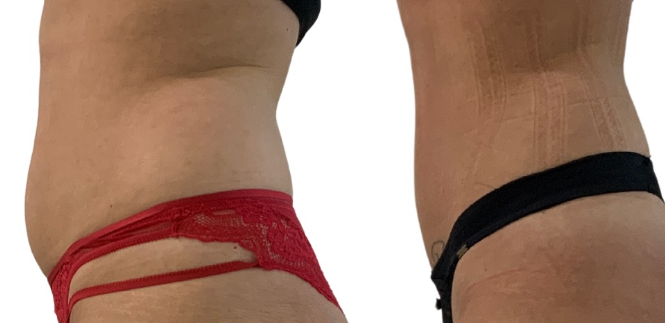
In April 2026, a woman shared her experience in a public C-section support community. She had undergone two C-sections and was nearly three years postpartum. At 157 cm and 55 kg, she described herself as petite, yet the shelf above her scar was still very noticeable on her frame.
She believed she had reached the point where losing more body fat would require extreme dieting. She also did not want a tummy tuck. After working specifically on what she described as tethered tissue around her scar, she reported a visible improvement.
Her experience is personal. It does not prove that scar work will remove a C-section shelf for everyone. However, it highlights an important point that is easy to miss when you look at your lower abdomen in the mirror: a bulge above a C-section scar is not always just a pocket of stubborn fat.
It may involve localized fat. It may be loose skin. Scar tissue can affect the shape of the area. Pregnancy-related changes to the abdominal wall may also play a part.
That distinction matters before considering lipolaser or any other fat-reduction treatment.
After hours of research into postpartum recovery, abdominal muscle separation, laser-assisted fat treatments, Dutch cosmetic-care rules, and real patient experiences, the most useful advice is surprisingly simple: first find out what is creating the shelf. Only then can you judge whether reducing fat is likely to help.
Why Can a Pocket or Shelf Form Above a C-Section Scar?
"C-section shelf" is an informal term rather than a formal medical diagnosis. Women often use it to describe a fold, pouch, or raised area that sits directly above a caesarean scar.
There is no reliable medical statistic showing exactly how many women develop a permanent C-section shelf. Any article or clinic that gives a precise percentage without strong evidence should be treated carefully.
What we do know is that pregnancy and abdominal surgery can both change the appearance of the lower abdomen.
During pregnancy, the abdominal wall stretches as the uterus grows. The skin expands. The connective tissues are placed under more tension. Fat distribution can also change.
A C-section adds another layer to the recovery process. The incision heals through several tissue layers. As healing takes place, the scar and surrounding tissue may not move or sit exactly as they did before pregnancy.
For one woman, the visible shelf may be mostly soft subcutaneous fat. This is the layer of fat directly beneath the skin.
For another woman, the main problem may be stretched or loose skin.
Someone else may have a scar that appears tight or tethered. This can make the tissue above the scar look more prominent.
In many cases, more than one factor is involved.
That is why two women can look as though they have the same lower-belly pouch while needing completely different approaches.
Sometimes the Problem Is Not Mainly Fat
Diastasis recti is another important part of the picture.
It happens when the two sides of the rectus abdominis muscles become separated along the middle of the abdomen. Pregnancy commonly causes these muscles and the tissue between them to stretch.
One of the better-known studies on the subject is "Diastasis Recti Abdominis During Pregnancy and 12 Months After Childbirth: Prevalence, Risk Factors and Report of Lumbopelvic Pain."
The prospective cohort study followed 300 first-time pregnant women. Using the study's definition of diastasis recti, researchers found it in 60.0% of participants six weeks after childbirth. The prevalence was 45.4% at six months and remained 32.6% at 12 months postpartum.
These figures do not tell us how many women have a C-section shelf. They also do not mean that every lower-abdominal bulge after pregnancy is caused by diastasis recti.
They do show why persistent abdominal shape after childbirth should not automatically be treated as a fat problem.
A fat-reduction procedure works on fatty tissue. It does not physically bring separated abdominal muscles back together.
So even when a woman has some localized fat, reducing that fat may not completely flatten the abdomen if the abdominal wall itself is also contributing to the bulge.
A proper assessment matters more than guessing from a mirror or comparing your stomach with someone else's before-and-after photograph.
Why Weight Loss May Help Without Making the Shelf Disappear
One of the most frustrating experiences for women is reaching a comfortable body weight while one small area above the scar refuses to change.
This is possible because fat loss is not fully under your control.
You can lose overall body fat through changes in nutrition, physical activity, and energy balance. You cannot reliably tell your body to remove fat from one exact spot first.
Some people lose fat quickly from their face or upper body while keeping more around the lower abdomen. Others notice a different pattern.
Exercise is still important. It supports general health, strength, mobility, and weight management. Appropriate postpartum exercises may also help women rebuild core control and function.
What exercise cannot do is guarantee that one particular pocket of subcutaneous fat will disappear.
Real patient experiences show how varied the outcome can be.
In a June 2026 discussion, one mother said her youngest child was almost 14 years old and that her C-section shelf was still present. She explained that weight loss had made it look much better. By that point, however, she felt that what remained was mostly loose skin rather than fat. Another woman in the same discussion said diet and exercise had improved her own shelf without fully returning her abdomen to its earlier appearance.
These are personal accounts rather than scientific evidence. Still, they illustrate a useful point.
Losing fat and removing loose skin are not the same thing.
If loose skin is the main concern, further fat reduction may not produce the smoother result someone expects. The treatment needs to match the tissue that is actually causing the problem.
Where Does Lipo Laser Fit Into This?
The term "lipo laser" or "lipolaser" can refer to different types of laser-based body-contouring treatments.
This can create confusion.
Some technologies use low-level laser energy externally and do not involve inserting anything beneath the skin. Other procedures use laser-assisted lipolysis, where laser energy is delivered into the fatty layer through a small instrument or fibre.
These methods should not be treated as identical.
When considering treatment for a small fat pocket above a C-section scar, the exact procedure matters. You should know what technology is being used, whether the treatment is invasive or non-invasive, who is performing it, and what result it is realistically designed to achieve.
Laser-assisted lipolysis is generally used for body contouring rather than significant weight loss.
It may therefore make more sense for someone who is already close to a stable weight and has a limited area of localized subcutaneous fat.
If the shelf is mainly loose skin, scar tethering, or abdominal muscle separation, reducing fat alone may not solve the problem.
What Does Research Actually Say About Laser-Assisted Fat Treatment?
There is research suggesting that some laser-assisted techniques may affect both localized fat and skin contraction, but the evidence needs to be presented carefully.
The "Randomized, Blinded Split Abdomen Study Evaluating Skin Shrinkage and Skin Tightening in Laser-Assisted Liposuction Versus Liposuction Control" by Barry E. DiBernardo compared laser-assisted liposuction with liposuction alone.
The study involved only 10 women with unwanted abdominal fat and mild to moderate skin laxity.
Different abdominal areas on the same participants were treated with the two approaches. At three months, the researchers reported significantly greater skin tightening and shrinkage on the laser-treated side.
The findings are relevant, but the study was small. A trial involving 10 participants cannot tell every woman exactly what result she will get.
Another study by Gordon H. Sasaki, titled "Quantification of Human Abdominal Tissue Tightening and Contraction After Component Treatments With 1064-nm/1320-nm Laser-Assisted Lipolysis," was even smaller.
It examined the lower abdomen of only three female participants.
The researchers reported average skin contraction of 9.1% at three months and 7.6% at six months with the specific technique they studied. These figures should be interpreted cautiously because results from three people cannot be generalized to everyone considering treatment.
The research suggests a possible tightening effect with certain laser-assisted procedures. It does not mean that a laser can remove a large amount of loose postpartum skin or guarantee a flat lower abdomen.
Non-Invasive Laser Research Is a Separate Area
It is also important not to mix evidence from different laser technologies.
The 2025 systematic review "Low-Level Laser Therapy for Reducing Body Circumferences" by Gotof Abdesalam Mustafa and colleagues examined non-invasive low-level laser therapy.
The review included three randomized controlled trials with a total of 160 participants.
Across the included trials, the researchers reported reductions in several body measurements. They found an average waist-circumference reduction of 2.48 cm in treatment groups compared with 0.635 cm in controls. The authors also noted wide differences between treatment protocols and limited follow-up, making it difficult to determine the best treatment settings or long-term effectiveness.
This research is useful for understanding laser-based body contouring, but low-level external laser therapy is not automatically equivalent to minimally invasive laser-assisted lipolysis.
When a clinic uses the term "lipolaser," ask exactly which procedure they mean.
Could Scar Tissue Be Making the Shelf Look Bigger?
The story at the beginning raises another possibility: scar tethering.
Some women notice that their C-section scar or the surrounding tissue feels tight, numb, sensitive, or less mobile than nearby skin.
The visible scar is only the surface part of the healing process. Changes also occur in the tissues beneath it.
If one part of the scar appears pulled inward, the softer tissue above it may look more prominent. This can create a shelf-like shape even when the amount of fat itself is not especially large.
That does not mean every C-section shelf is caused by scar tissue.
It also does not mean scar massage is a proven way to remove a fat pocket.
The important point is that scar mobility should be considered when the shape of the lower abdomen changes sharply at the incision line.
A healthcare professional with relevant postpartum or scar-management experience may be able to assess whether the scar is contributing to the appearance.
This is another reason why choosing fat reduction based only on appearance can lead to disappointment.
Give Your Body Enough Time After a C-Section
Timing is also important.
A woman who is a few weeks postpartum should not judge her abdomen in the same way as someone who is several years beyond childbirth.
Early C-section recovery involves healing, swelling, and continuing changes in the abdominal area. The body does not immediately return to its long-term postpartum shape.
Real online discussions show how emotionally difficult this stage can be. Women only weeks or months after surgery sometimes worry that the appearance they see will be permanent.
For some, the shelf becomes less noticeable as healing continues. For others, a pouch or fold remains for years.
If you have ongoing pain, unusual swelling, redness, wound changes, or other symptoms after a C-section, the priority should be medical assessment rather than cosmetic treatment.
A persistent bulge that seems related to abdominal function may also deserve assessment for issues such as diastasis recti before you consider reducing fat.
Who Might Be a More Suitable Candidate for Lipolaser?
The most logical candidate is someone whose body has fully recovered and whose concern is genuinely a small localized fat deposit.
Her weight is relatively stable. The fat is soft and sits beneath the skin. There is not a large amount of hanging excess skin. There is no unresolved medical issue affecting the abdominal wall.
Even then, suitability needs to be judged individually.
A person with mild skin laxity may have different expectations from someone with substantial loose skin after several pregnancies.
A woman with noticeable diastasis recti may need to think about the abdominal wall as well as the fatty layer.
Someone with strong scar tethering may need the scar itself assessed.
The best consultation is not the one where a doctor automatically agrees to perform the treatment.
It is the one where the doctor can explain what part of the problem the procedure can address and what part it cannot.
What Women in the Netherlands Should Check Before Treatment
For women considering cosmetic treatment in the Netherlands, provider selection is just as important as the procedure itself.
The Dutch Government, Rijksoverheid, states that not every practitioner may perform every medical cosmetic procedure. It also advises patients to check whether a healthcare professional is registered in the BIG-register where relevant.
Importantly, the government points out that being registered as a doctor confirms professional authority but does not automatically prove that the doctor is skilled at a particular cosmetic procedure. Experience and additional training also matter.
That is a useful distinction.
Do not stop at asking, "Is this person a doctor?"
Ask how much experience they have with the exact procedure.
Ask how often they treat the abdominal area.
Ask who will handle complications if something goes wrong.
Ask what aftercare is provided.
The Inspectie Gezondheidszorg en Jeugd (IGJ) oversees the quality and safety of cosmetic healthcare in the Netherlands. The IGJ states that cosmetic procedures are never completely without risk. Providers are expected to carry out careful intake procedures, properly inform patients, employ suitably trained and competent professionals, and have arrangements for complications and aftercare.
Dutch patients can also verify relevant BIG registration and look beyond advertising when comparing providers.
A low price or dramatic social media result should never replace a proper medical assessment.
The Best Decision Starts With Understanding Your C-Section Shelf
A stubborn pocket above a C-section scar can feel frustrating when you have already exercised, lost weight, or waited years for the area to change.
But there is no single explanation for every shelf.
One woman's problem may be mostly localized fat.
Another may have loose skin that became more obvious after weight loss.
Scar tethering may influence the shape for someone else.
Diastasis recti may contribute to a wider abdominal bulge in another woman.
Lipolaser may be worth considering when localized fat is truly the main concern and the body has had enough time to recover. It should not be expected to repair separated abdominal muscles or remove a large amount of excess skin.
For women in the Netherlands, the safest approach is to start with a careful assessment and realistic expectations. Check who is performing the procedure. Verify professional credentials where relevant. Ask about experience, risks, recovery, complications, and alternatives.
Most importantly, make sure the treatment matches the problem you actually have.
Your C-section scar represents a body that has been through pregnancy, childbirth, healing, and major surgery. You do not have to change it. At the same time, there is nothing wrong with exploring a cosmetic option if a persistent fat pocket genuinely bothers you.
The difference between a good decision and an expensive disappointment often comes down to one question: are you treating fat, or are you trying to treat something that only looks like fat?
- Goth Lifestyle
- Fashion & Style
- Music & Bands
- Art & Photography
- Creative Writing & Poetry
- Events & Scene
- Occult & Spirituality
- DIY & Tutorials
- Beauty & Self-Care
- Relationships & Dating
- Gaming & Media
- Tech & Gadgets
- Body Art & Piercings
- Underground Culture
- Spotlights & Interviews
- Travel & Places
- Lifestyle & Daily Life
- Fitness & Health
- Travel & Adventure
- Books & Literature
- Tech & Gaming
- Movies & TV
- Food & Drinks
- Humor & Memes
- Pets & Animals
- General Arts & Crafts

 English
 Arabic
 French
 Portuguese
 Deutsch
 Turkish
 Dutch
Dutch
 Italiano
 Russian
 Romaian
 Portuguese (Brazil)
 Greek
Greek