


The Future of Customer Experience Is AI—Don't Get Left Behind
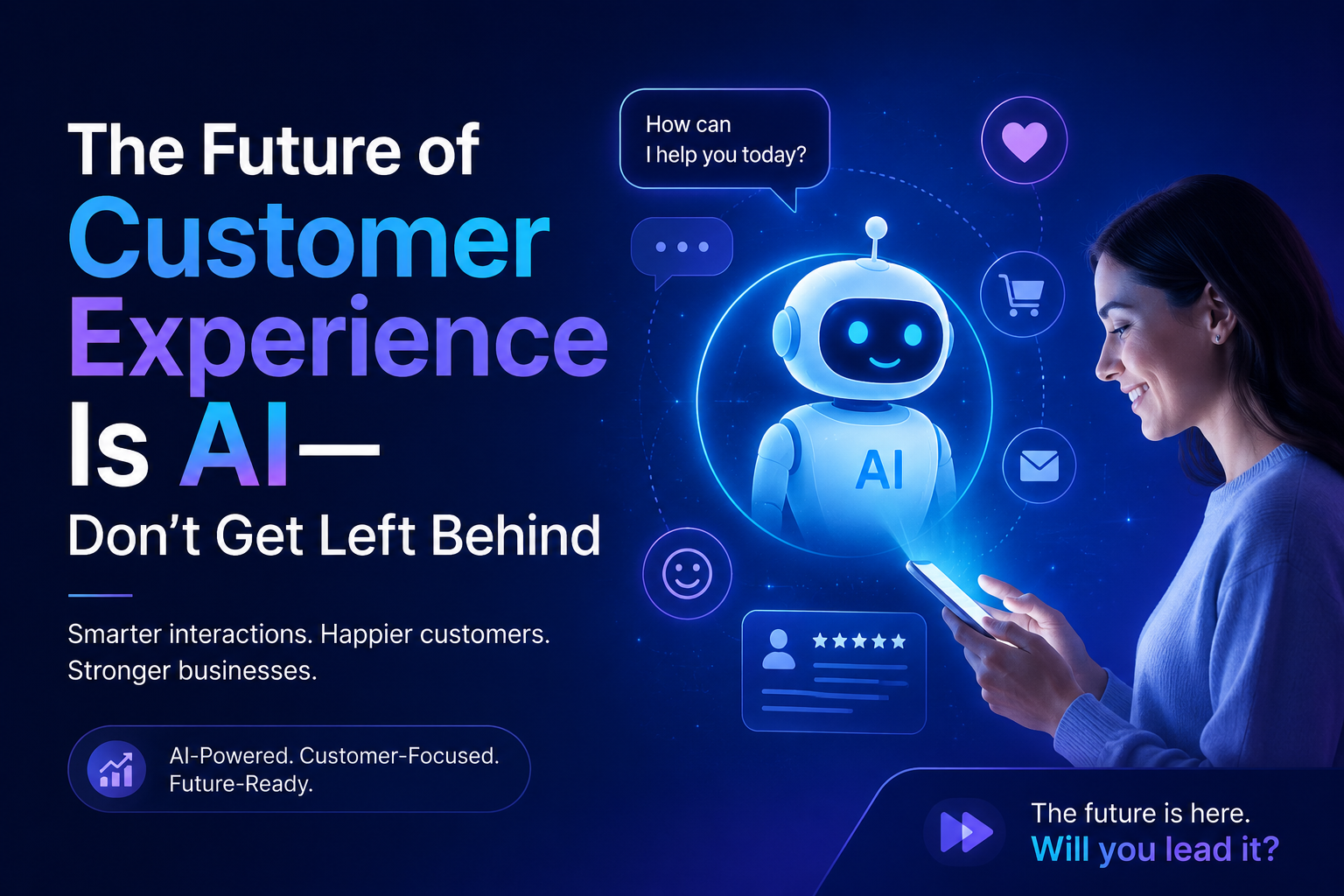
The Future of AI in Customer Experience
Have you ever chatted with a company's customer support and received an instant answer, even late at night? Or noticed how online stores recommend products that match your interests? These experiences are powered by Artificial Intelligence (AI).
AI is changing the way businesses communicate with customers. It helps companies answer questions faster, solve problems more accurately, and provide personalized experiences. Instead of making customers wait for long periods or repeat the same information multiple times, AI makes customer service faster, smarter, and more convenient.
Customer experience, often called CX, refers to every interaction a customer has with a business. From visiting a website and asking questions to buying a product and receiving support, each step shapes the customer's opinion of the company. Today, businesses understand that providing excellent customer experience is just as important as offering quality products or services.
As AI technology continues to improve, it is becoming an essential part of customer experience strategies across many industries. Retail stores, banks, hospitals, travel companies, and online businesses are all using AI to improve customer satisfaction while reducing costs and increasing efficiency.
However, AI also brings challenges. Companies must protect customer data, use AI responsibly, and ensure that technology does not replace the human touch when empathy and understanding are needed.
This blog explores how AI is transforming customer experience, the benefits it offers, the challenges businesses face, and the exciting future of AI-powered customer interactions.
Understanding AI in Customer Experience
Artificial Intelligence is the ability of computer systems to perform tasks that normally require human intelligence. These tasks include learning from data, recognizing speech, understanding language, solving problems, and making decisions.
In customer experience, AI helps businesses understand customer needs and respond more effectively. Instead of relying only on human employees, companies use AI tools to provide support, analyze customer behavior, and deliver personalized services.
One of the biggest advantages of AI is its ability to process large amounts of information within seconds. It can study customer preferences, purchase history, browsing habits, and feedback to provide useful insights. Businesses then use these insights to improve their products and services.
Several AI technologies play an important role in customer experience.
Machine Learning
Machine learning allows AI systems to learn from data without being manually programmed for every situation. As more customer information becomes available, the system becomes smarter and makes better predictions.
For example, an online shopping website can learn what products customers usually buy together and recommend similar items during future visits.
Natural Language Processing (NLP)
Natural Language Processing, or NLP, enables computers to understand and respond to human language. This technology powers chatbots, virtual assistants, and automated customer support systems.
NLP helps AI understand customer questions, identify the meaning behind words, and provide relevant answers in a natural conversation.
Generative AI
Generative AI creates new content instead of simply retrieving existing information. It can write emails, answer customer questions, summarize conversations, and generate personalized recommendations.
Modern AI assistants can handle complex conversations while maintaining a natural and friendly tone. This improves customer satisfaction and reduces the workload for support teams.
Predictive Analytics
Predictive analytics uses customer data to forecast future behavior. Businesses can identify customers who may stop using their services, predict future purchases, and offer personalized promotions before customers even ask.
This proactive approach allows companies to solve problems early and strengthen customer relationships.
The Evolution of Customer Experience
Customer service has changed significantly over the years.
In the past, customers visited physical stores or called customer service centers for assistance. They often waited in long queues or spent several minutes on hold before speaking with a representative.
As the internet became more popular, companies introduced email support, websites, and online help centers. Customers gained more ways to contact businesses, but response times could still be slow.
Today, AI has transformed customer service into a faster and more efficient experience. Customers can receive instant answers through chatbots, virtual assistants, social media, and messaging apps at any time of the day.
The future promises even more improvements. AI systems will become smarter, understand customer emotions more accurately, and provide highly personalized experiences across every communication channel.
Instead of simply reacting to customer requests, future AI systems will predict customer needs and offer solutions before problems occur. This shift from reactive support to proactive service represents one of the biggest changes in customer experience.
Current Applications of AI in Customer Experience
Artificial Intelligence is no longer a technology of the future. Many businesses already use it every day to improve customer experience. From answering questions to recommending products, AI helps companies provide faster, smarter, and more personalized services.
Let's explore some of the most common ways AI is being used today.
AI Chatbots and Virtual Assistants
One of the most popular uses of AI is customer support through chatbots and virtual assistants.
AI chatbots are available 24 hours a day, seven days a week. They can answer common questions, guide customers through websites, help with orders, and solve simple problems within seconds.
For example, if a customer wants to know the status of an order, the chatbot can quickly provide the latest update without making the customer wait for a human agent. Customers can also ask about return policies, payment options, or product information at any time.
Virtual assistants are even more advanced. They can understand natural conversations, remember previous interactions, and provide more accurate answers. Some virtual assistants can also schedule appointments, process payments, or help customers complete purchases.
Because chatbots handle routine questions, human support agents have more time to focus on complex issues that require personal attention and problem-solving skills.
Personalized Customer Experiences
Today's customers expect businesses to understand their needs and preferences. AI makes this possible by analyzing customer data and creating personalized experiences.
Every time customers visit a website, browse products, or make a purchase, they generate valuable information. AI studies this data to understand their interests and shopping habits.
For example, online stores recommend products based on previous purchases and browsing history. Streaming platforms suggest movies and TV shows that match a user's viewing habits. Music apps create playlists based on listening preferences.
Personalization is not limited to product recommendations. Businesses also use AI to send personalized emails, offer special discounts, display relevant website content, and provide customized marketing messages.
When customers receive recommendations that match their interests, they are more likely to make purchases and remain loyal to the brand.
Predictive Analytics
AI does more than analyze past customer behavior. It also predicts future actions.
Predictive analytics uses historical data and machine learning to identify patterns and forecast customer needs.
For example, AI can predict:
-
Which customers may stop using a service.
-
Which products customers are likely to buy next.
-
When demand for certain products will increase.
-
Which marketing campaigns will produce the best results.
Businesses use these predictions to improve customer satisfaction.
If AI detects that a customer may leave a subscription service, the company can offer a special discount or personalized support before the customer decides to cancel.
This proactive approach helps businesses keep customers happy and reduce customer loss.
Voice AI and Conversational AI
Voice technology has become an important part of customer experience.
Many customers now prefer speaking instead of typing. AI-powered voice assistants allow users to ask questions naturally and receive immediate responses.
Voice AI is widely used in customer service call centers. Instead of waiting for an available agent, customers can speak with an AI assistant that understands their requests and provides helpful solutions.
Modern conversational AI can understand different accents, recognize speech accurately, and continue conversations naturally. It can also transfer customers to human agents when necessary while sharing the conversation history, so customers do not have to repeat their problems.
This creates a smoother and less frustrating customer experience.
AI in Omnichannel Customer Experience
Customers interact with businesses through many different channels, including websites, mobile apps, email, social media, and messaging platforms.
AI helps create a consistent experience across all these channels.
For example, a customer may begin chatting with a company on its website, continue the conversation through a mobile app, and later receive follow-up support by email. AI keeps track of the conversation so customers do not have to explain their issue again.
This connected experience saves time and improves customer satisfaction.
Omnichannel AI also helps businesses respond faster on social media by automatically answering common questions, directing customers to helpful resources, and identifying urgent issues that require human support.
AI-Powered Recommendation Systems
Recommendation systems are among the most successful applications of AI.
These systems analyze customer preferences, browsing history, purchase behavior, and similar customer profiles to suggest products or services that are most likely to interest each individual.
For example:
-
Online stores recommend products based on previous purchases.
-
Streaming services suggest movies and TV shows.
-
Music platforms recommend songs and playlists.
-
News websites display articles based on reading history.
-
Travel companies suggest destinations and vacation packages.
These recommendations help customers discover products more easily while increasing sales for businesses.
Sentiment Analysis
Understanding customer emotions is just as important as answering their questions.
AI can analyze customer reviews, emails, chat messages, and social media posts to determine whether customers feel happy, frustrated, disappointed, or satisfied.
This process is called sentiment analysis.
Businesses use sentiment analysis to identify common customer concerns, improve products, and respond quickly to negative feedback before it affects their reputation.
For example, if many customers complain about delayed deliveries, AI can detect the trend and alert managers so they can solve the problem quickly.
AI for Self-Service Support
Many customers prefer solving simple problems on their own instead of contacting customer support.
AI-powered self-service tools make this possible.
These tools include:
-
Intelligent knowledge bases
-
Frequently Asked Questions (FAQs)
-
Interactive troubleshooting guides
-
Automated password recovery
-
Order tracking systems
AI helps customers find the right information quickly by understanding their questions and providing accurate answers.
This reduces waiting times while allowing support teams to focus on more complex customer issues.
Real-World Examples
Many well-known companies already use AI to improve customer experience.
E-commerce companies use AI to recommend products and provide instant customer support.
Banks use AI to detect fraud, answer customer questions, and help users manage their accounts.
Healthcare organizations use AI to schedule appointments, remind patients about medications, and answer common health-related questions.
Travel companies use AI to recommend destinations, assist with bookings, and provide real-time travel updates.
Streaming services use AI to recommend movies, TV shows, and music based on user preferences.
These examples show that AI is becoming an essential part of modern customer experience across many industries.
Summary
AI is transforming customer experience in many ways. Chatbots provide instant support, recommendation systems offer personalized suggestions, predictive analytics helps businesses anticipate customer needs, and voice assistants make communication more natural.
As AI technology continues to improve, businesses will be able to deliver faster, more personalized, and more convenient experiences than ever before. Companies that successfully combine AI with human expertise will be better prepared to meet customer expectations and build long-lasting relationships.
- Goth Lifestyle
- Fashion & Style
- Music & Bands
- Art & Photography
- Creative Writing & Poetry
- Events & Scene
- Occult & Spirituality
- DIY & Tutorials
- Beauty & Self-Care
- Relationships & Dating
- Gaming & Media
- Tech & Gadgets
- Body Art & Piercings
- Underground Culture
- Spotlights & Interviews
- Travel & Places
- Lifestyle & Daily Life
- Fitness & Health
- Travel & Adventure
- Books & Literature
- Tech & Gaming
- Movies & TV
- Food & Drinks
- Humor & Memes
- Pets & Animals
- General Arts & Crafts
 Turkish
 English
 Arabic
 French
 Spanish
 Portuguese
 Deutsch
 Dutch
Dutch
 Italiano
 Russian
 Romaian
 Portuguese (Brazil)
 Greek
Greek