


CBSE 2027 Board Exams: 10 Costly Mistakes That Could Cost You Your Dream Score
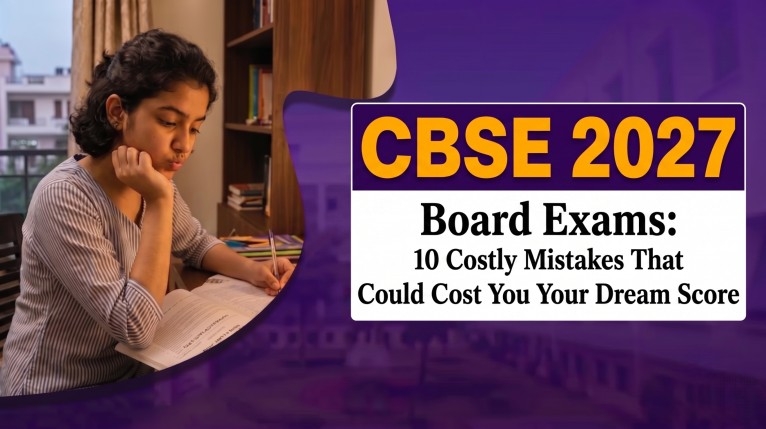
Every year, thousands of Class 10 and Class 12 students walk into their CBSE board examinations with months of preparation behind them, yet many still walk out disappointed with their results. The gap between hard work and good results often comes down to a handful of avoidable errors in strategy, mindset, and daily habits. If you're preparing for the CBSE 2027 board exams, understanding these pitfalls now, rather than discovering them the hard way in the exam hall, can make a genuine difference to your final percentage.
Preparation isn't just about the number of hours you put in; it's about how effectively those hours are used. A student studying eight hours a day with a scattered approach can easily be outperformed by one who studies for five hours with focus and structure. This is where the right guidance matters. Institutions that emphasize conceptual clarity alongside exam strategy, such as the Best CBSE School in Sikar, often help students build these habits early, long before the exam season pressure sets in. Whether or not you have access to such structured mentorship, the good news is that most preparation mistakes are entirely within your control to fix.
Why Preparation Mistakes Matter More Than You Think
Board exams are as much a test of discipline and self-awareness as they are of subject knowledge. The CBSE curriculum, particularly at the senior secondary level, rewards students who understand concepts deeply and can apply them under time constraints. A single misstep repeated over months, like relying purely on rote memorisation or ignoring the marking scheme, can quietly erode your performance without you even realising it until the results are declared.
Let's look at the mistakes that trip up even sincere, hardworking students.
1. Starting Preparation Too Late
One of the most frequent regrets among board exam candidates is not starting early enough. Many students assume that a few intense months before the exam will be sufficient, but the CBSE syllabus, especially for subjects like Mathematics, Physics, and Accountancy, requires layered understanding that builds over time.
-
Delayed starts lead to rushed revision and shallow understanding of complex chapters.
-
Late starters often skip foundational topics, which weakens performance in later, more advanced units.
-
Cramming increases anxiety and reduces retention during the actual exam.
The fix is straightforward: begin structured preparation at least ten to twelve months before the exam, dedicating the early months to concept-building rather than speed.
2. Ignoring the NCERT Textbooks
It's tempting to jump straight into reference books, guides, or online question banks, but CBSE question papers are drawn almost entirely from NCERT content. Students who bypass the textbook in favour of shortcuts often find themselves unfamiliar with the exact phrasing and depth expected by examiners.
-
NCERT examples and in-text questions frequently appear, sometimes with minor variations, in the actual paper.
-
Reference books are useful for extra practice, but they should supplement, not replace, the textbook.
-
Diagrams, definitions, and derivations in NCERT are considered the gold standard for scoring full marks.
3. Neglecting the Marking Scheme and Sample Papers
Many students study hard but lose marks simply because they don't understand how CBSE evaluators award points. The board releases sample papers and marking schemes well in advance, yet these resources are often underutilised.
-
Step-marking in subjects like Mathematics and Physics means partial answers still earn credit if the method is shown clearly.
-
Keyword-based evaluation in subjects like Biology and Social Science rewards precise terminology, not just correct ideas.
-
Reviewing previous years' toppers' answer sheets, available on the CBSE Academic website, reveals exactly what examiners are looking for.
4. Studying Without a Realistic Timetable
A vague plan to "study more" rarely translates into consistent action. Without a realistic, written timetable, students tend to gravitate toward subjects they enjoy while neglecting ones they find difficult, which is precisely the opposite of what effective preparation requires.
-
Allocate more time to weaker subjects rather than avoiding them.
-
Break preparation into weekly and monthly milestones instead of vague long-term goals.
-
Include buffer days in your schedule to accommodate unexpected disruptions like illness or school events.
5. Overloading on Passive Revision
Reading notes repeatedly or highlighting textbooks can feel productive, but passive revision techniques are among the least effective ways to retain information for a board exam. Active recall and spaced repetition, both well-documented in cognitive science literature, consistently outperform passive rereading.
-
Practice writing full answers by hand instead of just reading them, since board exams are handwritten.
-
Use active recall methods such as closing the book and attempting to reproduce diagrams, formulas, or definitions from memory.
-
Space out revision sessions over days and weeks rather than concentrating them right before the exam.
6. Avoiding Mock Tests Until the Last Moment
Some students postpone full-length mock tests until just a few weeks before the boards, which leaves little time to identify and correct weaknesses. Mock tests aren't just practice; they're diagnostic tools that reveal time-management issues, careless errors, and gaps in understanding.
-
Attempt full-length papers under timed, exam-like conditions at least once every two weeks in the final few months.
-
Analyse mistakes thoroughly rather than simply checking the score and moving on.
-
Track recurring error patterns, such as misreading questions or running out of time on long-answer sections.
7. Multitasking and Digital Distractions
With smartphones and social media constantly within reach, sustained focus has become harder to maintain than ever. Switching between study material and notifications fragments attention and significantly reduces the quality of study sessions, even if the total hours logged appear high.
-
Use focused study blocks, such as the Pomodoro technique, with phones kept out of reach during study time.
-
Designate specific, limited windows for checking messages or social media rather than allowing constant interruptions.
-
Create a dedicated, distraction-free study space separate from areas associated with relaxation or entertainment.
8. Comparing Yourself to Other Students
Comparison is an instinct, but constantly measuring your progress against classmates or siblings can be counterproductive. Every student has a different learning pace, and this kind of comparison often breeds unnecessary anxiety rather than motivation.
-
Focus on your own improvement over time by tracking personal mock test scores.
-
Remember that a student's visible study hours don't always reflect the quality or efficiency of their preparation.
-
Seek support from teachers or counsellors if comparison is affecting your confidence or mental well-being.
9. Neglecting Physical and Mental Health
It's easy to sideline sleep, exercise, and meals during exam preparation, believing that every extra hour of study is worth the trade-off. In reality, sleep deprivation and poor nutrition impair memory consolidation and concentration, both of which are essential for effective learning.
-
Aim for seven to eight hours of sleep, particularly in the weeks leading up to the exam.
-
Include short breaks and light physical activity in your daily routine to reduce stress.
-
Recognise the signs of burnout early, such as persistent fatigue or declining motivation, and address them rather than pushing through.
10. Underestimating Internal Assessments and Practicals
CBSE allocates a significant portion of marks, often twenty to thirty percent depending on the subject, to internal assessments, project work, and practical examinations. Students who focus exclusively on theory papers sometimes lose easy marks in these components.
-
Complete practical files, projects, and lab work well ahead of deadlines rather than rushing at the last minute.
-
Prepare thoroughly for viva voce sessions, as examiners often test conceptual understanding rather than memorised answers.
-
Treat internal assessments with the same seriousness as the final written paper, since these marks are added directly to your overall score.
Building a Better Preparation Strategy for CBSE 2027
Avoiding these mistakes isn't about perfection; it's about awareness and consistency. Small, sustainable changes, like starting early, prioritising NCERT material, practising active recall, and taking care of your physical and mental health, compound over months into a noticeably stronger performance. Board exams reward steady, informed effort far more than last-minute intensity.
If you're a parent or student currently evaluating preparation resources or school support systems, it's worth having a conversation with teachers or mentors about which of these areas need the most attention in your specific case. Every student's gaps are different, and a personalised approach will always outperform a generic one.
Conclusion
The journey to a strong CBSE 2027 board result isn't defined by a single dramatic effort in the final weeks, but by the everyday choices students make over the entire academic year. Starting early, trusting NCERT material, testing yourself regularly, and taking care of your physical and mental well-being aren't just exam strategies; they're habits that will serve you well beyond the boards too. Mistakes are a natural part of any learning process, but the students who succeed are the ones who recognise these patterns early and correct course before it's too late. With the right awareness, a realistic plan, and consistent effort, CBSE 2027 aspirants can walk into their exam hall with genuine confidence rather than last-minute panic. The goal isn't just to pass the boards, but to build a foundation of discipline and understanding that will carry forward into whatever comes next.
FAQs
Q1. When should CBSE 2027 board exam preparation ideally begin?
Ideally, ten to twelve months in advance, starting with concept-building in the early months before shifting to intensive revision and mock tests closer to the exam date.
Q2. Are NCERT books enough to score well in CBSE board exams?
NCERT books cover the core syllabus and most exam questions, but supplementing them with sample papers and previous years' question papers strengthens overall preparation.
Q3. How many mock tests should a student attempt before boards?
Ideally, one full-length timed mock test every two weeks during the final few months, allowing enough time to review mistakes and improve weak areas.
Q4. Do internal assessments really affect the final CBSE percentage?
Yes, internal assessments typically contribute twenty to thirty percent of the total marks in most subjects, making them significant to the overall final result.
Q5. How can students avoid exam stress during CBSE board preparation?
Maintaining a realistic timetable, adequate sleep, regular breaks, and open communication with teachers or family helps manage stress effectively throughout preparation.
Q6. Is it better to study many hours or study efficiently?
Efficient, focused study with active recall and regular self-testing produces better retention and results than long hours of passive, distracted studying.
- Goth Lifestyle
- Fashion & Style
- Music & Bands
- Art & Photography
- Creative Writing & Poetry
- Events & Scene
- Occult & Spirituality
- DIY & Tutorials
- Beauty & Self-Care
- Relationships & Dating
- Gaming & Media
- Tech & Gadgets
- Body Art & Piercings
- Underground Culture
- Spotlights & Interviews
- Travel & Places
- Lifestyle & Daily Life
- Fitness & Health
- Travel & Adventure
- Books & Literature
- Tech & Gaming
- Movies & TV
- Food & Drinks
- Humor & Memes
- Pets & Animals
- General Arts & Crafts

 English
 Arabic
 French
 Spanish
 Portuguese
 Deutsch
 Turkish
 Dutch
Dutch
 Italiano
 Russian
 Romaian
 Portuguese (Brazil)