


The Unsung Hero of Projection: The Ultimate Guide to Projector Screens
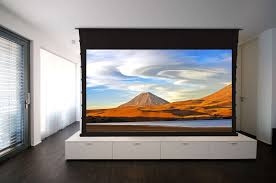
When building a premium visual environment—whether it is a state-of-the-art corporate boardroom, a university lecture hall, or a dedicated home cinema—the choice of display hardware is usually centered entirely on the projector. Individuals spend weeks analyzing laser light engines, native resolutions, and ANSI lumen ratings. However, pairing a high-performance data projector with a standard blank wall or a basic white sheet is one of the most common mistakes in audio-visual integration.
A blank wall features microscopic textures, paint imperfections, and uneven reflectivities that cause geometric distortions, color shifts, and severe image washout. To truly unlock the engineering potential of a modern projector, you need an equally sophisticated canvas: a dedicated projector screen.
Acting as an optical mirror, a professional projection screen is engineered with specialized fabric coatings that manage light distribution, maximize contrast, and preserve pixel-level sharpness. In this comprehensive guide, we will explore the science behind projection fabrics, demystify critical metrics like screen gain and Ambient Light Rejection (ALR), and break down the primary physical form factors available on the market.
1. The Science of Screen Fabrics: Understanding "Gain"
At the heart of every projector screen is its gain rating. Screen gain is a measurement of the surface’s reflectivity compared to a standard industry baseline (typically a block of magnesium carbonate or a flat matte white board, which has a gain rating of 1.0).
Understanding how gain impacts your viewing experience is essential for mapping out room geometry:
-
Matte White (Gain 1.0): This is the universal standard for light diffusion. A 1.0 gain matte white screen reflects light uniformly in all directions across a full 180-degree viewing cone. It offers exceptional color accuracy and ensures that an audience member sitting far off-center sees the exact same brightness and contrast as someone sitting directly in the middle. However, it offers zero defense against ambient room lighting.
-
High-Gain Screens (Gain 1.3 to 2.5): These screens feature reflective coatings (such as glass-beaded or metallic layers) that actively focus and redirect light straight back toward the center of the room instead of scattering it. While this drastically brightens the image—making them excellent for low-lumen projectors—it introduces a narrower viewing angle. Viewers sitting off-center will experience a dimmer image, and if the gain is too high, it can cause "hot-spotting" (where the center of the screen appears noticeably brighter than the outer edges).
-
Low-Gain/Gray Screens (Gain 0.6 to 0.9): Gray screen fabrics purposely absorb a portion of the incoming light. By utilizing the non-linear way human eyes perceive contrast, a lower-gain gray screen drastically deepens black levels and enhances color saturation, making it perfect for multi-purpose rooms where overhead lights cannot be entirely turned off.
2. Advanced Optics: Ambient Light Rejection (ALR) and CLR
The greatest adversary of any projection system is ambient light. When natural sunlight from windows or artificial light from ceiling fixtures collides with a standard screen, it overpowers the projector's light, muddying details and graying out shadows. Modern display engineering solves this problem through specialized optical surfaces:
Ambient Light Rejection (ALR)
ALR screens are highly advanced, multi-layered surfaces designed with angular-reflective properties. They are engineered to selectively reflect the projector’s light (which strikes the screen from a specific, straight-on angle) directly toward the audience while absorbing or redirecting ambient light crashing down from the ceiling or bouncing from side windows. This allows organizations to run clear presentations in broad daylight or fully illuminated offices.
Ceiling Light Rejection (CLR)
A specialized sub-category of ALR is the CLR screen, engineered explicitly for Ultra-Short-Throw (UST) projectors. Because a UST projector sits mere inches below the screen and shoots light upward at a steep vertical angle, a CLR screen utilizes a microscopic triangular, lenticular grid structure. These micro-structures trap down-ward traveling overhead office light while simultaneously grabbing the up-ward traveling projector light and pushing it horizontally out toward the viewers, preserving contrast under intense overhead illumination.
3. Physical Form Factors: Fixed vs. Retractable Frameworks
Once you identify the ideal optical fabric for your lighting conditions, you must select a structural format that integrates smoothly into your architectural environment.
Fixed-Frame Projector Screens
Fixed-frame screens feature an industrial aluminum bezel (often wrapped in light-absorbing black velvet) that anchors permanently to a wall, holding the screen material under continuous mechanical tension. Because the fabric is pulled tight from all four sides, it remains perfectly flat and immobile. This uniform flatness is absolute mandatory if you are utilizing a short-throw or UST projector, as even a microscopic wrinkle in an untensioned screen will distort an ultra-short-throw light path.
Motorized and Manual Retractable Screens
For multi-purpose rooms where a permanent display screen disrupts the room's aesthetic or functionality, retractable screens are the ideal solution.
-
Manual Pull-Down: Economical and spring-loaded, these roll up into a compact wall-mounted housing when not in use.
-
Electric/Motorized: Driven by internal electric motors, these screens can lower smoothly from the ceiling at the touch of a remote or via a low-voltage trigger connected directly to the projector’s power state.
Pro Tip: When choosing a retractable screen for professional applications, opt for a tab-tensioned motorized model. These systems use a system of side cords to pull the retractable fabric taut, preventing the edges from curling over time.
4. Acoustic Transparency: Hiding Your Sound Stage
In high-end presentation theaters or corporate auditoriums, sound localization is key to immersion. If speaker columns are pushed to the far left and right corners of a massive screen, the audio feels disconnected from the visual data.
Acoustically Transparent screens solve this problem by utilizing either a microscopic perforated PVC pattern or a tightly woven synthetic fabric. These specialized micro-holes allow sound waves from speakers mounted directly behind the screen to travel freely through the material without muffled degradation, all while maintaining an opaque, reflective front surface that preserves high-definition video clarity.
5. Procuring Professional-Grade Visual Infrastructure
Constructing an elite, high-impact display environment requires careful orchestration across your entire hardware chain. A premium projection surface must be perfectly paired with authorized data projectors, structural ceiling mounts, high-speed multi-gigabit switches, and seamless signal-distribution matrices. To protect your capital investments and guarantee long-term system interoperability, sourcing authentic components from a certified enterprise distribution network is essential.
When scaling corporate footprints, outfitting modern classrooms, or designing interactive control rooms, leading organizations bypass consumer retail markups and partner with professional IT channels. Modern enterprises rely on dedicated procurement platforms like Tecisoft to purchase authorized commercial projector screens, professional projection systems, high-performance computing components, and enterprise networking hardware engineered to maximize operational uptime and deliver uncompromised visual clarity.
Conclusion: Completing the Visual Equation
A projector screen should never be treated as an afterthought; it is exactly half of your projection system's visual equation. By investing in a dedicated screen, you translate raw projector lumens into deep contrast ratios, accurate color spaces, and sharp resolutions that maximize audience engagement and prevent eye strain. By mapping your room’s ambient light to the correct gain or ALR fabric classification, and sourcing your foundational infrastructure from trusted enterprise suppliers, you can convert any bare corporate wall into an exceptional, highly immersive information hub built for long-term operational success.
- Goth Lifestyle
- Fashion & Style
- Music & Bands
- Art & Photography
- Creative Writing & Poetry
- Events & Scene
- Occult & Spirituality
- DIY & Tutorials
- Beauty & Self-Care
- Relationships & Dating
- Gaming & Media
- Tech & Gadgets
- Body Art & Piercings
- Underground Culture
- Spotlights & Interviews
- Travel & Places
- Lifestyle & Daily Life
- Fitness & Health
- Travel & Adventure
- Books & Literature
- Tech & Gaming
- Movies & TV
- Food & Drinks
- Humor & Memes
- Pets & Animals
- General Arts & Crafts

 English
 Arabic
 French
 Spanish
 Portuguese
 Deutsch
 Turkish
 Italiano
 Russian
 Romaian
 Portuguese (Brazil)
 Greek
Greek