

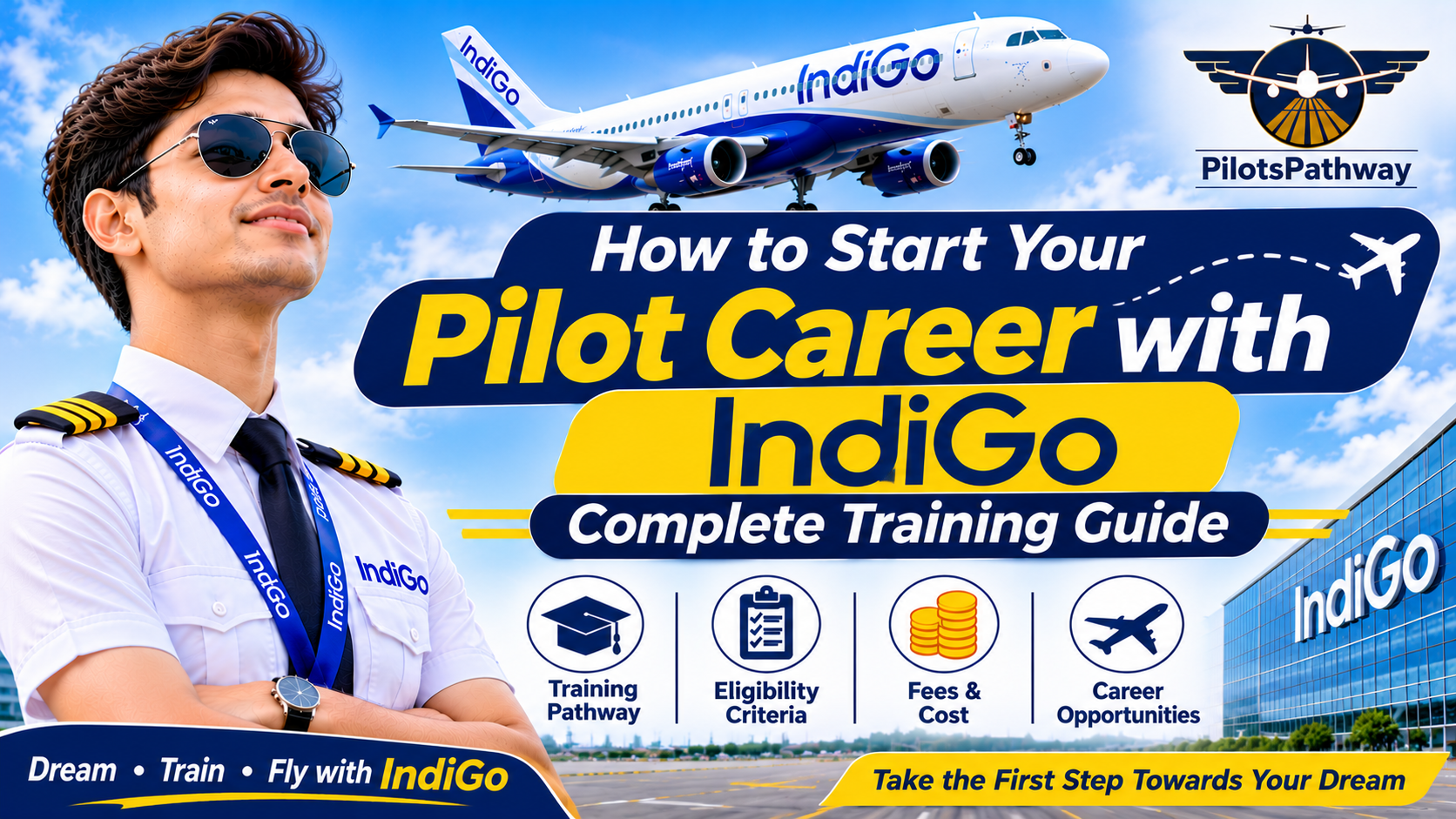
How to Start Your Pilot Career with IndiGo – Complete Training Guide
Becoming a commercial airline pilot is an exciting career goal for students who are passionate about aviation, aircraft technology and travelling around the world. However, entering the airline industry requires much more than an interest in flying. Candidates need the right educational qualifications, medical fitness, technical knowledge, professional skills and structured training.
For students in India, the IndiGo Cadet Pilot Program is one of the pathways worth exploring when planning an airline pilot career. It provides an airline-oriented training structure through designated training partners and helps eligible candidates work towards the qualifications required for professional flying.
Before applying, students should understand how the programme works, what qualifications are needed, how much training may cost and how the selection process operates.
This article explains the complete journey, from preparing after school to understanding the training stages, financial investment and potential career opportunities associated with the IndiGo cadet pilot pathway.
1. Understanding the IndiGo Cadet Pilot Program
The IndiGo Cadet Pilot Program is a structured pilot training pathway intended for aspiring pilots who want to pursue an airline career.
In a traditional pilot training route, students generally select a flying school, complete the required ground training and flying hours, obtain their Commercial Pilot Licence and independently apply for airline opportunities.
A cadet pilot pathway follows a more structured airline-oriented approach. Selected candidates undergo training through designated aviation training partners according to the programme's requirements.
The training journey may involve:
-
Academic and theoretical aviation training.
-
DGCA examination preparation.
-
Practical flying experience.
-
Multi-engine flight training.
-
Instrument rating training.
-
Commercial Pilot Licence requirements.
-
Airbus A320 type rating.
-
Airline-specific preparation and assessments.
The exact training sequence depends on the current programme agreement and training partner.
One important consideration is that candidates must successfully complete the applicable training, examinations and airline assessments. Admission into a cadet programme should not automatically be interpreted as an unconditional employment guarantee.
2. Why Are Students Interested in IndiGo Cadet Pilot Training?
Many aspiring pilots prefer a structured training pathway because it provides a clearer understanding of the different stages involved in becoming an airline pilot.
Students entering aviation for the first time may not know how to select a flying school, prepare for DGCA examinations or plan their training towards airline recruitment.
A cadet pathway can provide a defined training structure and airline-oriented preparation.
Some reasons students explore this option include:
Structured training: Candidates follow a planned programme rather than independently organising every stage of training.
Airline-oriented learning: The programme is designed around the requirements of an airline flying career.
Professional development: Students develop technical knowledge, communication and teamwork skills.
Aircraft-specific preparation: The training pathway includes relevant aircraft-specific preparation, subject to the applicable programme structure.
Career planning: Candidates can understand the expected progression from initial training towards airline selection.
However, students should compare the programme's costs, conditions and training arrangements before deciding whether it suits their career goals.
3. IndiGo Cadet Pilot Program Requirements: Are You Eligible?
Understanding the IndiGo Cadet Pilot Program requirements is essential before beginning the application process.
Applicants should check their educational qualifications, age, nationality and medical fitness against the latest admission guidelines.
Educational Qualifications
Candidates generally need to complete Class 12 with the following subjects:
-
Physics.
-
Mathematics.
-
English.
Several published programme guidelines specify at least 51% marks individually in Physics, Mathematics and English.
Students who have not studied Physics or Mathematics in their original school education should check the accepted NIOS or equivalent qualification provisions with the relevant programme partner.
Age Requirements
Candidates generally need to be at least 18 years old for entry into the cadet pilot training pathway.
The maximum permitted age can differ depending on the training partner and admission intake.
Applicants should verify the current age conditions before submitting their application.
Medical Fitness
Medical fitness is a fundamental requirement for becoming a professional pilot.
Candidates must satisfy the applicable DGCA medical standards and obtain the required Class 1 medical certification at the appropriate stage.
An aviation medical examination evaluates whether a candidate meets the health standards required for professional flying.
Students should complete the relevant medical checks early to reduce the risk of unexpected issues after making a significant financial commitment.
Nationality
Nationality and documentation requirements depend on the current programme guidelines. Indian citizens and eligible OCI cardholders may be considered where specified.
Candidates should confirm the latest requirements with the selected training partner.
English Communication
English is the international language of aviation communication.
A pilot must understand instructions, communicate with air traffic control and coordinate effectively with other crew members.
Students should therefore improve their spoken English, listening ability and confidence before beginning airline selection preparation.
4. Indigo Cadet Pilot Program Fees: Planning Your Aviation Budget
Financial planning is one of the most important parts of becoming a commercial pilot.
The Indigo cadet pilot program fees can represent a significant investment for students and their families. The total amount depends on the training academy, location, programme structure, aircraft availability and services included in the package.
There is no single universal fee applicable to every cadet training partner.
For example, Chimes Aviation Academy has published an approximate programme fee of ₹104 lakh for its IndiGo cadet programme. This is a partner-specific published figure and should not be treated as a guaranteed current price for every intake.
Before selecting an academy, candidates should request the latest written fee schedule.
What Does the Training Investment Cover?
Depending on the programme, the fee may include:
Ground school: Theoretical aviation education and preparation for relevant examinations.
Flying training: Practical aircraft training under qualified instructors.
Multi-engine training: Experience and instruction involving multi-engine aircraft.
Instrument rating: Training in instrument-based flying procedures.
CPL-related training: The applicable practical and academic requirements for a Commercial Pilot Licence.
Type rating: Aircraft-specific training, including Airbus A320 preparation where included in the programme.
Additional Expenses to Consider
Students should also check whether the following costs are included:
-
Hostel and accommodation.
-
Food and daily living expenses.
-
Medical examination charges.
-
Examination and licensing fees.
-
International travel and visa expenses.
-
Insurance.
-
Additional flying hours.
-
Retest and additional training fees.
-
Administrative and documentation charges.
Questions to Ask Before Paying Programme Fees
Before making an admission payment, students should ask the training provider:
-
What is the complete programme fee?
-
Is the Airbus A320 type rating included?
-
Are accommodation and meals included?
-
What is the payment schedule?
-
What is the refund policy?
-
Are additional flying hours charged separately?
-
What happens if training takes longer than expected?
-
What are the applicable employment and contractual conditions?
A transparent fee structure helps families make better financial decisions.
5. How Does the Cadet Pilot Selection Process Work?
The selection process is designed to assess whether candidates have the academic foundation, aptitude and professional qualities required for aviation training.
The exact process may differ by intake and training partner, but it can involve several stages.
Stage 1: Initial Application
Candidates submit their educational information, personal details and supporting documents.
The programme team checks whether applicants satisfy the basic eligibility criteria.
Stage 2: Cognitive and Aptitude Testing
Aptitude testing evaluates different abilities that are useful in aviation.
Important areas can include:
-
Numerical reasoning.
-
Logical reasoning.
-
Spatial awareness.
-
Memory.
-
Concentration.
-
Multitasking.
-
Problem-solving.
Students should practise regularly rather than relying only on last-minute preparation.
Stage 3: Psychometric Assessment
Psychometric assessments may evaluate behavioural characteristics, decision-making, teamwork and professional suitability.
Candidates should answer honestly and maintain consistency.
Stage 4: Group Assessment
Some selection processes include group discussions or collaborative activities.
These exercises help assess communication, listening, leadership and teamwork.
Students should express their opinions confidently while respecting other participants.
Stage 5: Personal Interview
The interview stage allows assessors to understand the candidate's motivation and suitability for an aviation career.
Common discussion topics include:
-
Why do you want to become a pilot?
-
Why are you interested in IndiGo?
-
What responsibilities does an airline pilot have?
-
How do you handle pressure?
-
What do you know about aviation safety?
-
How do you work in a team?
Candidates should prepare genuine and well-structured answers.
Stage 6: Medical and Final Admission Formalities
Candidates must satisfy the applicable medical requirements and complete the required admission documentation.
Final selection depends on the current programme procedures and applicable conditions.
6. What Happens During Pilot Training?
After selection, candidates begin their structured aviation training.
The process combines classroom education, examinations, practical flying and aircraft-specific preparation.
Ground School Education
Ground school provides the theoretical foundation required for professional flying.
Students generally study:
Air Navigation: Understanding aircraft navigation, directions, routes and flight planning.
Meteorology: Learning about weather conditions, atmospheric behaviour, wind and visibility.
Air Regulations: Understanding aviation rules and operating requirements.
Technical General: Studying aircraft systems, engines, instruments and technical principles.
Technical Specific: Understanding aircraft-specific technical knowledge.
Principles of Flight: Learning the aerodynamic principles responsible for aircraft movement and stability.
Radio Telephony: Developing effective communication procedures for aviation operations.
Students must develop a strong understanding of these subjects because theoretical knowledge is essential for safe flight operations.
Practical Flight Training
Practical flying allows students to apply their theoretical knowledge.
Under instructor supervision, candidates learn aircraft handling, navigation, take-offs, landings and other flying procedures.
They gradually develop the skills and judgement needed to operate aircraft professionally.
Commercial Pilot Licence
Candidates must complete the applicable flying hours, examinations, skill tests and regulatory requirements to obtain their Commercial Pilot Licence.
The licence is an important qualification for pursuing a professional flying career.
Airbus A320 Type Rating
Aircraft-specific training prepares candidates to understand the Airbus A320 and its operating systems.
The training can involve:
-
Aircraft systems.
-
Flight deck familiarisation.
-
Standard operating procedures.
-
Simulator training.
-
Crew resource management.
-
Emergency procedures.
-
Operational assessments.
Completion of the applicable training and assessments is necessary before progressing to the relevant airline flying duties.
7. How Much Time Is Required to Become an Airline Pilot?
The duration of a cadet pilot training programme depends on the academy, training location and individual progress.
Some published training pathways have indicated an approximate duration of 20 to 24 months.
However, this should not be considered a guaranteed completion timeline.
Training can be affected by weather conditions, aircraft availability, examination schedules, medical requirements and additional training needs.
Students should request the current training schedule and ask about the procedures for managing delays.
8. Career Growth After Completing the IndiGo Cadet Pathway
Completing pilot training can be an important milestone in an aspiring pilot's professional journey.
Candidates who successfully complete the programme and satisfy all applicable airline requirements may progress towards a Junior First Officer position with IndiGo.
A typical airline pilot career progression can include:
Junior First Officer: Begins airline flying duties under the applicable operating and supervision requirements.
First Officer: Performs flight operations as a qualified member of the cockpit crew.
Senior First Officer: Gains additional operational experience and responsibilities.
Captain: May progress to command responsibilities after meeting the required experience, performance and regulatory standards.
Career advancement depends on flying experience, training performance, airline requirements and available operational opportunities.
Students should understand that employment and career progression remain subject to the relevant programme agreement and airline policies.
9. Cadet Pilot Training or Independent CPL: Which Is Better?
Both cadet pilot training and independent CPL training can provide routes towards a professional aviation career.
However, their structures and planning requirements are different.
|
Factor |
Cadet Pilot Training |
Independent CPL Training |
|
Training structure |
Structured programme |
Flexible training route |
|
Training arrangements |
Designated partner |
Independently selected flying school |
|
Airline orientation |
Programme-oriented |
Additional preparation may be needed |
|
Financial planning |
Programme-specific fees |
Expenses across different stages |
|
Training choices |
Defined programme structure |
More flexibility |
|
Airline employment |
Subject to programme conditions |
Requires independent recruitment |
A cadet programme may suit candidates who prefer a structured airline-oriented pathway.
Independent CPL training may suit students who want greater flexibility in selecting their training provider and managing their training journey.
There is no universally best option. Students should compare costs, training quality, regulatory compliance and career conditions before choosing.
10. How Should Students Prepare Before Applying?
Early preparation can help students become more comfortable with the selection process.
A successful candidate needs more than academic eligibility.
Build Strong Mathematics Skills
Practise numerical reasoning, calculations and problem-solving.
Improve Physics Knowledge
Understand fundamental concepts involving motion, forces, pressure and other principles relevant to aviation.
Develop Spatial Awareness
Practise visual reasoning, orientation and direction-based questions.
Improve English Communication
Speak English regularly, practise listening and learn aviation terminology.
Develop Decision-Making Skills
Learn to analyse situations, remain calm and make logical decisions.
Follow Aviation News
Read about airlines, aircraft, airport operations, aviation safety and developments in the Indian aviation industry.
Consistent preparation can help candidates approach selection assessments with greater confidence.
11. Why Choose Pilotspathway for Cadet Pilot Preparation?
Preparing for an airline selection process can be challenging, particularly for students who are new to aviation.
Candidates may understand the academic requirements but still need guidance with aptitude assessments, psychometric preparation, interviews and aviation knowledge.
Pilotspathway offers aviation-focused preparation support for aspiring pilots who want to develop the skills needed for competitive cadet pilot selection.
Preparation areas include:
-
Airline cadet pilot aptitude preparation.
-
Numerical and logical reasoning.
-
Spatial awareness practice.
-
Psychometric assessment preparation.
-
Aviation technical knowledge.
-
Personal interview guidance.
-
Group discussion preparation.
-
Airline selection awareness.
Students from Jaipur, Rajasthan and other parts of India can explore relevant preparation opportunities through Pilotspathway.
The purpose of structured preparation is to help candidates understand the selection process, identify areas for improvement and develop confidence before applying.
Frequently Asked Questions
1. What is the IndiGo Cadet Pilot Program?
It is an airline-oriented pilot training pathway in which selected candidates undergo structured training through designated partners and work towards the qualifications required for a professional airline career.
2. What are the IndiGo Cadet Pilot Program requirements?
Candidates generally need Class 12 with Physics, Mathematics and English, the required minimum marks, applicable age and nationality eligibility, and compliance with DGCA medical requirements.
3. What are the Indigo cadet pilot program fees?
The fees depend on the selected training partner and programme structure. Chimes Aviation Academy has published an approximate programme fee of ₹104 lakh. Candidates should confirm the current amount and inclusions directly with the academy.
4. Can I become a pilot after completing Class 12?
Yes. Eligible students can explore cadet pilot training after Class 12 if they satisfy the academic, age, medical and other programme requirements.
5. Is Mathematics compulsory for cadet pilot training?
Mathematics is generally required at the 10+2 level, along with Physics and English, subject to the accepted qualification provisions.
6. Is DGCA Class 1 Medical necessary?
Candidates must satisfy the applicable DGCA Class 1 medical requirements at the relevant stage of the programme. Medical timelines should be confirmed with the training partner.
7. How long does cadet pilot training take?
Some published programmes indicate approximately 20 to 24 months, although actual duration can vary depending on training progress, weather, aircraft availability and regulatory requirements.
8. Which aircraft is included in IndiGo cadet pilot training?
The airline-oriented pathway includes Airbus A320 type-specific preparation, depending on the applicable programme structure.
9. Can graduates apply for the cadet pilot programme?
Graduates may apply if they meet the applicable educational, age, medical and other eligibility requirements.
10. Does joining a cadet pilot programme guarantee employment?
No. Candidates must successfully complete training, assessments, medical requirements and applicable airline selection and contractual conditions.
Conclusion: Plan Your Aviation Career with the Right Preparation
Becoming an airline pilot requires commitment, financial planning, academic preparation and professional development. The IndiGo cadet pilot pathway can provide a structured route for eligible candidates who want to pursue a career in commercial aviation.
Before applying, students should carefully understand the educational qualifications, medical standards, programme fees, selection stages and training conditions.
Choosing the right training pathway is an important decision, but preparing yourself for the selection process is equally important.
If becoming an airline pilot is your goal, Pilotspathway can help you explore cadet pilot preparation, aptitude training, technical learning and interview guidance.
Start building your aviation knowledge today, prepare consistently and take informed steps towards your dream of becoming a professional airline pilot.



