

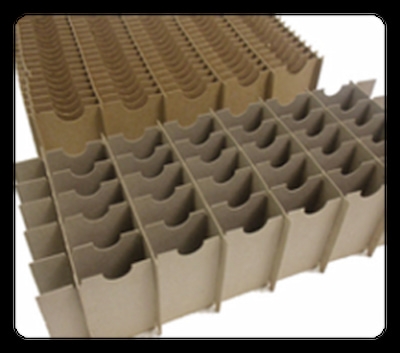

Shipping products safely requires packaging that can withstand handling, movement, stacking, and transportation conditions. Outer cartons provide essential protection, but internal packaging components also play an important role in preventing product damage. Corrugated dividers create separate compartments that help keep individual items organized and reduce unwanted contact. Choosing suitable corrugated partitions allows businesses to improve internal carton protection while supporting efficient packing operations. These dividers can be customized for different product dimensions, weights, and shipping requirements, making them useful across manufacturing, food and beverage, automotive, and distribution industries.
Understanding Corrugated Partitions
Corrugated partitions are internal packaging components manufactured from corrugated board. This material generally features a fluted layer positioned between flat liner sheets, creating a structure that provides rigidity and practical support. The partitions can be arranged inside cartons to create individual compartments for products of different sizes. Their dimensions, thicknesses, and configurations depend on the intended application. By separating products within a shared container, corrugated dividers help reduce direct contact and improve organization during storage, handling, and transportation.
Reducing Damage During Transportation
Products may experience vibration, sudden movement, pressure, and repeated handling while moving through distribution networks. When several items share a carton without internal separation, they can collide and cause scratches, dents, or breakage. Corrugated partitions create individual spaces that help limit this movement. Their effectiveness depends on suitable material selection, accurate dimensions, and compatibility with the outer carton. Businesses handling multiple products in one package can use properly designed dividers to support safer transportation and reduce avoidable product damage.
Providing Structural Support Inside Cartons
The fluted construction of corrugated board contributes to its rigidity, making it useful for selected applications requiring internal packaging support. Corrugated partitions help maintain separation between products while providing a structured arrangement within the carton. Their strength depends on board grade, flute characteristics, thickness, and divider design. Businesses should consider product weight and expected handling conditions before selecting a configuration. Reviewing corrugated partition products can help identify suitable options for different packaging and shipping applications.
Protecting Fragile Products
Fragile goods require careful packaging because impacts and direct contact can cause significant damage. Glass containers, ceramic items, and delicate components may benefit from individual compartments that reduce contact with neighboring products. Corrugated dividers can be designed to accommodate specific shapes and dimensions, helping maintain separation inside cartons. However, highly delicate products may also require cushioning materials or additional protective packaging. Evaluating the complete packaging arrangement helps businesses determine whether corrugated partitions provide sufficient support for the expected shipping conditions.
Customizing Compartments for Product Dimensions
A suitable partition design should reflect the actual dimensions and arrangement of packaged products. Compartments that are too large may allow items to move, while spaces that are too narrow can make packing difficult. Manufacturers can adjust cell widths, divider heights, material thicknesses, and overall layouts to achieve a more appropriate fit. Customization is particularly useful when cartons contain products with unusual shapes or multiple sizes. Accurate measurements help create consistent packaging arrangements and support practical product placement during packing operations.
Supporting Food and Beverage Packaging
Food and beverage manufacturers frequently transport bottles, jars, containers, and packaged products in shared cartons. Corrugated partitions can help separate these items and maintain organized arrangements during distribution. Individual compartments reduce direct contact and may help prevent containers from striking one another during movement. Material suitability should be evaluated according to the product, packaging configuration, and applicable handling requirements. Businesses can explore food packaging box partition solutions when considering internal dividers for food and beverage packaging applications.
Improving Warehouse Organization
Organized cartons can make warehouse activities more predictable and easier to manage. Corrugated partitions create designated spaces that help employees arrange products consistently during packing and storage. This structure can simplify counting, inspection, and order preparation, particularly when cartons contain several individual items. Standardized compartment layouts also help packaging teams follow repeatable procedures. Businesses handling large inventories may benefit from internal packaging that supports clear product placement and reduces confusion during routine warehouse operations.
Supporting Automotive Parts Packaging
Automotive components often vary in size, shape, and weight, creating different internal packaging requirements. Some parts may have delicate finishes, while others require separation to prevent contact during transportation. Corrugated partitions can be customized to create compartments that accommodate individual components and maintain organized carton arrangements. The design should account for product dimensions, weight, surface sensitivity, and expected handling conditions. Businesses can also review automotive parts protective packaging when evaluating packaging approaches for automotive components.
Improving Packaging Line Efficiency
Packaging materials should support efficient handling rather than introduce unnecessary complexity during production. Corrugated partitions manufactured to consistent specifications can fit cartons more accurately, helping employees position products with fewer adjustments. Standardized layouts may also simplify repetitive packing procedures and improve consistency across production batches. For businesses handling high order volumes, these advantages can support more predictable workflows. Manufacturers should consider how dividers will be inserted, assembled, and handled during regular operations to ensure that the final design remains practical.
Selecting the Appropriate Board Thickness
Corrugated board is available in different grades and thicknesses, allowing manufacturers to develop dividers for various packaging applications. Lighter materials may suit smaller products, while heavier items may require stronger board constructions. Selecting excessive thickness can increase material use, whereas insufficient strength may reduce the effectiveness of the packaging structure. Product weight, carton dimensions, stacking conditions, and transportation requirements should guide material selection. A balanced specification helps businesses achieve practical separation and support without adding unnecessary complexity to the packaging system.
Considering Custom Manufacturing Capabilities
Standard divider configurations may not provide the right fit for every product. Custom manufacturing allows businesses to specify compartment dimensions, material characteristics, and overall partition layouts according to their packaging requirements. This flexibility can be useful for irregularly shaped products, specialized components, or cartons containing several product varieties. Manufacturers should evaluate product measurements and the intended shipping environment before developing a design. Reviewing custom cut sheets, layer pads, and separators can help businesses explore additional internal packaging components for specific applications.
Maintaining Consistent Product Quality
Consistent manufacturing quality helps ensure that corrugated partitions fit correctly and perform as expected across different production batches. Variations in board thickness, cutting accuracy, or compartment dimensions can create problems during packing. A reliable manufacturer should follow established specifications and suitable quality control procedures. Businesses can evaluate product samples and review manufacturing processes before committing to recurring orders. Consistent components help packaging teams maintain uniform arrangements, reduce avoidable adjustments, and support dependable product separation throughout ongoing distribution activities.
Evaluating Design and Engineering Support
Some packaging applications require detailed planning to achieve the appropriate balance between protection, material use, and packing efficiency. Design engineering can help assess product dimensions, carton measurements, divider layouts, and transportation conditions. Prototypes provide an opportunity to check compartment fit and identify potential weaknesses before full-scale production begins. This evaluation can reduce the risk of ordering unsuitable packaging components in large quantities. Businesses can explore design engineering and prototyping services when refining internal packaging concepts.
Considering Storage and Stacking Conditions
Corrugated partitions should be selected according to the conditions products are expected to encounter throughout storage and distribution. Cartons may be stacked in warehouses, transported over long distances, or handled multiple times before reaching their destinations. Product weight, external carton strength, moisture exposure, and stacking arrangements can influence packaging performance. Businesses should assess these factors as part of the complete carton design. Selecting suitable materials and compartment dimensions helps ensure that internal dividers remain appropriate for the intended shipping environment.
Balancing Protection and Packaging Costs
Effective packaging should provide appropriate protection while keeping material use and purchasing expenses under control. Corrugated partitions can be evaluated according to their thickness, design complexity, manufacturing quantity, and expected performance. Customization may help avoid unnecessary material by matching compartment dimensions to actual product requirements. Businesses should also consider the potential cost of damaged goods, replacement shipments, and packaging inefficiencies. Comparing overall packaging value rather than focusing only on unit price can support more informed purchasing decisions.
Choosing a Reliable Corrugated Partition Supplier
A dependable supplier should understand material requirements, production specifications, and the practical challenges of product distribution. Businesses should assess manufacturing capacity, customization options, quality control, communication, and order fulfillment capabilities. Experience with different industries can also help suppliers recommend suitable divider configurations for specific products. Clear discussions about dimensions, quantities, and delivery schedules support smoother purchasing arrangements. A careful supplier evaluation helps organizations establish packaging relationships that can accommodate recurring requirements and changing product specifications.
Conclusion
Corrugated partitions provide businesses with a practical way to separate products, improve carton organization, and support safer shipping operations. Their adaptable construction makes them suitable for numerous packaging applications, provided that material strength and compartment dimensions match the intended products. Businesses should evaluate product weight, transportation conditions, manufacturing quality, and customization requirements before choosing a divider design. Working with an experienced packaging supplier can help maintain consistent protection across shipments. General Partition Co Inc offers packaging products and manufacturing-related capabilities that businesses can explore when considering corrugated partitions for dependable shipping protection.



