

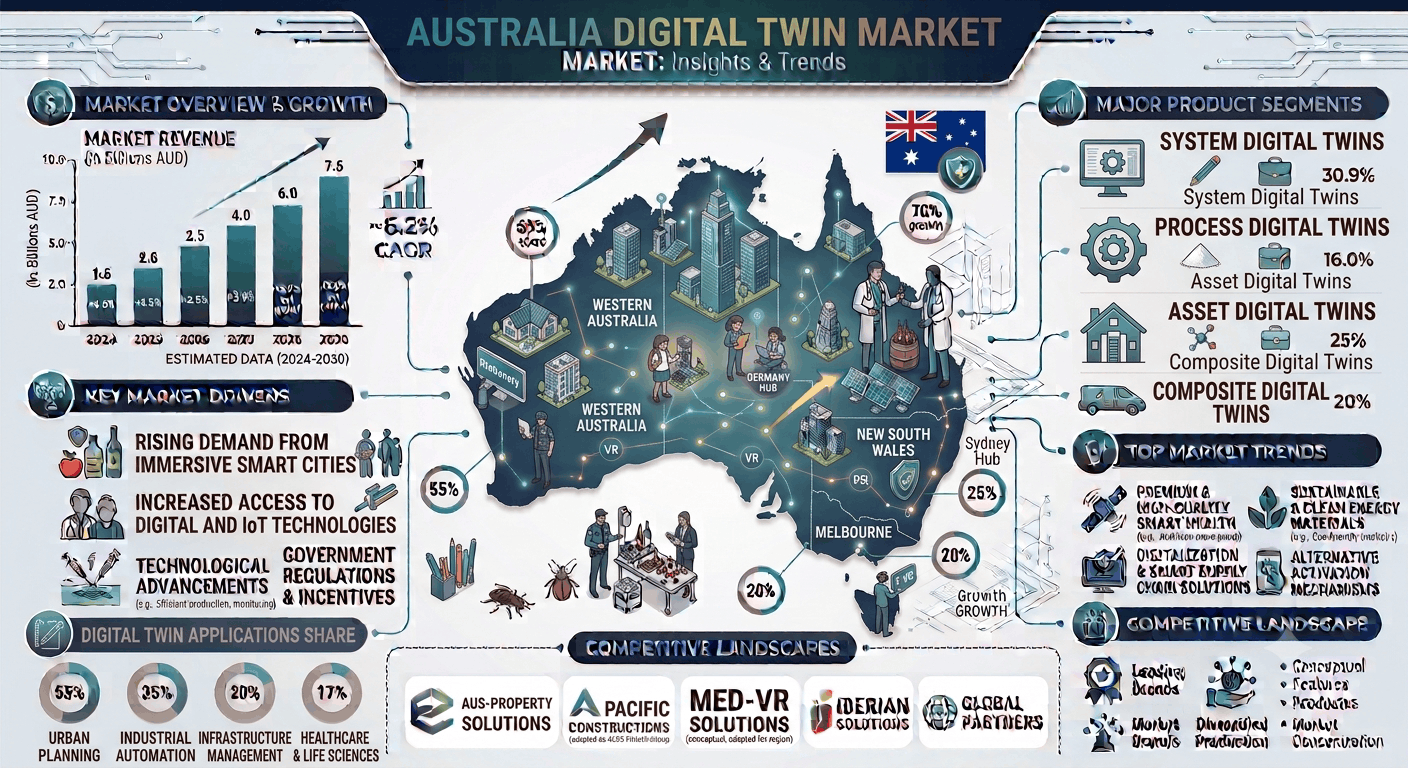
Australia Digital Twin Market Size, Share, Trends and Forecast by 2026-2034

MARKET OVERVIEW
The Australia digital twin market grew from USD 813.0 Million in 2025 to USD 1,059.4 Million in 2026. Looking forward, the market is expected to reach USD 5,767.3 Million by 2034, exhibiting a compound annual growth rate (CAGR) of 23.59% during 2026-2034. Smart infrastructure programs, state-led spatial digital twins, heavy adoption in mining and energy, growing use in predictive maintenance and asset management, and rising integration with IoT, AI, and cloud platforms are shaping the Australia digital twin market share and outlook through 2034. Australia combines large public investment, a strong research base, and some of the world's most automated industrial operations, which makes it one of the most active digital twin markets in the Asia-Pacific region.
MARKET SUMMARY
- Governments are building statewide twins. Western Australia is investing AUD 140 million over ten years in Spatial WA, alongside AUD 40 million from New South Wales and AUD 37.4 million from Victoria.
- Mining is the most advanced industrial user. A 2024 Bentley Systems survey found nearly 90% of mining organizations were using, implementing, or piloting digital twins, with health and safety as the top driver.
- Digital twins are moving beyond cities. The Australasian Space Innovation Institute launched a AUD 15 million National Digital Twin for Australian Agriculture in February 2026.
- Policy is formalizing data standards. The NSW Spatial Digital Twin Policy Framework was published on 19 October 2026.
- Regulation is linking BIM and twins. In November 2024, the Victorian government released the eComply Framework under the Digital Twin Victoria program to guide BIM-enabled digital compliance assessment.
- The market is segmented by type, technology, end use, and region, with forecasts for 2026-2034.
MARKET GROWTH DRIVERS
Infrastructure Modernization and Smart City Programs
Population growth and urbanization in Sydney, Melbourne, Brisbane, and Perth are placing pressure on transport networks, utilities, and public services, and digital twins give planners a way to simulate and optimize assets in real time. State governments are leading the way. The NSW Spatial Digital Twin is live across councils and supported by a formal state policy (DCS-2025-02) that sets how agencies share and integrate spatial data. It brings together authoritative spatial data, tools, and services to create a near real-time digital model of the state, and can be used for infrastructure planning, emergency response, and 3D city visualization. Digital Twin Victoria was built with CSIRO under a AUD 37.4 million program and connects 2D, 3D, and live data on buildings, roads, farmland, and natural environments. Queensland is exploring a regional South East Queensland digital twin, backed by state budget funding for a proof of concept covering infrastructure, land use, and utilities. Western Australia's program is entering delivery, as Jacobs was awarded a AUD 73.7 million contract to develop its spatial digital twin platform.
Mining, Energy, and Natural Resource Management
Australia's mining, oil and gas, and energy sectors operate in remote, high-risk environments, which makes real-time simulation, predictive maintenance, and remote monitoring especially valuable. Miners are building digital twins across processing plants and entire value chains. Rio Tinto's Gudai-Darri mine in the Pilbara includes a full digital replica of the processing plant, monitored remotely from Perth, along with autonomous trucks, trains, and drills. BHP uses a digital twin of its BMA mining value chain, combined with generative AI, to predict production outcomes and test what-if scenarios. At Copper South Australia, a digital twin assesses water, energy, and material flows to support stable operations. BHP reports that its digital and analytics initiatives have delivered more than US$2 billion in value over four financial years, which strengthens the business case for broader deployment. The clean energy transition adds demand, as operators use twins to improve the performance of solar farms, wind farms, and storage assets.
Research Strength, Technology Advances, and Local Innovation
Australia's research ecosystem is a core advantage. CSIRO's Data61 developed the TerriaJS platform behind the NSW Spatial Digital Twin and the National Map, and CSIRO's Terria platform supports organizations experimenting with spatial digital twin tools. Terria and Amristar were selected to support Jacobs in delivering the Spatial WA digital twin in October 2025. Around 25 startups across Australia and New Zealand focus on digital twin technology, and universities are partnering with industry on healthcare, construction, transport, and agriculture applications. A TPG Telecom and UTS partnership received a AUD 1.3 million federal grant to build a digital twin that helps assess disaster risks to network infrastructure. Government innovation grants and Industry 4.0 programs further encourage experimentation, while integration with AI, IoT, and geospatial data improves the realism and usefulness of each model.
Request a Sample Report for In-Depth Market Insights: https://www.imarcgroup.com/australia-digital-twin-market/requestsample
PORTER'S FIVE FORCES ANALYSIS
Competitive Rivalry: High
- Global software and engineering firms, cloud providers, geospatial specialists, and local start-ups compete for government platforms and enterprise projects.
- Large public programs are awarded through tenders, which increases price and capability competition.
- Domain expertise, data integration skill, platform openness, and local delivery capacity are the main differentiators.
Supplier Power: Moderate
- Cloud infrastructure, simulation software, sensors, and geospatial data come from a limited number of global providers.
- Open platforms such as TerriaJS and open data standards reduce lock-in for public sector buyers.
- Shortages of digital engineering and data talent give skilled service providers leverage.
Buyer Power: Moderate to High
- Governments and large resource companies are major buyers and negotiate terms through procurement frameworks and long-term contracts.
- Buyers expect interoperability and clear return on investment, and BHP has noted that digital twins depend on high-quality data and clear decision use.
- Switching costs rise once a twin is embedded in operations, which protects established suppliers.
Threat of Substitutes: Low to Moderate
- Conventional GIS, BIM, SCADA, and simulation tools can meet simpler needs without a full twin.
- Many digital twin projects build on these tools, so they often act as complements rather than substitutes.
- Higher data quality needs and real-time decision support favor full digital twin solutions over time.
Threat of New Entrants: Moderate
- Software development and open platforms keep entry barriers modest for niche applications.
- Large infrastructure and mining projects require proven delivery, security clearance, and domain depth, which favors incumbents.
- Research spinouts and start-ups often enter through partnerships with larger integrators.
MARKET SEGMENTATION
Type Insights
- Product Digital Twin
- Process Digital Twin
- System Digital Twin
Technology Insights
- IoT and IIoT
- Blockchain
- Artificial Intelligence and Machine Learning
- Augmented Reality, Virtual Reality and Mixed Reality
- Big Data Analytics
- 5G
End Use Insights
- Aerospace and Defense
- Automotive and Transportation
- Healthcare
- Energy and Utilities
- Oil and Gas
- Agriculture
- Residential and Commercial
- Retail and Consumer Goods
- Telecommunication
- Others
Regional Insights
- Australian Capital Territory and New South Wales
- Victoria and Tasmania
- Queensland
- Northern Territory and South Australia
- Western Australia
REGIONAL ANALYSIS
Australian Capital Territory and New South Wales: This region is a hub for government-led digital twin development. The NSW Spatial Digital Twin integrates data across agencies and councils, and Canberra hosts the federal agencies and research organizations that shape national policy. NSW published its updated Spatial Digital Twin Policy Framework in October 2026, which signals a move toward formal governance and wider adoption.
Victoria and Tasmania: Victoria is a leader in BIM-linked planning and digital compliance. Digital Twin Victoria, backed by AUD 37.4 million, supports state planning and building approvals, and the eComply Framework released in November 2024 links BIM to faster compliance assessment. Tasmania's smaller market is supported by energy, agriculture, and environmental monitoring applications.
Queensland: Queensland combines heavy mining and infrastructure activity with growing public sector interest. BHP Mitsubishi Alliance uses value chain digital twins at its Queensland metallurgical coal operations, and the state is exploring a South East Queensland digital twin through a funded proof of concept.
Northern Territory and South Australia: Demand is linked to mining, defense, agriculture, and space-related activity. BHP's Copper South Australia uses a digital twin to manage water, energy, and material flows. Adelaide has also hosted Digital Twin Consortium sessions at Smart Cities Week Asia Pacific in July 2024 and a workshop on digital twins for agriculture.
Western Australia: Western Australia is the center of mining digital twin adoption and the home of Spatial WA, a whole-of-government program led by Landgate with more than 30 agencies. The program shifted into implementation mode in 2026 after onboarding two technology partners late in 2025. Rio Tinto's Pilbara operations and Perth-based remote operations centers show how digital twins are being linked with autonomous systems.
COMPETITIVE LANDSCAPE
The Australia digital twin market features global software vendors, engineering and consulting firms, geospatial and mining technology specialists, research organizations, and local start-ups. Competition is being shaped by large public platform contracts, partnerships with resource companies, integration of AI and generative AI, and the use of open data standards. Software companies such as Bentley Systems, Accruent, and Trimble are working with Australian mining operators, while consulting firms such as Jacobs deliver government-scale platforms and CSIRO's Terria platform supports many public programs. The report covers market structure, key player positioning, top winning strategies, competitive dashboard, and company evaluation quadrant, along with detailed profiles of all major companies.
Key players include:
- Bentley Systems
- Siemens
- Microsoft
- Jacobs
- Trimble
- CSIRO (Terria)
RECENT INDUSTRY DEVELOPMENTS
October 2026: The NSW Spatial Digital Twin Policy Framework was published on 19 October. On 26 October, Charles Sturt University and the Australasian Space Innovation Institute announced a partnership, starting with a AUD 465,000 project backed by Meat & Livestock Australia, to combine the Australian Agricultural Data Exchange with the National Digital Twin for Agriculture.
March 2026: BHP reported that its digital and analytics initiatives, including digital twins and AI, had delivered more than US$2 billion in value over four financial years.
February 2026: The Australasian Space Innovation Institute launched a AUD 15 million National Digital Twin for Australian Agriculture, with support from Elders, Meat & Livestock Australia, and Charles Sturt University. Spatial WA also moved into implementation mode.
October 2025: The Western Australian Government awarded Jacobs a AUD 73.7 million contract to develop the Spatial WA digital twin platform. Terria and Amristar were selected to support the delivery.
February 2025: The Digital Transformation Agency highlighted the Australian Government's use of innovative investment models and emerging technologies, including AI trials and responsible AI policy development.
November 2024: The Victorian Government released the eComply Framework under Digital Twin Victoria to guide BIM-enabled digital compliance assessment.
July 2024: The Digital Twin Consortium announced that its members would lead sessions on smart city digital twin applications at Smart Cities Week Asia Pacific in Adelaide.
March 2024: The Western Australian Government announced a USD 140 million (AUD 140 million) investment in Spatial WA to create a 4D virtual model of the state's built and natural environment.
KEY ASPECTS REQUIRED FOR THE AUSTRALIA DIGITAL TWIN MARKET
Market Performance: The market grew from USD 813.0 Million in 2025 to USD 1,059.4 Million in 2026 and is projected to reach USD 5,767.3 Million by 2034, driven by public infrastructure programs, mining and energy adoption, and AI and IoT integration.
Market Outlook: A 23.59% CAGR during 2026-2034 reflects rapid expansion supported by government platforms, predictive maintenance, resilience planning, and sustainability reporting.
Growth Drivers: Infrastructure modernization and smart city programs; mining, energy, and natural resource management; and research strength, technology advances, and local innovation.
Competitive Landscape: Bentley Systems, Siemens, Microsoft, Jacobs, Trimble, and CSIRO (Terria) compete on platform capability, domain expertise, data integration, and delivery capacity.
Value Chain Analysis: The value chain runs from sensors, IoT devices, and data sources through cloud and simulation platforms, analytics and AI, and visualization tools to system integrators and end users in government, mining, energy, agriculture, healthcare, and other sectors across Australian states and territories.
Industry Trends: State and national spatial twins; BIM-linked digital compliance; generative AI added to mining twins; value chain and plant twins in resources; agricultural and environmental twins; disaster and climate resilience applications; and growing emphasis on data standards and sovereign platforms.
Strategic Recommendations: Align projects with state spatial twin frameworks and open standards; focus on data quality and clear decision use cases before scaling; combine twins with AI and generative AI interfaces for non-specialist users; develop resilience and climate applications for utilities, telecom, and emergency services; partner with research bodies such as CSIRO; and invest in digital engineering and data skills.
Note: If you need any specific information that is not covered currently within the scope of the report, we will provide the same as a part of customization.
Speak to an analyst: https://www.imarcgroup.com/request?type=report&id=32032&flag=E
FREQUENTLY ASKED QUESTIONS
1. How big is the digital twin market in Australia?
The Australia digital twin market was valued at USD 813.0 Million in 2025 and grew to USD 1,059.4 Million in 2026.
2. What is the expected growth rate of the Australia digital twin market during 2026-2034?
The Australia digital twin market is projected to exhibit a CAGR of 23.59% during 2026-2034.
3. What is the future outlook of the digital twin market in Australia?
The Australia digital twin market is expected to reach a value of USD 5,767.3 Million by 2034.
4. What are the key trends of the Australia digital twin market?
Key trends include growing use in climate resilience and infrastructure planning, integration with AI, IoT, and geospatial data for real-time simulation, BIM-led regulatory efficiency, and government-backed initiatives and academic-industry collaborations that are accelerating nationwide adoption.
5. What are the growth drivers of the Australia digital twin market?
The market is driven by smart city initiatives, a strong research ecosystem, and growing adoption in sectors such as mining, healthcare, and energy. Digital transformation goals and sustainability efforts are also key contributing factors.
ABOUT US
IMARC Group is a global management consulting firm that helps the world's most ambitious changemakers to create a lasting impact. The company provides a comprehensive suite of market entry and expansion services. IMARC offerings include thorough market assessment, feasibility studies, company incorporation assistance, factory setup support, regulatory approvals and licensing navigation, branding, marketing and sales strategies, competitive landscape and benchmarking analyses, pricing and cost research, and procurement research.
CONTACT US
IMARC Group
134 N 4th St., Brooklyn, NY 11249, USA
Email: [email protected]
Tel No: (D) +91 120 433 0800
United States: +1-631-791-1145



