


Finding the right accounting software can be challenging for real estate businesses, especially when different platforms promise similar features. A solution that works well for an independent landlord may not meet the needs of a company managing hundreds of rental units or several property owners. In Dubai, financial administration also involves local rental practices, different property categories, and specific accounting responsibilities.
Choosing Property Accounting Software in Dubai therefore requires careful consideration of your business model, existing financial processes, and future requirements. Rather than focusing only on product demonstrations or subscription prices, real estate professionals should examine how software performs during actual accounting activities. This article highlights the practical considerations that can help businesses make a confident and informed decision.
First, Identify What Type of Property Business You Operate
Before comparing accounting platforms, understand the financial responsibilities your business handles. An individual landlord primarily needs to monitor rental income, expenses, and the financial performance of owned properties. A third-party property management company must also maintain accurate records for different landlords, including ownership balances and transactions carried out on their behalf. Real estate developers and investment groups may have additional requirements involving multiple companies, asset accounting, and consolidated financial reviews.
These distinctions matter because real estate accounting software Dubai solutions are not designed for identical business models. A useful starting point is to identify who owns the properties, who collects rent, who pays expenses, and who needs access to the resulting financial information.
Consider How the Software Handles Rental Payment Arrangements
Dubai rental agreements may involve different payment frequencies, installment schedules, and collection methods.
Some tenants pay through bank transfers, while others provide post-dated cheques according to their tenancy agreements. The accounting system must maintain accurate financial records regardless of how payments are arranged.
When evaluating software, examine how tenant receivables are created, how payments are allocated, and how unpaid balances are identified.
It is also important to distinguish scheduled payments from actual collections.
For example, receiving a post-dated cheque does not necessarily mean that the associated funds have been deposited and cleared.
A suitable rental accounting system should support the collection procedures used by your business and make related financial records easy to review.
Look for Accounting That Goes Beyond Basic Rent Tracking
Some property management applications focus mainly on tenancy administration and rental payment records.
However, businesses requiring comprehensive accounting need more than a list of collected and outstanding rent.
Core financial functions may include general ledger management, accounts receivable, accounts payable, journal entries, bank and cash administration, and financial statements.
These capabilities are important because property transactions must be recorded according to appropriate accounting classifications.
For example, a supplier invoice may affect an expense account and an outstanding liability. The system should provide sufficient information for accountants to understand how that transaction is represented.
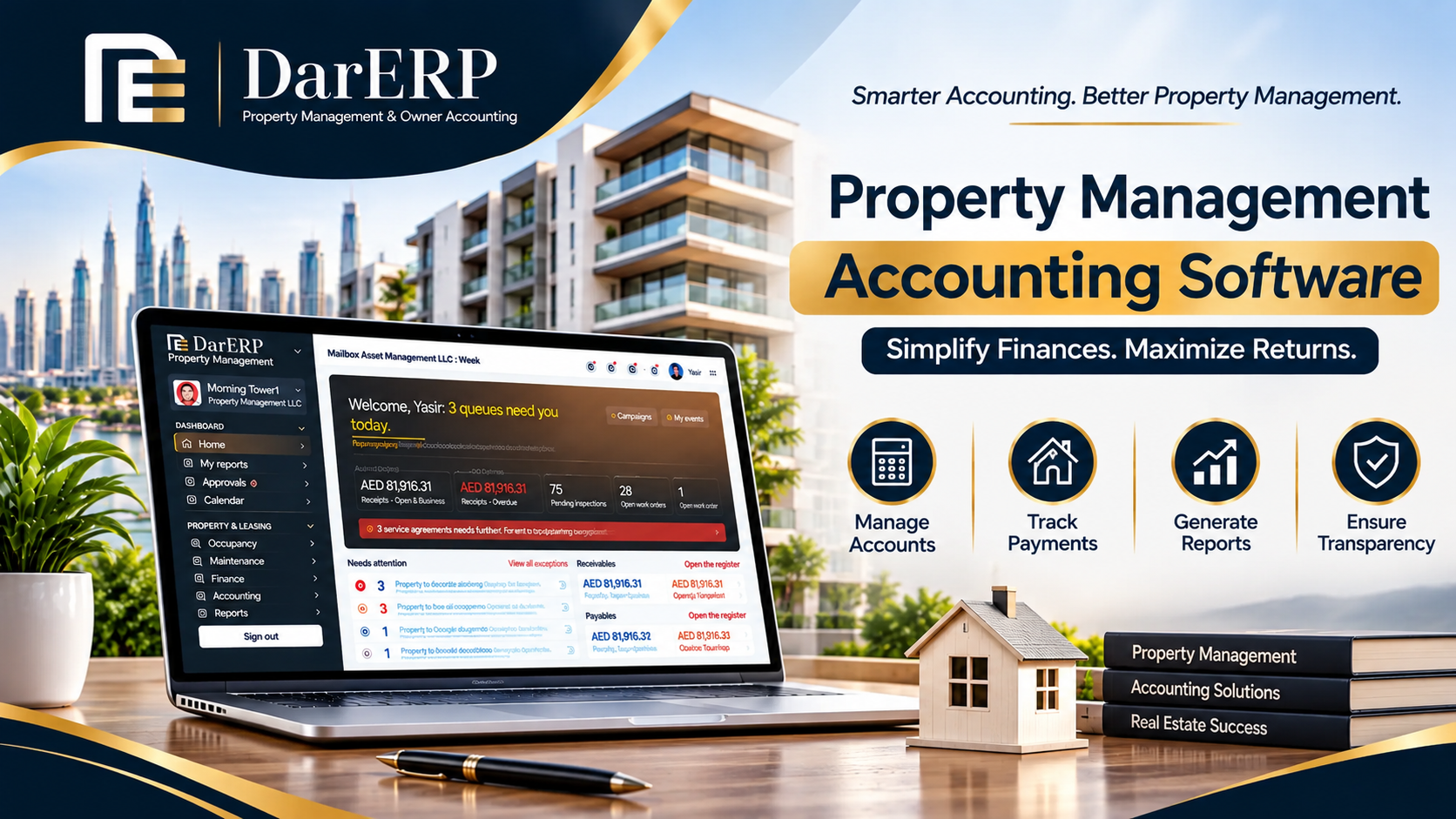
DarERP offers property administration alongside core accounting functions, making it relevant for businesses evaluating a more integrated financial management environment.
The important consideration is whether a platform supports the accounting depth your organization requires.
Examine Owner Accounting and Landlord Statement Capabilities
Property management companies frequently administer properties belonging to different investors.
Each landlord may have separate rental income, operating expenses, management charges, and financial settlements.
Without appropriate records, preparing owner statements can become difficult, particularly when a management company handles transactions across several buildings.
A dedicated property owner accounting system should help organize financial information according to ownership arrangements.
During evaluation, determine whether the software can maintain individual landlord accounts and provide understandable financial statements.
Also investigate how it handles expenses paid on behalf of owners and adjustments to ownership balances.
These capabilities are particularly important for companies responsible for managing third-party real estate assets.
Check Whether Property Expenses Are Easy to Categorize
Accurate property accounting requires expenses to be assigned to the correct asset and financial category.
Maintenance invoices, building services, insurance, utilities, and contractor charges may need to be recorded separately for each property.
An effective property expense management system should make these classifications straightforward.
For instance, if a contractor performs maintenance work across different buildings, accountants need a reliable method for identifying which property is responsible for each cost.
This supports more meaningful expenditure reviews and helps prevent unrelated expenses from being combined.Businesses should also investigate whether the system accommodates different accounting treatment for operating expenditure and capital-related transactions.
Important Features Worth Comparing
Before selecting a platform, prepare a shortlist of capabilities directly related to your operations.
Key areas include:
-
Rental accounting: Tenant receivables, payment histories, installment arrangements, and outstanding balance reporting.
-
Financial management: General ledger, accounts payable, accounts receivable, journal adjustments, and reconciliation support.
-
Property finances: Expense classifications, owner accounts, asset-related records, and financial statements.
-
Business administration: User permissions, multi-property management, and company-level accounting where needed.
-
Data management: Historical transaction access, financial exports, and suitable backup arrangements.
These features should be assessed through practical demonstrations rather than product descriptions alone.
Understand Your Reporting Requirements Before Buying
Many accounting platforms provide predefined financial reports, but businesses often need information tailored to their responsibilities.
A landlord may want to review operating income and expenses for an individual apartment. A property management company may need to prepare separate owner statements, while senior management may require information across multiple properties.
Before choosing property management accounting software in Dubai, identify which reports employees prepare regularly.
Ask the software provider to demonstrate these reports using realistic financial records.
Check whether relevant information can be filtered by property, owner, company, or accounting period where required.
Reporting flexibility matters because accountants should not need to rebuild standard financial statements manually every time management requests information.
Consider the Experience of Your Accounting Team
A technically capable system may still be unsuitable if employees find its routine processes unnecessarily complicated.
Accountants need to enter transactions, review balances, investigate discrepancies, and prepare reports with reasonable efficiency.
During a demonstration, observe how many steps are required to complete common activities.
For example, ask an employee to record a supplier invoice, review an outstanding tenant balance, and retrieve a relevant ledger entry.
The interface should be understandable to the people responsible for maintaining the records.
Involving accounting staff in the evaluation helps identify practical difficulties before implementation.
Review Data Migration and Historical Record Requirements
Changing accounting software involves moving important financial information from an existing system.
This may include the chart of accounts, opening balances, tenant receivables, supplier liabilities, ownership records, and historical transactions.
Before making a purchase, ask which types of information can be imported and how existing balances will be verified.
Data migration should not be treated as a simple file-upload exercise.
Incomplete records or incorrect classifications can create difficulties after implementation, even when the new software operates correctly.
Businesses should establish a clear process for preparing, validating, and approving financial information before switching systems.
Check UAE Accounting and Tax Requirements
Real estate businesses in Dubai operate within the UAE's accounting and regulatory environment.
Depending on their activities, organizations may need to maintain financial records relevant to VAT, corporate tax, and other applicable obligations.
The accounting treatment of transactions can vary according to the property type and the nature of the supply.
A suitable UAE property accounting solution should support the financial classifications and record-keeping procedures required by the business.
However, software functionality does not automatically establish regulatory compliance.
Qualified accounting and tax professionals should confirm the appropriate treatment of transactions and relevant reporting responsibilities.
Look Beyond the Subscription Price
Software pricing is important, but it should not be the only factor influencing your decision.
Some solutions may involve additional costs for implementation, data migration, employee training, customization, or ongoing technical services.
Others may offer broader functionality than your business actually needs.
Evaluate the overall cost in relation to the accounting activities the platform can support.
A system that reduces repeated administrative work may provide operational value, while an unnecessarily complex application may increase training and maintenance requirements.
The objective is to choose a financially sustainable solution that fits your organization's requirements.
Why Testing Real Scenarios Matters
A product demonstration becomes more useful when it reflects actual situations faced by your business.
Instead of asking only to see the dashboard, prepare realistic accounting scenarios.
For example, request a demonstration of how the software records rent due under a tenancy agreement, handles a payment correction, processes a maintenance invoice, and prepares a landlord statement.
Observe how the system maintains financial relationships between these activities.
DarERP Property Management Software can be evaluated through these practical workflows, particularly by businesses seeking to connect property administration with accounting functions.
A structured demonstration helps identify functional limitations and reduces the risk of choosing a platform based on presentation quality alone.
Final Thoughts
Choosing the right accounting software requires a clear understanding of your financial responsibilities and how your property business operates.
Property Accounting Software in Dubai should help maintain accurate rental records, organize property expenses, support ownership accounting, and provide reliable financial information.
However, the most suitable platform is not necessarily the one with the most features or the lowest price.
Businesses should prioritize accounting functionality, practical usability, data management, reporting capabilities, and compatibility with their operating structure.
By evaluating real financial workflows before making a decision, Dubai landlords and property management companies can select technology that supports dependable accounting and long-term business efficiency.
Frequently Asked Questions
1. What should I look for when choosing property accounting software in Dubai?
Look for reliable rental accounting, general ledger functionality, accounts payable and receivable, property expense tracking, owner accounting, financial reporting, and appropriate user permissions. The software should also support your business's actual payment and reporting procedures.
2. Is property accounting software different from general accounting software?
Yes. General accounting software manages conventional financial transactions, while property accounting software typically includes additional functionality for rental properties, tenancy-related finances, ownership accounts, and property-specific expenditure.
3. Can property accounting software manage multiple landlords and properties?
Suitable platforms can organize financial records across several properties and ownership accounts. Businesses should verify how each solution handles owner relationships, financial separation, property expenses, and reporting.
4. Should small property businesses in Dubai use specialized accounting software?
Specialized software can be useful for small businesses when rental administration, ownership accounting, or financial reporting becomes difficult to manage. However, the decision should depend on accounting complexity and operational responsibilities rather than business size alone.



