

The Science Behind Biomarker Testing: A Guide for Families in Alamo Ranch

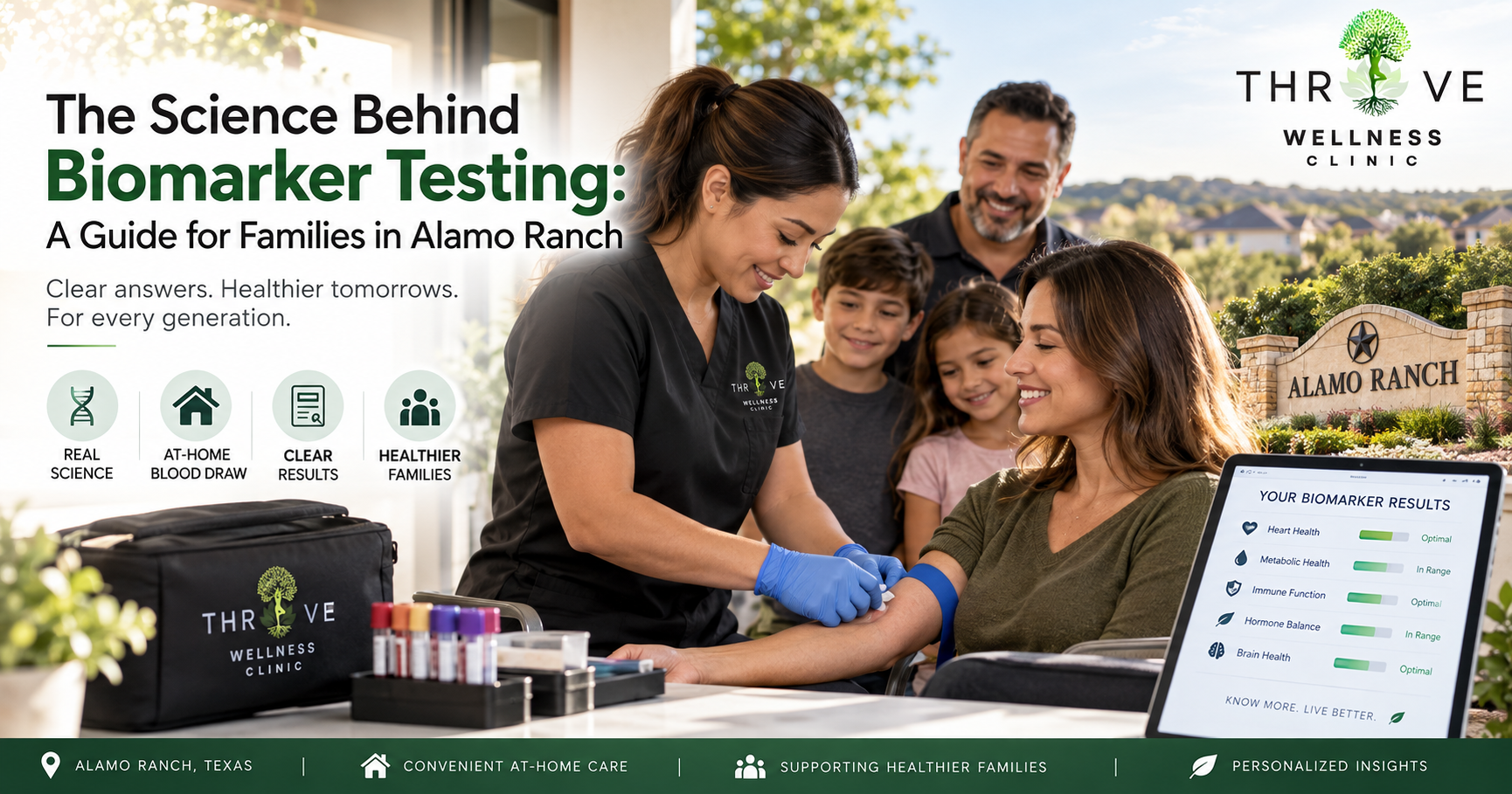
Thryve Wellness Clinic offers biomarker testing for families in Alamo Ranch, with a mobile phlebotomist drawing blood at home and a clear report of your results. This guide explains the science behind biomarker testing, what panels can and cannot tell you, and how to decide whether it fits your household.
Between school drop-offs, sports practices, and work, most families in Alamo Ranch put their own checkups last. Understanding biomarker testing science helps you decide whether a lab panel is worth the effort and how to read what comes back.
If you are curious about the practical side, you can learn how Thryve biomarker testing is set up for eligible patients in Texas. The sections below cover the evidence first, then the logistics.
What Are Biomarkers?
A biomarker is a measurable sign in your body that gives information about your health, your risk of a condition, or how you respond to something. The biomarker definition is broad: blood pressure and heart rate count, and so do substances in your blood such as glucose or cholesterol.
When people search for biomarker meaning, they usually want the blood-based version. These biomarkers are molecules a lab can measure from a small sample, and each one is a clue about a body system, not a diagnosis on its own.
How Does Biomarker Testing Science Work?
A lab analyzes your blood sample with validated methods and reports a number for each marker. That number is then compared with a reference range, which describes the values seen in a large group of healthy people.
Two ideas matter most. First, most biomarkers are proxies. Hemoglobin A1c reflects average blood sugar over roughly two to three months, so it stands in for something you can't observe directly. Second, an association is not a guarantee. A marker that predicts risk across thousands of people can still be a poor predictor for one individual.
That is why good biomarker analysis combines several markers with your history, symptoms, and medications.
What Does a Comprehensive Blood Panel Measure?
A comprehensive blood panel looks at several body systems at once. Typical categories include:
- Metabolic health: fasting glucose and hemoglobin A1c
- Heart-related markers: LDL, HDL, and triglycerides, sometimes ApoB
- Thyroid function: TSH and related markers
- Nutrients: vitamin D, B12, iron, and ferritin
- Inflammation: markers such as hs-CRP, which can rise for many reasons
- Organ function and blood counts: liver, kidney, and red and white cell markers
A full blood work panel goes broader than a routine physical, which often checks only a few of these. The exact list varies by provider, so ask what your plan includes.
What Are the Limits of Biomarker Tests?
Biomarker tests are informative but imperfect. MedlinePlus explains that reference ranges come from groups of healthy people, differ between labs, and that a result inside the range is not a guarantee of good health. Its guide to understanding your lab results also notes that lab tests are one part of the picture and no test is perfect.
Practical limits to keep in mind:
- One result is a snapshot. Illness, poor sleep, hard workouts, and dehydration can all shift numbers.
- Abnormal does not mean disease. A value just outside a range is often harmless.
- Supplements can interfere. High-dose biotin can distort some assays, so tell your clinician what you take.
- Some reports use a "health grade" or score. That can be a useful summary, but a grade is a simplification, so ask which markers drive it.
Which Biomarkers Have Strong Evidence, and Which Are Emerging?
Evidence is strongest for long-studied markers: blood pressure, cholesterol, hemoglobin A1c, and thyroid function. Clinicians have used them for decades to guide care.
Other markers are more debated. Inflammation markers can rise for many unrelated reasons, and guidance on when to use advanced cholesterol markers varies. Biological age tests, often based on DNA methylation, remain research tools, and scientists caution that their results can vary and are not reliable for individual health decisions. A trustworthy provider tells you which category a marker falls into.
Is Biomarker Testing Useful for Families?
It can be, for adults who want a preventive baseline or who have a family history of heart or blood sugar conditions. It can also help parents who have ongoing fatigue and want to rule out common contributors such as low iron or thyroid changes.
It is not a substitute for care. Sudden or severe symptoms need urgent attention. Concerns about a child's health or growth belong with a pediatrician, and you should ask Thryve directly whether testing is appropriate for anyone under 18 before booking.
How Does At-Home Biomarker Testing Work?
Thryve runs the process in four steps:
- Choose your plan. The labs in your plan are ordered when you buy.
- A mobile phlebotomist draws your blood at home. You book the visit from your dashboard.
- Meet your clinician by telemedicine. A consult is included with the Comprehensive plan or available as a one-time add-on.
- Receive your personalized plan. Your plan reflects your results, history, and goals.
The collection step uses at-home lab testing through mobile phlebotomy, subject to availability for your address and tests. Thryve says results arrive in about 72 hours, though turnaround can vary by test and laboratory.
What Does Biomarker Testing Cost?
Pricing varies by provider and panel size. Thryve lists plans starting at $119, and it describes each plan as a one-time payment with no membership. The entry plan covers 75 biomarkers, the Advanced plan covers 100 at $149, and the Comprehensive plan covers 110+ at $249 and includes a 30-minute online consult.
Thryve is self-pay and does not bill insurance. Prices can change, so confirm current details before you buy, and compare what each plan includes rather than just the price.
Biomarker Blood Test San Antonio: Is It Available in Alamo Ranch?
Families searching for a biomarker blood test san antonio often want to know whether a draw can reach the far west side. Thryve provides testing to eligible patients in San Antonio, and Thryve's San Antonio page explains local details.
I can't confirm coverage for a specific Alamo Ranch address from published information. Availability depends on your address, requested time, and test, so check eligibility before choosing a plan.
Is Biomarker Testing Available Across Texas?
Thryve describes service for eligible patients across Texas. You can see how it presents its reach on Thryve's Texas coverage page. Eligibility still depends on your address.
What About Families With Ties to Austin?
Many San Antonio families have relatives or work in Austin. Thryve's Austin page covers what is available there, and the same advice applies: confirm your specific address first.
What Is Thryve Wellness Clinic?
Thryve Wellness Clinic is a modern wellness and functional medicine clinic offering advanced biomarker testing, at-home lab testing, mobile phlebotomy, telemedicine consultations, and personalized physician-guided wellness plans.
Thryve does not replace your primary care provider, a pediatrician, or emergency care. Its role is to provide blood biomarker testing, explain results, and point you toward in-person care when needed.
Frequently Asked Questions
What does a biomarker blood test measure?
It measures several substances in your blood, such as blood sugar, cholesterol, thyroid markers, nutrients, and inflammation. The exact list depends on the plan, so ask which biomarkers are included.
Can a biomarker test diagnose a condition?
Not by itself. Results can point to possible issues, but a diagnosis also depends on symptoms, history, and sometimes more testing. A clinician should review your results.
How often should I repeat biomarker testing?
Many clinicians retest once or twice a year, or after a major change in diet, exercise, or medication. Your clinician sets the schedule based on your results.
Do I need to fast before an at-home draw?
It depends on the tests. Your care team will tell you whether fasting or other preparation applies before your visit.
Conclusion
The best way to use biomarker testing science is to treat results as clues, not verdicts. Ask what each plan measures, how results are explained, and what follow-up looks like, and bring your results to your regular clinician. For Alamo Ranch families who want a draw at home and a clear report, confirm your address and compare plans on Thryve's pricing page.
This article is educational and is not a substitute for medical advice, diagnosis, or treatment. Talk with a licensed clinician about your own health.



