

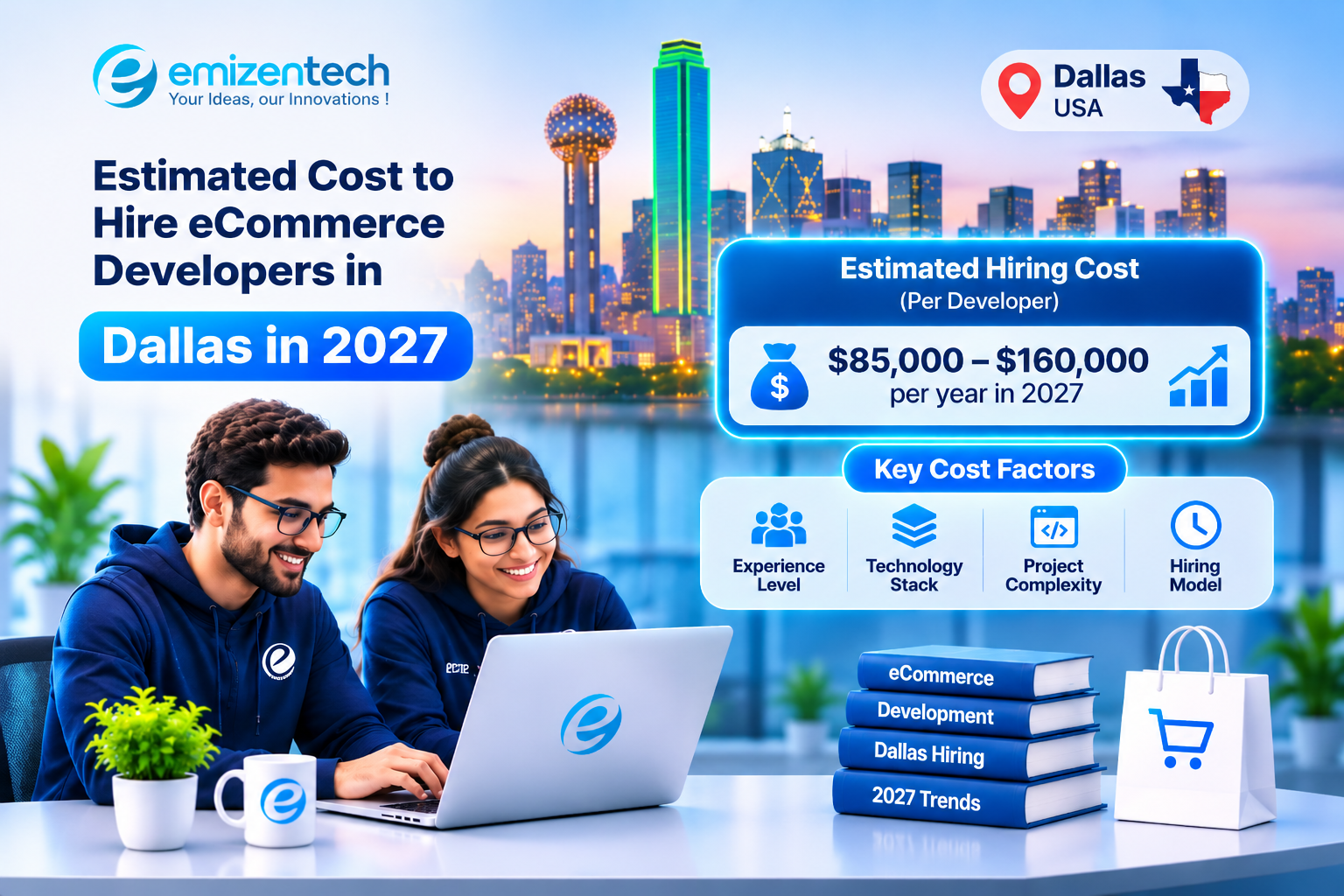

Dallas is one of the busiest tech hubs in the country, and online retailers feel that every time they need a developer. Demand is high, rates swing widely from one provider to the next, and it’s hard to know what a fair price looks like.
Maybe you’re launching a first store, or rebuilding one that has outgrown its platform. Either way, the first question is the same: what will it cost? This guide covers what to expect in 2027, what moves the price, and how to budget without surprises.
What Dallas eCommerce Developers Charge
Pricing in Dallas isn’t uniform. Hourly rates, salaries and contract fees all point to different numbers depending on who you hire. Here is how each option looks as you plan for 2027.
Directory data from 2026 puts the median hourly rate for local eCommerce firms in the high $30s. Small studios list $25 to $60, while established Magento and Shopify firms often quote $100 to $150 or more. In-house site developers earn roughly $95,000 to $120,000 a year, and with benefits and equipment the real cost is closer to 1.3 times that. For 2027, assume a rise of 5 to 10 percent.
| Hiring option | Estimated 2027 cost |
|---|---|
| Freelancer (Dallas) | $45–$95/hour |
| Local development firm | $80–$175/hour |
| In-house full-time developer | $115,000–$155,000/year |
| Remote dedicated developer | $20–$55/hour |
AI coding assistants are pulling in the opposite direction. They handle routine work like boilerplate templates, theme tweaks and test scripts, so a good developer finishes those tasks faster than before. Senior judgment still costs real money, but it’s fair to question any quote that bills heavy hours for simple jobs.
Local Hiring vs. Remote Developers
Hiring close to home feels safe, but it isn’t the only route. Remote developers have become a serious option for Dallas retailers. Here is how the two compare on cost and convenience.
Local hiring has clear perks: face-to-face meetings, the same time zone and an easier working relationship. You also pay for Dallas salaries and overhead, and that shows up in every rate.
A growing number of Dallas retailers now hire e-commerce developer talent through dedicated remote providers instead. Hourly rates are far lower, and some offshore options start near $20. Check for a trial period, a refund policy and overlap with Central Time before you sign.
A hybrid setup works too. Keep a local product owner and let remote developers handle the build.
Hourly, Part-Time or Full-Time: Which Model Fits?
The way you engage a developer changes your total spend as much as the rate does. Each model suits a different workload. Pick based on how steady your work is, not just the sticker price.
Hourly works for small, defined jobs like fixing a checkout bug or speeding up product pages. You pay only for what you use, but costs can drift if the scope is loose.
Part-time suits stores that need steady attention without a full workload, such as monthly updates and conversion tweaks. Remote part-time developers often start around $1,200 a month, while a local contractor can cost several times that.
Full-time makes sense for a large catalog, a marketplace or a constant stream of new features. A dedicated remote developer typically starts near $7,000 a month, and a comparable local hire costs considerably more.
If you’re unsure, start part-time for two or three months. Scaling up is easier than unwinding a poor fit.
Estimated Cost by Project Type
Most store owners care less about the hourly rate than the final invoice. These are rough 2027 ranges for the Dallas market, based on scope and platform.
- Basic Shopify or WooCommerce store: $5,000–$20,000
- Custom mid-market store: $20,000–$75,000, with custom features, ERP or CRM connections and a tailored checkout
- Enterprise or multi-vendor marketplace: $75,000–$250,000 and up
- Platform migration: $8,000–$40,000, depending on data and integrations
- Monthly maintenance and support: $500–$3,000
AI features add a line item of their own. Smart product recommendations, natural-language search and chatbots that answer order questions all need setup and integration. Budget roughly $3,000 to $15,000 for a first rollout. They can pay for themselves through higher order values and fewer support tickets, so treat them as an investment.
If your project needs more than one hire, an experienced ecommerce development company can bring designers, QA and project management under a single contract. That often costs less than assembling those roles one by one.
What Pushes the Price Up
Quotes can differ wildly for the same project. A few factors explain most of the gap. Knowing them helps you compare offers fairly.
Platform choice. Shopify and WooCommerce are usually the most affordable. Adobe Commerce and Salesforce Commerce Cloud need specialists, and specialists cost more.
Customization. Every custom feature adds hours. Subscription logic or a product configurator can double a module’s cost compared with a plugin.
Integrations. Inventory, shipping, accounting and warehouse tools each carry their own build and testing time.
Design depth. Template-based design costs less than custom UI/UX with prototypes, though custom work often pays off in conversions.
Developer experience. A senior developer may charge double a junior one and still finish cheaper, thanks to less rework. AI tools widen that gap. In skilled hands they speed things up, and in unskilled hands they produce code that looks fine and fails under load.
Hidden Costs to Plan For
The development invoice is rarely the whole story. Smaller recurring costs add up fast after launch. It’s better to see them coming now.
- Paid apps and plugins with monthly subscriptions
- Hosting, CDN and security monitoring
- Sales tax automation, which matters in Texas given the local jurisdictions involved
- PCI compliance checks and SSL management
- Product data and content entry
- Post-launch bug fixes and performance tuning
Add 15 to 20 percent to your build budget as a cushion. It’s far less painful to have it and not use it.
Tips to Keep Your Budget in Check
A little discipline early saves a lot of money later. These habits work whether you hire locally or remotely. None of them require technical knowledge.
Define the scope in writing. Separate must-haves from nice-to-haves and launch with the first group.
Ask about process, not just price. Ask how a developer handles QA, version control and handovers, and how they use AI tools. Good answers mention code review and testing.
Start with a paid trial. A small first task shows communication style and code quality before you commit.
Plan in phases. Launch lean, learn from real customer behavior and fund the next features with data behind you.
Compare total cost. A $30 developer who needs three rounds of fixes often costs more than a $60 developer who gets it right once.
Conclusion
Hiring eCommerce developers in Dallas in 2027 will cost anywhere from about $20 an hour for remote providers to $150 or more for premium local firms. Project totals run from a few thousand dollars for a simple store to well over $100,000 for enterprise builds. Your number depends on scope, platform, experience and how well you plan. Whether you hire locally or work with a remote provider like EmizenTech, define your needs clearly, test the fit early and keep a buffer for extras. That protects your budget far better than chasing the lowest rate.
FAQs
1. How much does it cost to hire an eCommerce developer in Dallas?
Freelancers typically charge $45 to $95 an hour in 2027, and local development firms charge $80 to $175. Remote dedicated developers can start around $20 an hour.
2. Is it cheaper to hire remote developers than local ones?
Usually, yes. Remote and offshore options often cost 40 to 70 percent less per hour. The trade-off is time zone overlap, so confirm shared working hours before you sign.
3. How much does a custom eCommerce website cost in Dallas?
A basic store runs $5,000 to $20,000, a custom mid-market build $20,000 to $75,000, and an enterprise or marketplace project $75,000 and up.
4. Does AI reduce the cost of eCommerce development?
It cuts the time spent on repetitive coding and testing, which can trim hours on routine tasks. AI-powered search and recommendations also add integration costs, so the overall effect depends on your project.
5. What other costs should I budget for besides development?
Plan for apps and plugins, hosting, security, sales tax tools, content entry and post-launch support. Setting aside 15 to 20 percent of your build budget for extras is a safe rule.



