

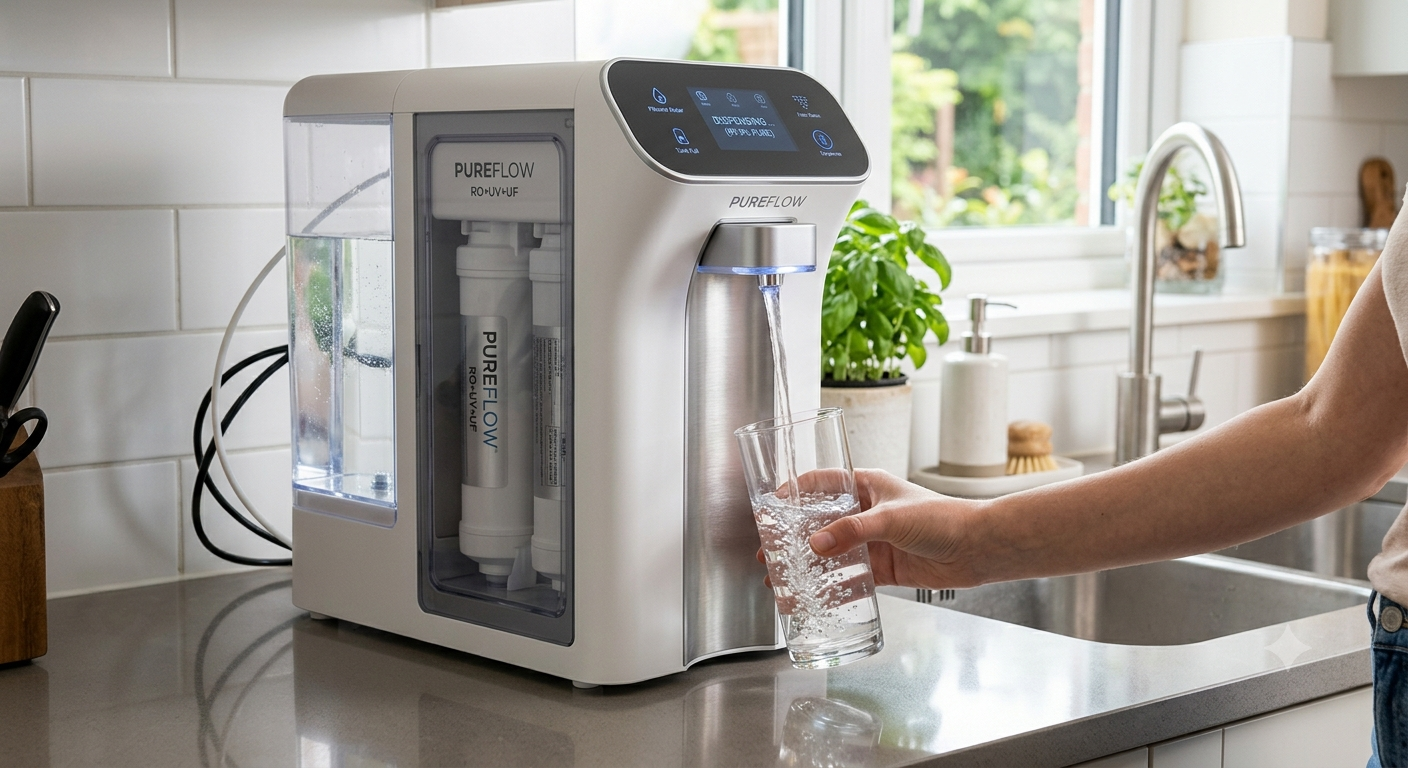

How to Choose the Right water purifier for Safe and Healthy Drinking Water
Clean drinking water is essential for everyday health, cooking and hydration. Yet water quality can vary from one locality to another, depending on its source, storage and supply network. Choosing the right water purifier starts with understanding these differences rather than buying a model simply because it has the most features. If you are comparing home water purifier systems, this guide explains the technologies, features and maintenance points that can help you make a practical decision.
Why Water Quality Deserves Your Attention
Water may look clear and still contain dissolved salts, sediments or microorganisms. Contamination can enter through the source, leaking pipelines, overhead tanks or household storage containers. The type and level of impurities are not identical everywhere, so a solution that works well in one home may not be suitable for another.
A reliable water purifier can reduce specific contaminants when it uses the appropriate treatment method and is maintained correctly. However, no single technology removes every possible impurity in every situation. Start by learning about your water source and, where possible, getting a laboratory or reliable local water-quality test. This gives you a clearer basis for choosing equipment.
Understand the Main Purification Technologies
Before comparing models, learn what each filtration method is designed to do. Many modern units combine more than one technology to address different types of contamination.
Reverse Osmosis (RO)
Reverse osmosis pushes water through a semi-permeable membrane that helps reduce dissolved salts and many other dissolved substances. It is often considered for sources with elevated total dissolved solids (TDS), including some borewell supplies. RO systems usually send some water to a reject outlet, so check the recovery rate and plan how reject water might be reused for suitable non-drinking purposes, such as floor cleaning.
RO is not automatically necessary for every household. If your supply has low dissolved solids and the main concern is microbial contamination, another treatment combination may be more appropriate. Use test results and expert advice instead of relying on taste alone.
Ultraviolet (UV) Treatment
UV technology uses ultraviolet light to inactivate many bacteria, viruses and other microorganisms. It does not remove dissolved salts, heavy metals or suspended particles. For this reason, UV is commonly paired with a sediment or carbon filter, and sometimes other stages, depending on the source water.
Ultrafiltration (UF)
UF uses a fine membrane to reduce suspended particles and many microorganisms. Unlike RO, it generally does not remove dissolved salts. It may suit certain low-TDS supplies, but the correct choice depends on the contaminants identified in the water.
Sediment and Activated Carbon Filters
A sediment filter traps visible and fine suspended particles such as sand, rust and silt. Activated carbon helps reduce chlorine, unpleasant odours and some organic compounds that affect taste. These stages are often used before or alongside other treatment methods to protect the system and improve the drinking experience.
Seven Factors to Consider Before Buying
1. Test Your Source Water
Find out whether your home receives municipal water, borewell water, tanker supply or a mixture. Ask for a water test that checks relevant parameters, including TDS and microbiological quality. TDS is a useful measurement of dissolved substances, but it does not identify every contaminant or prove that water is safe. A full assessment may be needed when the source is uncertain.
2. Match the Technology to the Results
Choose a system based on the actual water-quality report. High dissolved solids may indicate a need for RO, while microbial concerns may call for UV or another validated disinfection method. Sediment and carbon stages can address different issues. Avoid paying for multiple technologies that do not solve a problem present in your supply.
3. Select the Right Storage Capacity
Think about the number of people in your household, daily drinking and cooking needs, and how reliable the electricity and water supply are. A small family may manage with a compact tank, while a larger household may prefer greater storage. Consider the unit's purification rate as well as tank capacity, especially during busy mornings or interruptions in supply.
4. Check Filter Life and Service Costs
The purchase price is only one part of ownership. Ask how often the sediment cartridge, carbon filter and membrane need replacement under your local conditions. Request an estimate for genuine replacement parts, routine servicing and labour. A model with a lower initial price may cost more over time if its consumables are expensive or difficult to source.
5. Look for Practical Features
Useful features may include an alert for filter replacement, an automatic shut-off function, a leak warning, a child lock or a transparent service indicator. Mineral or taste-enhancement features should be evaluated carefully: they do not replace proper contaminant removal, and marketing terms alone are not proof of better health outcomes. Choose features that solve a real household need.
6. Measure the Available Space
Check the installation area before ordering. Wall-mounted units need suitable wall strength and clearance for servicing. Countertop or under-sink models require accessible connections and enough room for the unit and its storage tank. Also confirm that a nearby power point and drainage arrangement are available if the model needs them.
7. Verify Brand Support and Warranty
Read the warranty terms and confirm what is covered: the pump, electrical components, membrane, filters or service visits. Ask who will install the unit and whether support is available in your area. Keep the invoice, warranty information and service records so future maintenance is easier.
Common Buying Mistakes to Avoid
One common mistake is selecting a model only because it has the highest number of purification stages. More stages do not necessarily mean better results; the stages must match the water-quality problem. Another mistake is choosing based only on a low online price without checking installation, replacement filters and after-sales support.
Do not judge water safety by taste, smell or appearance. Some contaminants cannot be detected by the senses. Similarly, a basic TDS meter cannot identify bacteria, viruses or every chemical contaminant. If water quality changes seasonally or the source changes, arrange another test and review whether your current setup remains suitable.
Avoid delaying filter replacement. A clogged or overdue cartridge can reduce flow and affect performance. Follow the manufacturer's schedule, but remember that actual replacement frequency can vary with incoming water quality and household use. If the water develops an unusual taste, odour, colour or flow change, stop relying on assumptions and arrange an inspection.
How to Maintain Your System Properly
Regular care helps protect performance and can extend the working life of the equipment. Keep the outside clean with a soft cloth and avoid allowing dust or moisture to collect around electrical parts. Do not open the unit or attempt electrical repairs unless you are qualified to do so.
Follow the service schedule in the product manual. Ask the technician to check filter condition, membrane performance, tubing, connectors, storage tank hygiene and any leakage. Use compatible replacement cartridges from a reliable source. After servicing, follow the recommended flushing procedure before using the water for drinking.
The storage tank and dispensing tap also need attention. Wash hands before handling the tap, keep the dispensing area clean and avoid touching the outlet with bottles or cups. If the unit will remain unused for an extended period, follow the manufacturer's instructions for cleaning and restarting it.
Choosing a Model for Your Home
A practical water purifier for home use should fit your source water, household size, installation space and service budget. For example, a home using borewell water with high dissolved solids may need an RO-based system selected after testing. A home receiving treated municipal water with a microbial concern may need a different combination. These are examples, not universal rules; the test report should guide the final decision.
Compare specifications rather than relying on promotional labels. Check the rated storage capacity, purification rate, input-water limits, power consumption, water recovery, filter replacement cost and warranty. If you are unsure how to interpret the figures, ask the seller or service professional to explain them in writing.
Tawi Bazaar lists products from established brands and offers options across household purification needs, along with related parts and larger systems. Compare the available models against your test results and ask about local installation and service coverage before placing an order.
Conclusion
Choosing a water purifier is an important household decision, but it does not need to be complicated. Begin with a clear understanding of your water source, identify the contaminants that need attention and select a suitable technology. Then compare capacity, running costs, genuine replacement filters, warranty and service support. Regular maintenance is just as important as the initial purchase.
Explore the range at Tawi Bazaar and compare the specifications carefully before deciding. If you need help narrowing down the options, contact the team with details of your water source and household requirements so you can choose a solution that makes sense for your home.
Frequently Asked Questions
1. How can I check the quality of my household water?
You can arrange a test through a recognised water-testing laboratory or an appropriate local authority. Ask which parameters are included and choose tests based on your water source and concerns.
2. Is a higher number of filtration stages always better?
No. The number of stages is less important than whether each stage addresses a contaminant found in your supply. Compare the technology and verified performance claims.
3. How often should filters be replaced?
Replacement intervals depend on the model, filter type, incoming water quality and daily usage. Follow the manufacturer's guidance and have the system checked when performance changes.
4. Can I install a unit myself?
Some products may be designed for straightforward setup, but professional installation is advisable when plumbing, electrical connections or drainage are involved. Always follow the product instructions.
5. What should I check before ordering online?
Review the model specifications, seller details, warranty, delivery terms, installation availability, return policy and cost of replacement cartridges. Confirm that the product is suitable for your water source.



