

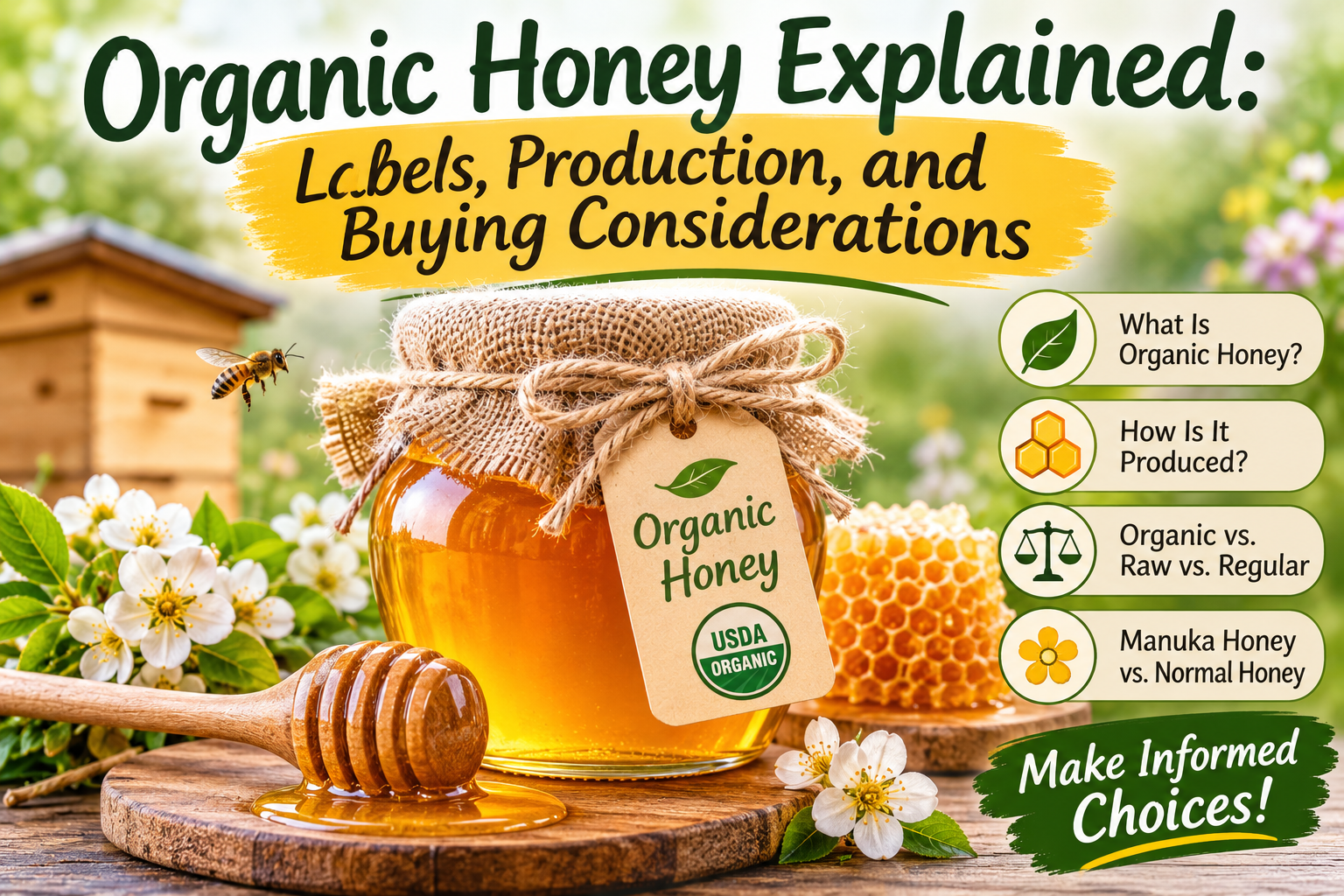

Honey is a popular natural sweetener enjoyed in kitchens around the world. From adding sweetness to tea and breakfast bowls to enhancing marinades and baked goods, it is a versatile ingredient with a long history of use. Today, consumers can choose from numerous varieties, including organic honey, raw honey, wildflower honey, clover honey, and specialty options such as Manuka honey.
However, choosing the right honey is not always straightforward. Product labels often include terms such as organic, raw, unfiltered, pure, and natural, which can describe different aspects of production and processing. Understanding these terms can help shoppers make informed decisions about quality, origin, and value.
Whether you are purchasing honey for everyday cooking or exploring specialty varieties, learning how honey is produced and what its labels mean is a useful starting point.
1. What Is Organic Honey?
Organic honey refers to honey produced under specific organic agricultural and beekeeping standards. These standards generally focus on environmental conditions, hive management, pest control, and processing methods.
Unlike conventional honey production, certified organic beekeeping places particular importance on limiting exposure to prohibited substances and maintaining suitable conditions around bee colonies.
Important Aspects of Organic Beekeeping
Several factors are considered when producing certified organic honey:
-
Foraging areas: Bees need access to suitable flowering plants within areas that meet applicable organic requirements.
-
Hive management: Beekeepers must follow approved practices for maintaining and managing their colonies.
-
Pest control: Organic production standards restrict the use of certain chemical treatments.
-
Processing methods: Honey must be handled and processed according to relevant certification requirements.
-
Traceability: Producers are generally required to maintain records demonstrating compliance with applicable standards.
Requirements vary between countries and certification organizations. Therefore, consumers should check the certification information on packaging rather than assuming that every product labeled natural or pure is certified organic.
2. How Is Organic Honey Produced?
Honey production begins with the relationship between bees and flowering plants. Worker bees collect nectar from blossoms and transport it to their hives, where it undergoes natural enzymatic changes and moisture reduction.
Once the honey reaches an appropriate level of maturity, bees store it in wax cells and seal them.
From Nectar to Finished Honey
The production process generally involves several stages:
1. Nectar collection: Worker bees visit flowering plants and collect nectar.
2. Natural transformation: Bees process the nectar through enzymatic activity and evaporation inside the hive.
3. Honey storage: The transformed nectar is stored in honeycomb cells until it reaches suitable maturity.
4. Harvesting: Beekeepers remove appropriate honey frames from the hive while following responsible colony management practices.
5. Extraction: Honey is separated from the wax comb using suitable extraction equipment.
6. Filtering and packaging: Depending on the product, honey may be strained or filtered before being packaged in sealed containers.
Organic honey producers must also follow the processing and handling requirements established by their certification system.
3. Organic Honey vs. Raw Honey: Understanding the Difference
Organic and raw honey are often discussed together, but they do not mean the same thing. Each term describes a different characteristic of honey production.
What Is Organic Honey?
Organic honey is associated with specific agricultural and production standards. Its certification relates to how the honey is produced, harvested, handled, and processed.
What Is Raw Honey?
Raw honey generally refers to honey that has undergone limited processing. It is commonly strained to remove larger particles while avoiding extensive filtration or heat treatment.
However, the term raw does not have one universally consistent legal definition across all markets.
What Is Conventional Honey?
Conventional honey is produced under standard food production and safety requirements without necessarily following organic certification standards.
It can still be genuine, high-quality honey. Its characteristics depend on its floral source, handling, processing, and storage.
Understanding these distinctions helps consumers avoid assuming that raw honey is automatically organic or that organic honey must always be unfiltered.
4. Understanding Different Types of Honey
Honey comes in many varieties, and each can have its own flavor, aroma, color, and texture. These differences are influenced by the flowers visited by bees, the surrounding environment, and the conditions under which honey is harvested.
Before choosing a variety, consumers should understand the differences in floral origin, natural composition, flavor, and other identifying characteristics. Learning about Manuka Honey vs Normal Honey can help shoppers make a more informed purchasing decision.
What Makes Manuka Honey Different?
Manuka honey is a specialty variety associated with nectar from plants belonging to the Leptospermum genus. It is particularly recognized for its naturally occurring methylglyoxal (MGO) content.
MGO is commonly used to describe and measure an important characteristic of Manuka honey. Products may carry different MGO ratings, indicating the measured concentration of this compound.
How Does Regular Honey Compare?
Regular honey can originate from many flowering plants, including clover, eucalyptus, and wildflowers. Its flavor and appearance depend on the floral source and production conditions.
Some important differences include:
-
Floral origin: Manuka honey comes from suitable Manuka blossoms, while conventional varieties can come from numerous flowering plants.
-
MGO content: Manuka honey is often tested and labeled according to its MGO concentration.
-
Flavor: Manuka honey typically has a distinctive, rich taste, while other honey varieties can range from mild to strongly floral.
-
Color and texture: Both types can vary in color, thickness, and crystallization.
MGO ratings provide information about methylglyoxal concentration, but they should not be treated as a complete measurement of overall honey quality.
Consumers should also understand that MGO and UMF are separate measurement and certification systems. Their numerical ratings are not directly interchangeable.
5. How to Read Organic Honey Labels
Product labels provide important information about honey's origin, ingredients, certification, and processing. Taking a few moments to review the packaging can help prevent confusion and misleading assumptions.
Check Organic Certification
If honey is marketed as certified organic, look for the name or mark of the certifying organization. Certification requirements differ depending on the country where the product is manufactured or sold.
A recognized certification provides more useful information than vague descriptions such as naturally produced or environmentally friendly.
Review the Country of Origin
Origin information helps consumers understand where honey was produced. Some products contain honey from multiple countries, so it is worth checking whether the packaging identifies a single origin or a blend.
Examine the Ingredient List
Pure honey generally lists honey as its only ingredient. If additional syrups, flavorings, or sweeteners are included, the product should be evaluated as a blended or flavored honey rather than assuming it is pure honey.
For specialty varieties, look for additional information about floral origin, MGO testing, batch identification, and traceability where available.
6. What to Consider Before Buying Organic Honey
Choosing honey involves more than selecting the most attractive jar or the product with the highest price. Consumers should consider quality information, intended use, packaging, and seller transparency.
Choose Honey According to Its Intended Use
Different varieties are suitable for different culinary purposes.
-
Everyday sweetening: Mild honey varieties work well in tea, oatmeal, and breakfast bowls.
-
Baking: Liquid honey can add sweetness and moisture to selected baked goods.
-
Marinades: Honey can balance acidic ingredients in homemade sauces and marinades.
-
Specialty tasting: Manuka and other distinctive varieties offer different flavor characteristics worth exploring.
Compare Product Information
Before purchasing, consider the following:
-
Is the product's origin clearly identified?
-
Does the packaging provide a complete ingredient list?
-
Is organic certification supported by a recognized organization?
-
Are specialty honey ratings supported by appropriate testing information?
-
Is the container properly sealed?
-
Does the seller provide clear product descriptions and storage recommendations?
If you are exploring specialty varieties, searching for manuka honey for sale
can help you compare different MGO grades, jar sizes, and product options. Focus on origin, product documentation, and seller reputation rather than relying entirely on promotional descriptions or price.
Buying from a reputable retailer makes it easier to access reliable product information and understand what you are purchasing.
7. How to Store Honey Properly
Proper storage helps maintain honey's flavor, consistency, and overall quality.
Honey should generally be stored in a tightly sealed container in a cool, dry location away from direct sunlight and excessive heat.
Prevent Moisture and Contamination
Always use a clean, dry spoon when removing honey from its container. Introducing water or food particles can affect its quality.
Keep the lid securely closed after each use to prevent moisture absorption and unwanted odors.
Refrigeration is generally unnecessary. Honey may naturally crystallize during storage, but crystallization does not automatically mean that it has spoiled.
If you prefer liquid honey, gently warming the sealed container in warm water can help soften the crystals. Avoid excessive heating.
8. Is Organic Honey Always the Best Choice?
Organic certification provides useful information about production practices, but it does not automatically mean that one honey variety tastes better or has greater nutritional value than another.
Honey's characteristics depend on several factors, including floral source, climate, harvesting conditions, and processing methods.
Conventional honey can also be a suitable choice when it comes from a reliable producer and meets applicable food safety requirements.
Consumers should consider their priorities, including certification, flavor, origin, processing, and price, before deciding which variety best suits their needs.
It is also important to remember that honey is primarily composed of sugars. Organic certification does not make honey sugar-free, and all varieties should be consumed in moderation. Honey should not be given to children younger than 12 months because of the risk of infant botulism.
Conclusion
Organic honey offers consumers an opportunity to explore honey produced under specific agricultural and processing standards. However, understanding its labels, production methods, and certification requirements is essential when comparing products.
Learning the differences between organic and raw honey, exploring specialty varieties such as Manuka, and checking product origin and ingredient information can help shoppers make more confident purchasing decisions.
Ultimately, choosing good honey comes down to understanding what is inside the jar, how it was produced, and whether the product meets your personal expectations. With a little knowledge and careful label reading, finding a suitable honey variety becomes a much simpler process.



