

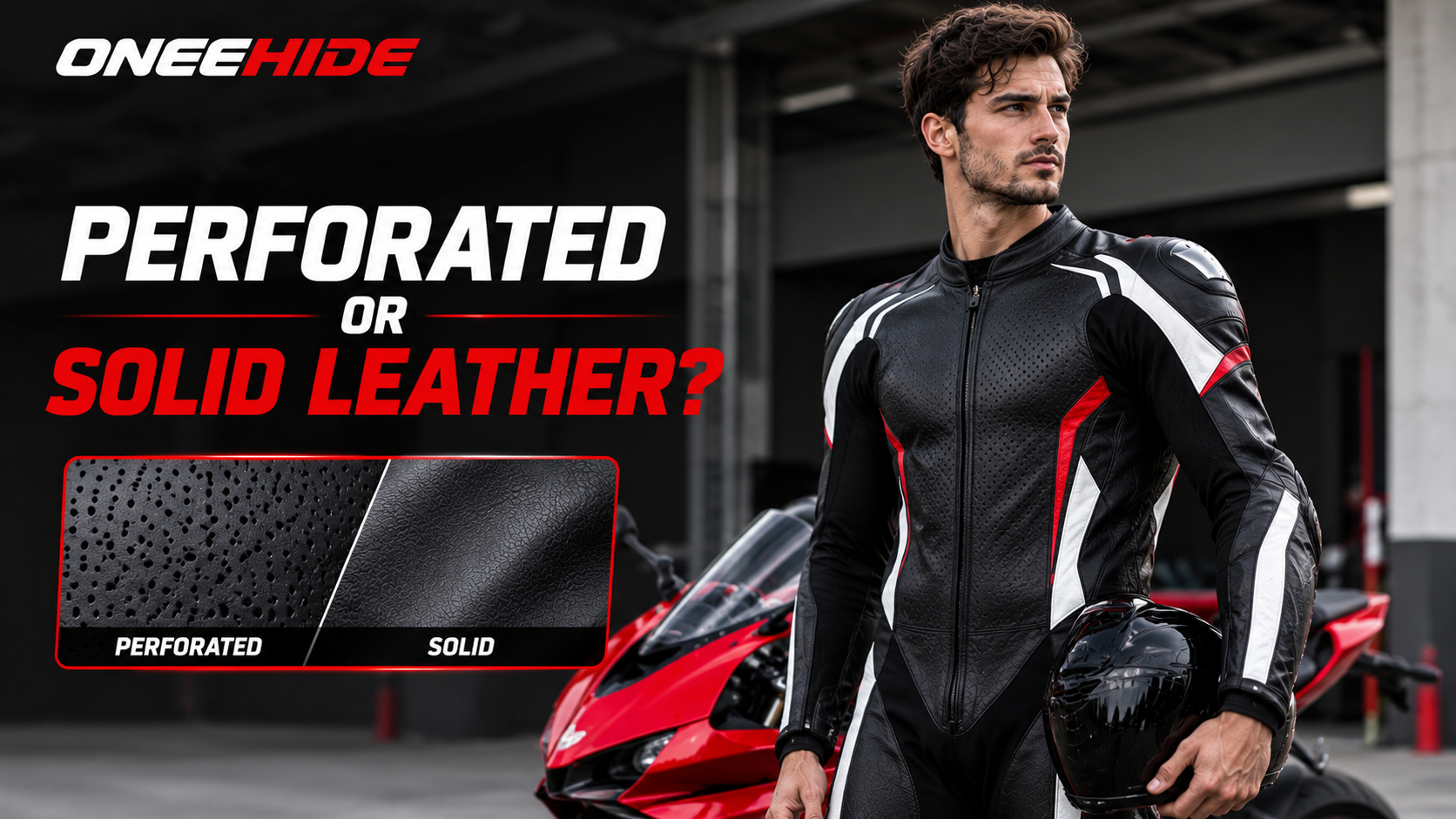
How Do You Choose Between Perforated and Non-Perforated Leather Panels in a Custom Race Suit?

Choosing the leather construction for a custom motorcycle race suit involves more than deciding how the finished garment should look. One of the most important decisions is how much of the suit should use perforated leather and which areas should retain solid, non-perforated panels.
Perforated leather contains small openings designed to allow air to pass through the material. This can improve ventilation during demanding riding sessions, particularly in warm conditions. Non-perforated leather provides a continuous material surface without those openings, making it an important consideration in areas where abrasion resistance and structural strength are priorities.
The challenge is balancing both requirements. A suit with too little ventilation can become uncomfortable during hot track sessions, while excessive perforation can introduce unnecessary weaknesses into the leather construction. The most practical solution is often a combination of both materials, positioned according to the suit's protective requirements, riding conditions, and intended use.
Understanding how perforations affect airflow, abrasion resistance, tear strength, and garment construction helps riders make a more informed decision before approving their custom design.
What Is the Difference Between Perforated and Non-Perforated Leather?
Perforated leather is leather manufactured with small, regularly spaced holes that allow air to pass through the panel. Non-perforated leather has a continuous surface without these openings.
Both can be used in motorcycle racing suits, but they serve different purposes within the garment.
Perforated panels primarily support airflow and thermal comfort, whereas solid leather panels retain their uninterrupted material structure and are generally preferable where maximum material continuity is required.
Riders considering a custom motorcycle race suit should therefore discuss panel construction as part of the original design rather than treating perforation as a purely cosmetic choice.
How Perforated Leather Improves Ventilation
During track riding, the rider generates body heat while wearing a garment designed to provide substantial coverage. Leather is relatively resistant to airflow, so heat and moisture can accumulate inside the suit.
Perforations create openings through which moving air can enter and circulate.
Their effectiveness depends on several factors, including:
-
Hole diameter and spacing.
-
Total perforated surface area.
-
Position of the panels on the suit.
-
Riding speed and airflow direction.
-
The presence of internal liners.
-
The rider's posture.
For example, a perforated chest panel may behave differently from a similarly perforated lower-back panel because the airflow reaching each area depends on the motorcycle's aerodynamics and the rider's position.
Why Non-Perforated Leather Remains Important
Solid leather retains a continuous material structure without the additional openings created during perforation.
This matters because holes interrupt the leather fibres and can affect resistance to abrasion and tearing.
Non-perforated leather is therefore particularly useful when designing areas that need additional material continuity, including heavily exposed sections and important structural regions.
A solid panel also helps avoid uncontrolled airflow through areas where the rider may not need additional ventilation.
Neither material is universally superior. Their suitability depends on the location, construction, leather type, and protective requirements of the finished garment.
How Perforation Affects Abrasion Resistance and Tear Strength
One of the most important considerations when choosing leather panels is understanding the relationship between ventilation and protective performance.
Perforated leather generally has lower abrasion and tear resistance than otherwise comparable non-perforated leather because the openings interrupt the material structure.
A particularly useful technical reference is A Guide to Designing and Manufacturing Motorcycle Protective Clothing, written by researchers at Deakin University's Institute for Frontier Materials, with funding from Road Safety Victoria and Transport for NSW.
The guide explains that the number, size, and spacing of perforations influence the tear strength and abrasion resistance of leather.
It provides an example of smaller holes measuring 1 to 2 mm, separated by an 8 to 10 mm grid spacing, as having a lower risk of tearing or bursting during road contact.
These measurements are examples from the research guide, not universal specifications that every manufacturer must follow.
Why Hole Size and Spacing Matter
Perforation design involves more than making as many holes as possible.
Large openings can interrupt more of the leather's continuous structure, while closely spaced perforations can leave less uninterrupted material between neighbouring holes.
The result can affect how the panel behaves under tension and during contact with an abrasive surface.
For this reason, the perforation pattern should be designed around the intended location and construction of the garment.
The Deakin University guide also discusses laminating a mesh fabric with a weight greater than 100 g/m² behind perforated leather to improve tear and abrasion strength.
This is an example of how an additional protective layer can help address the weaknesses introduced by perforation. It should not be interpreted as proof that every backed perforated panel will achieve the same performance.
Why Perforations Should Not Cross Important Seams
Seam placement is another detail that deserves attention before a suit is manufactured.
Stitching already introduces needle holes through the materials being joined. Adding leather perforations across the same area can create additional points of weakness.
The Deakin guide recommends avoiding perforations that overlap seams because they can increase the risk of premature tearing or seam failure.
It also illustrates a partially perforated leather panel in which the perforations remain within the panel rather than extending across the seam lines.
This provides a useful design principle: maintain solid leather around critical seam areas and use perforation selectively within suitable sections of the panel.
The complete seam construction still needs to be evaluated. A strong perforation pattern cannot compensate for an unsuitable stitching method or poorly designed panel connection.
Which Areas of a Racing Suit Should Have Perforated Leather?
The best perforation layout depends on the suit's overall construction, rider position, and expected riding conditions.
A manufacturer should consider where heat accumulates and how air travels around the rider rather than distributing holes uniformly across every available leather surface.
Chest and Upper Torso Panels
The chest is a common location for ventilation because it can receive airflow while the rider moves forward on the motorcycle.
Perforated chest panels can help improve air exchange during warmer sessions.
However, their position should be coordinated with the suit's closure, chest protection, airbag system, and surrounding seams.
The designer should identify the available ventilation area without unnecessarily compromising other functional components.
Upper Back and Side Panels
The upper back and sides can also benefit from strategically positioned perforation.
These locations can contribute to airflow through the garment, depending on the rider's posture and the suit's overall ventilation arrangement.
A useful design considers both air entry and air escape. Simply adding openings at the front does not guarantee effective ventilation if air becomes trapped inside the suit.
The Deakin guide explains that at least two openings are needed for effective airflow through a garment and discusses how chest and back ventilation can work together.
Arms and Legs
Some racing suit designs incorporate perforated sections on the upper arms, forearms, thighs, or lower legs.
However, these areas require careful consideration because their exposure, movement, and protective requirements differ.
For example, the forearm may experience a different combination of movement and road exposure from the chest. A designer might therefore choose smaller perforations or retain solid leather in particular sections.
The important point is that a single perforation pattern does not necessarily suit the entire garment.
When Should You Choose Non-Perforated Leather Panels?
Non-perforated leather deserves priority when material continuity, abrasion resistance, and structural requirements outweigh the need for additional airflow.
This does not mean every solid panel automatically offers a higher level of protection than every perforated panel. Leather type, thickness, reinforcement, seam construction, and testing all influence the final result.
Consider non-perforated construction when:
-
The panel is located in a particularly exposed area.
-
The manufacturer needs to preserve material around structural seams.
-
Additional ventilation is unnecessary for the intended climate.
-
The design requires uninterrupted leather around important attachment points.
-
The panel is part of an area with specific protective construction requirements.
For riders who regularly attend events in cooler conditions, extensive perforation may also create unnecessary airflow.
A solid leather construction can help limit direct air entry, although the suit's complete thermal performance also depends on its lining, fit, and other ventilation features.
Perforated vs. Non-Perforated Leather: Which Should You Choose?
The decision is not necessarily about selecting one material for the entire suit. It is about assigning each material to the locations where it provides the greatest practical benefit.
|
Consideration |
Perforated leather |
Non-perforated leather |
|
Airflow |
Allows air to pass through openings |
Restricts direct airflow through the leather |
|
Thermal comfort |
Generally better suited to additional ventilation |
Better suited to limiting direct air entry |
|
Abrasion resistance |
Lower than otherwise comparable solid leather |
Generally higher material continuity |
|
Tear resistance |
Affected by hole size, number, and spacing |
No additional perforation-related weakness |
|
Seam positioning |
Perforations should be kept away from seams |
Allows an uninterrupted area around seams |
|
Warm-weather riding |
Useful for strategic ventilation |
Can help retain a more controlled airflow arrangement |
|
Cool-weather riding |
Extensive perforation may create discomfort |
Useful where additional ventilation is unnecessary |
Choose Strategic Perforation for Hot Conditions
Riders who regularly attend summer track days may benefit from strategically perforated panels.
However, full perforation is not automatically the best solution, even in hot weather.
The Deakin guide warns that garments made entirely from perforated leather cannot regulate airflow. This can contribute to excessive sweating or chilling depending on the environmental conditions and airflow.
A combination of perforated and solid panels provides more flexibility in managing the garment's construction and ventilation.
Prefer More Solid Construction Where Protection Takes Priority
Riders who prioritise material continuity in exposed areas should discuss non-perforated leather and suitable reinforcement with their manufacturer.
This is particularly relevant around structural seams and areas where additional perforation could compromise the panel design.
The goal is not simply to maximise the amount of solid leather. It is to ensure the selected construction meets the protective requirements of the complete suit.
How Motorcycle Clothing Standards Affect Perforated Leather Design
Custom suit designs should be considered alongside recognised motorcycle protective-clothing standards.
In Europe, EN 17092:2020 covers motorcycle protective garments, including one-piece and two-piece suits. It establishes different performance classes, including AAA, AA, A, B, and C.
According to SATRA's explanation of EN 17092, garment assessments include impact abrasion resistance, tear strength, seam strength, structural closures, and fit.
These requirements are important because a perforated panel cannot be judged solely by its ventilation performance.
The complete garment and its materials need to satisfy the applicable requirements for their intended protective classification.
A manufacturer's tested material and construction should not automatically be assumed to retain the same performance when the leather thickness, perforation layout, backing, or seam arrangement is changed.
For riders competing in organised championships, additional regulations may apply. The applicable technical rules should be checked before deciding where perforation can be used.
Questions to Ask Before Ordering a Custom Leather Racing Suit
Before approving the final artwork and construction, discuss the perforation layout directly with the manufacturer.
A useful design consultation should cover the following points.
1. Which areas will use perforated leather?
Request a visual panel map showing all perforated and non-perforated sections from the front, back, and sides.
2. What leather will be used?
Ask about leather type, thickness, and the material's intended role in each panel.
3. How will perforation affect the protective construction?
Ask whether the selected hole size, spacing, and backing material have been evaluated for the intended application.
4. Will any perforations overlap seams?
Confirm that the design maintains appropriate solid material around structural stitching and attachment areas.
5. How will the suit manage airflow?
Discuss the position of air entry and exit points, including how the design behaves when the rider is sitting upright and when tucked behind the windscreen.
6. Does the final construction meet the intended safety requirements?
Request documentation identifying the relevant certification or testing applicable to the specific suit design.
These questions are more useful than simply requesting a suit with maximum perforation.
A Practical Decision Framework for Your Custom Suit
Before making the final decision, consider three elements together: your riding environment, the intended protective construction, and the ventilation layout.
Riders who regularly ride in hot conditions may benefit from additional perforated chest, back, or limb panels, provided their placement is appropriate.
Those riding in cooler climates or prioritising uninterrupted leather construction may prefer more solid panels.
For many custom designs, a strategically mixed configuration offers a sensible balance.
A final design review should confirm:
-
Perforation locations are clearly identified.
-
Hole size and spacing have been discussed.
-
Critical seam areas remain appropriately constructed.
-
Reinforcement requirements have been reviewed.
-
Ventilation supports the rider's normal position.
-
The leather selection suits each panel's intended purpose.
-
Applicable protective standards and event regulations have been considered.
REV'IT!'s technical explanation of race-suit perforation provides an example of how manufacturers can use different perforation approaches within a single suit, including more extensive perforation on selected areas and lighter micro-perforation on others.
That approach highlights an important design principle: ventilation and protection should be planned together, not treated as competing afterthoughts.
The right leather configuration is the one that provides appropriate airflow without making unnecessary compromises to the suit's protective construction. By deciding where solid and perforated panels belong before production, riders can create a custom racing suit that is better suited to their riding conditions, comfort requirements, and intended use.
Add a direct recommendation earlyTrim repeated ventilation explanations



