

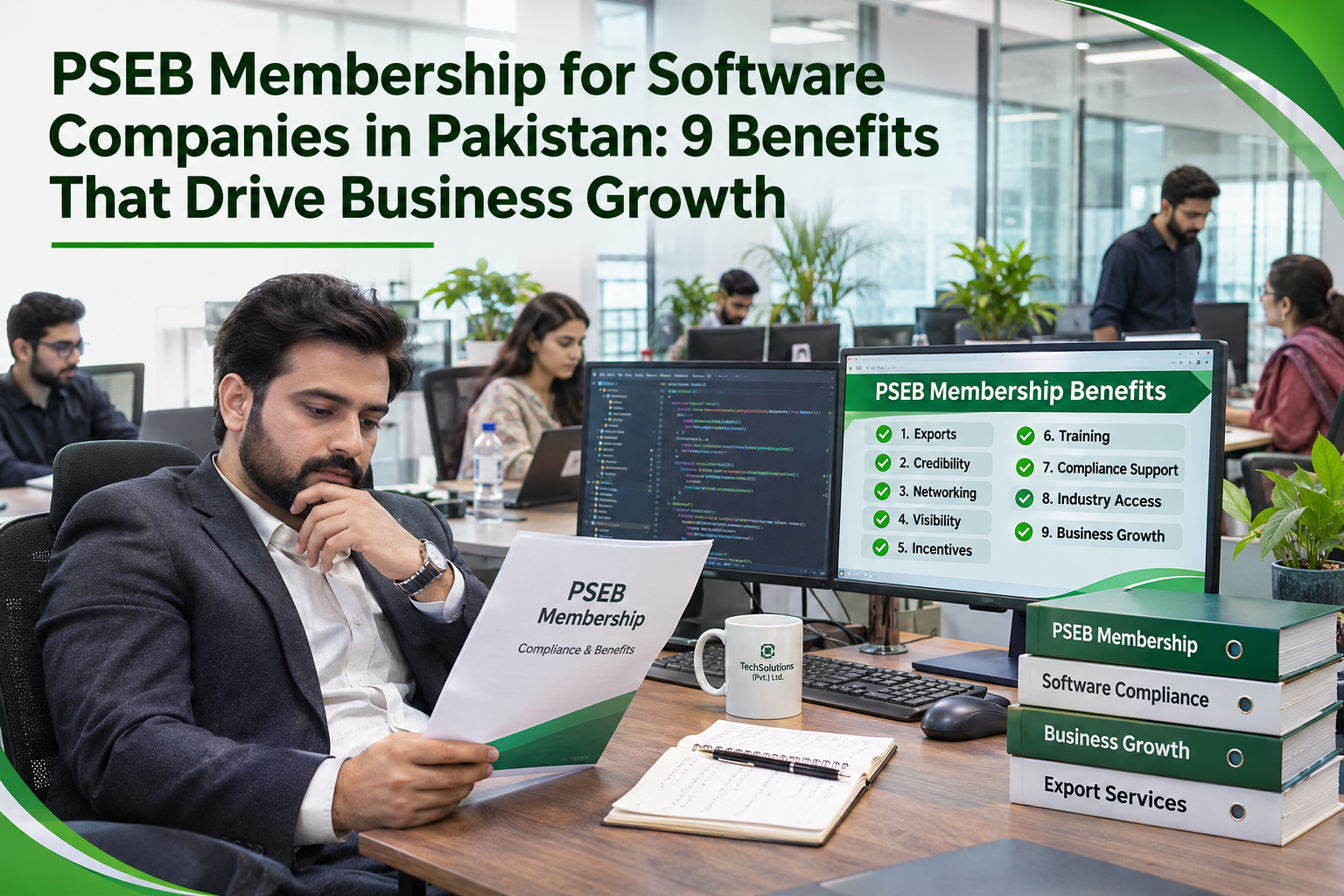
PSEB Membership for Software Companies in Pakistan: 9 Benefits That Drive Business Growth

Introduction
Pakistan's information technology sector continues to create opportunities for software houses, IT startups, freelancers, and technology service providers. As businesses expand beyond local markets and begin working with international clients, they need more than technical expertise to remain competitive. Access to export incentives, professional certifications, international networking, and regulatory support can make a significant difference in long-term growth.
The Pakistan Software Export Board (PSEB) plays an important role in developing the country's IT industry. Through its membership programmes, it provides registered IT and IT-enabled services businesses with access to government-backed initiatives, export facilitation, industry connections, and other growth opportunities. These services can help businesses improve their operations while building a stronger position in international markets.
For technology entrepreneurs researching pseb membership benefits software companies can access, understanding the available opportunities is an important first step. Membership is not simply an additional registration certificate. It can become a useful part of a business strategy when combined with proper financial management, tax planning, and corporate compliance.
1. Reduced Tax Rates on Eligible IT Export Revenue
One of the most important advantages of PSEB membership for software companies is access to the reduced withholding tax treatment available for qualifying IT and IT-enabled services exports.
Under the applicable tax framework, companies registered with PSEB can benefit from a 0.25% withholding tax rate on qualifying export proceeds of computer software, IT services, and IT-enabled services, compared with the general 1% rate applicable to other cases under the relevant provision. Eligibility depends on meeting the legal and documentation requirements.
For a software house receiving payments from clients in the United States, United Kingdom, Europe, or other international markets, this difference can influence financial planning and overall profitability.
However, companies should understand that PSEB tax benefits are linked to applicable tax provisions and compliance conditions. Registration alone does not automatically make every business receipt eligible for reduced taxation.
Businesses should maintain accurate export invoices, client agreements, bank remittance records, and tax documentation. Their income declarations should also match the nature of the services being exported.
2. Foreign Currency Retention for International Business Expenses
Software companies frequently deal with international expenses. These may include cloud hosting, software subscriptions, digital advertising, overseas travel, international certifications, and payments for certain business services.
Converting every export receipt into Pakistani rupees can create operational difficulties when a company regularly pays foreign suppliers.
Through the applicable State Bank of Pakistan framework, eligible IT and ITeS exporters can retain up to 50% of their export proceeds in an Exporters' Special Foreign Currency Account (ESFCA). These funds can be used for permitted business-related international payments.
This facility makes foreign currency retention for IT exporters an important financial advantage.
For example, a software development company earning foreign revenue may need to pay for international cloud infrastructure, development tools, and professional services. Retaining eligible foreign currency can help the business manage these expenses more efficiently.
Companies should coordinate with their authorised banks to ensure export receipts are correctly classified and transactions comply with current foreign exchange regulations.
3. International Market Access and Business Networking
Finding reliable international customers is one of the biggest challenges for growing Pakistani software houses. A company may have a talented development team and a strong portfolio but still struggle to establish relationships with international buyers.
PSEB supports the IT industry through international exhibitions, business delegations, trade events, and networking opportunities.
Registered businesses may become eligible to participate in relevant government-supported export promotion programmes, subject to the criteria and availability of each initiative.
These opportunities can help software houses:
-
Introduce their services to international technology companies.
-
Build relationships with potential investors and business partners.
-
Explore outsourcing and software development contracts.
-
Understand international customer expectations.
-
Develop connections with overseas technology communities.
PSEB international business networking can be especially valuable for startups that have limited experience entering foreign markets.
Participating in an international exhibition is not a guarantee of new contracts. However, meeting potential customers directly, presenting technical capabilities, and developing professional relationships can create opportunities that may otherwise take considerable time to establish.
4. Subsidized International Certifications and Professional Training
International clients often evaluate software companies based on more than pricing and technical capabilities. They also consider information security, quality management, service delivery processes, and operational reliability.
Certifications such as ISO 27001, ISO 27701, and CMMI can help businesses demonstrate structured management practices and strengthen their credibility.
PSEB provides access to selected subsidized IT certifications and professional training programmes. Depending on the programme, registered companies may receive financial support for international certifications and technical capacity development.
These opportunities can help software houses improve their internal processes without carrying the full cost of every development initiative.
Professional training is another important area. Employees may need to learn new technologies, improve cybersecurity knowledge, develop project management skills, or strengthen communication with international customers.
A company that invests in employee development can improve service quality and become more competitive when responding to international project requirements.
However, certification support is programme-specific. Businesses should review the current eligibility criteria, application requirements, available subsidies, and approved certification providers before making financial commitments.
5. Affordable Office Facilities Through Software Technology Parks
Office infrastructure can become a significant expense for startups and expanding technology companies. Rent, internet connectivity, backup power, maintenance, and other workplace requirements increase operating costs.
PSEB-supported Software Technology Parks (STPs) provide IT-enabled office facilities designed to support technology businesses.
These facilities aim to provide a suitable working environment, reliable connectivity, and access to supporting infrastructure.
Selected initiatives also offer rental and internet-related subsidies. For example, the PSEB programme for establishing 25 Software Technology Parks has advertised a 25% rental subsidy during the first year of establishment and free internet for the first year under the applicable scheme conditions.
This can help eligible software companies reduce their initial infrastructure expenses.
For a startup with limited capital, spending less on office facilities may allow more resources to be allocated to product development, employee salaries, marketing, and customer acquisition.
Businesses should check the location, availability, rental terms, and current subsidy conditions before applying for a workspace.
6. International Exposure and Export Promotion Support
Entering international markets requires preparation. Companies need to understand customer expectations, industry standards, business communication, and the competitive environment.
PSEB facilitates participation in relevant international technology exhibitions, roadshows, conferences, and business delegations.
Such programmes can expose Pakistani technology companies to global industry developments and help them understand how international businesses evaluate service providers.
IT export promotion in Pakistan is particularly relevant for companies offering:
-
Custom software development.
-
Mobile application development.
-
Web development services.
-
Artificial intelligence solutions.
-
Cloud computing and infrastructure support.
-
Cybersecurity services.
-
Business process outsourcing.
-
IT-enabled consultancy.
By attending selected industry events, businesses can present their portfolios, understand emerging requirements, and establish direct relationships with potential customers.
PSEB's social media updates also provide information about upcoming events, training opportunities, delegations, and export promotion initiatives. Following official announcements helps companies identify programmes before application deadlines pass.
7. Business Matchmaking and Investment Opportunities
International businesses do not always know where to find reliable Pakistani technology partners. Similarly, local software houses may struggle to reach foreign investors, outsourcing clients, and established technology companies.
PSEB's industry matchmaking initiatives help connect suitable Pakistani businesses with international entities based on their requirements.
The process may involve identifying companies that match a potential customer's service needs, technical capabilities, or investment interests.
For startups, such opportunities can improve visibility and create introductions to relevant business networks.
PSEB business development support can also help established companies explore new markets and diversify their customer base.
However, successful matchmaking depends on the quality of a company's services, portfolio, business documentation, communication, and ability to meet client requirements.
Businesses should maintain updated company profiles, case studies, service descriptions, technical credentials, and professional presentations to make the most of these opportunities.
8. Visa Facilitation and Support for International Business Travel
International travel can be important for software companies looking to secure new customers, attend exhibitions, meet investors, and develop overseas partnerships.
However, arranging business travel involves documentation, invitations, travel planning, and visa applications.
PSEB provides business visa facilitation for IT companies in connection with relevant international business development activities, exhibitions, conferences, and delegations.
It may also facilitate visa-related processes for incoming employees, customers, investors, and business partners.
This support can be useful for companies whose founders or representatives need to establish relationships with international clients through in-person meetings.
It is important to understand that facilitation does not guarantee visa approval. Final decisions remain with the relevant embassy or immigration authority, and applicants must meet the applicable requirements.
9. Recognition, Credibility, and Industry Representation
International customers often prefer dealing with technology companies that can demonstrate their business identity, operational structure, and industry involvement.
PSEB membership provides official recognition as a registered participant in Pakistan's IT or IT-enabled services sector.
This recognition can strengthen a company's business profile when communicating with potential customers, investors, and industry partners.
Membership also provides access to relevant industry support programmes and opportunities for capacity building and policy representation.
For emerging businesses, PSEB registration for IT companies can help establish a more formal industry presence.
Nevertheless, membership should be treated as one component of business credibility rather than a substitute for strong delivery performance, proper contracts, secure data management, and professional customer service.
Who Is Eligible for PSEB Company Membership?
Companies and businesses providing eligible IT or IT-enabled services can apply for PSEB company membership.
The official registration framework includes different business structures, such as:
-
SECP-registered private limited companies.
-
Single member companies.
-
Registered partnerships and associations of persons.
-
Sole proprietorships operating with a business NTN.
An important point for small business owners is that SECP incorporation is not a universal requirement for PSEB company membership. Eligible firms and sole proprietors can also apply under the relevant categories.
Common supporting documents include a business NTN, business bank account certificate, CNIC information of owners or stakeholders, and applicable business registration documents.
The required documents depend on the applicant's legal structure and current registration category. Applicants should verify the latest portal checklist before submitting an application.
How to Make the Most of PSEB Membership
Obtaining membership is only the beginning. Businesses need a practical approach to use available facilities and maintain their eligibility.
Consider the following steps:
Maintain accurate financial records: Keep export invoices, banking documents, tax returns, and payment evidence organised.
Monitor tax requirements: Confirm that export receipts are reported correctly and that applicable tax benefits are claimed according to current law.
Renew membership on time: Track the annual renewal date and update the required supporting information.
Follow official announcements: Monitor PSEB's updates about international events, certifications, technology parks, and business development opportunities.
Improve company documentation: Maintain a professional business profile, service portfolio, client agreements, and technical information.
Review corporate compliance: Keep FBR registration, applicable SECP filings, employment records, and other statutory obligations up to date.
A structured approach ensures that membership becomes part of the company's wider business development and compliance strategy.
Conclusion
PSEB membership can provide software companies in Pakistan with valuable opportunities to improve their financial efficiency, strengthen industry recognition, access professional development programmes, and explore international markets. From reduced withholding tax treatment on qualifying IT exports to foreign currency retention, certifications, technology parks, and business networking, the available facilities can support businesses at different stages of growth.
However, companies must understand the eligibility requirements and maintain accurate records to benefit from these opportunities. Coordinating PSEB membership with FBR taxation, SECP obligations, and business documentation is equally important. For technology businesses looking to establish this structure professionally, Pakistan's First Online Consultants (PFOC) offers compliance support covering PSEB registration, tax matters, and related software house obligations.
The real value of PSEB membership benefits for software companies comes from using the available support strategically rather than treating registration as a one-time administrative task. With proper planning, consistent compliance, and a clear international growth strategy, Pakistani software houses can build stronger operations and compete more effectively in the global technology industry.



