

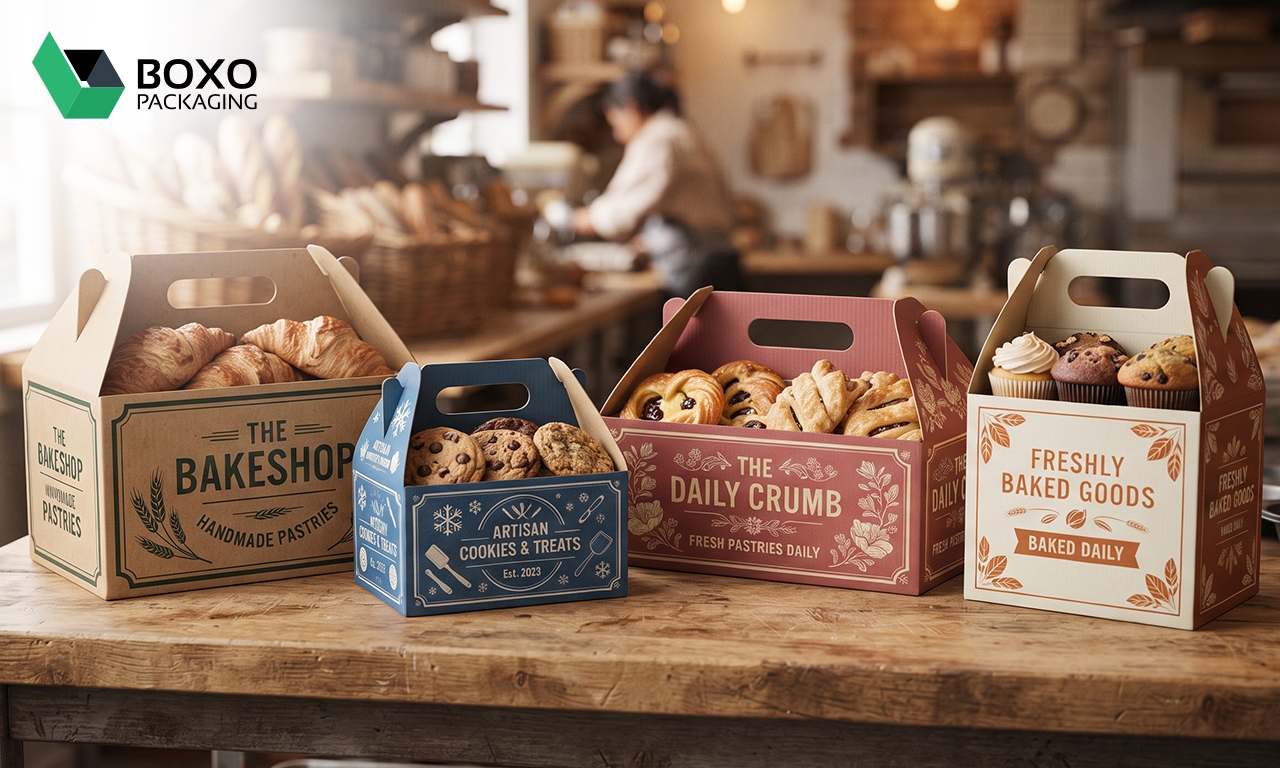
A plain Kraft carrier moves food from a counter to a car without any help from a designer. Custom gable packaging does that job and talks at the same time, because a box with a handle spends its working life in public, riding through sidewalks, offices, and kitchens at eye level. Every trip doubles as an impression, and the shop that prints its name on the roof of the carrier collects those impressions for free all day long.
The economics make sense for small food businesses especially. A bakery that sends out forty carriers on a Saturday has no advertising budget to speak of, yet those forty printed boxes pass hundreds of people on the way to forty front doors. The format rewards brands with a simple mark and a short message, since the roof panel reads at a glance while the box is in motion.
Where the Artwork Goes on a Handled Box
Panel choice matters more on a gable than on a flat carton, because the box is seen from angles a shelf box never meets. The roof around the handle lock is the most visible zone and belongs to the logo or the shop name. Side panels face the person carrying the box, which suits a thank you line or a web address rather than a sales pitch. Board color sets the mood before any ink lands: natural kraft warms every color printed on it and suits farm stands and bakeries, while a bright white sheet shows inks exactly as designed for brands built on strong color. A few choices settle the design before artwork begins:
- Board color first, since kraft shifts every ink toward warm while white board keeps color honest.
- Logo at the handle lock, where the most eyes land while the box travels.
- Quiet panels for the carrier's own view, holding a short thank you or a reorder link.
- Spot color on colored board where the budget is tight, saving full coverage for panels that face outward.
Keeping One Look across the Whole Line
A handled carrier rarely works alone. It shares customers with the folding cartons on the shelf, the product boxes in the display, the mailer boxes leaving the online shop, and the paper bags at the register. Custom gable packaging earns the word custom when it lands in that family with the same palette and type in the same positions, so a customer who met the brand through a lunch order recognizes the retail box a month later. Printing the handled carrier and its matching formats in one run also keeps color from drifting between orders.
Boxo Packaging bundles handled carriers with the rest of a line for exactly that reason, since one coordinated run costs less than two mismatched orders and sells harder than either.
Custom Tuck Boxes from Artwork to Shelf
The route has four stops: a dieline, the artwork, a proof, and a physical sample. A dieline is the flattened map of the box, showing every panel, fold, and tuck slot in one view, and artwork gets laid out directly on it. A digital proof checks color and placement, and a folded sample confirms the box behaves in hand before the press runs the full quantity.
Skipping the sample is the classic first order mistake. A screen shows color and layout, but only a folded box answers whether the flap holds shut, whether the board feels right for the product, and whether the print still reads under shop lighting instead of a monitor's glow.
Dielines, Proofs, and the First Sample
Reading a dieline takes ten minutes and saves weeks. The panels face different directions on the flat sheet, so artwork placed without checking orientation can arrive upside down on the back face or centered across a fold. A careful supplier sends the dieline as a template file, the artwork goes on top of it, and the proof comes back panel by panel. Custom tuck boxes ordered with a window add one more layer, since the film patch has its own placement on the sheet, and header cards or insert trays that ship with the order follow the same proofing round. Rushed approvals are where misprints are born, and misprints on a full run cost more than any sample ever will.
What to confirm before approving a full run:
Every panel sits the right way up, checked against the folded sample rather than the flat file
The proof is reviewed under lighting close to the shop floor, not only a bright screen
Flap tension on the sample closes without effort and reopens without tearing
Windows, insert trays, and hang tabs ride the same proof instead of joining the order late
Print Methods and Finishes for Small and Large Runs
Digital printing makes short runs affordable and forgives artwork changes between orders, which suits seasonal designs and products still finding their audience. Offset printing carries setup costs that only long runs of one design can spread thin, and it rewards stability with a lower price per piece at volume. Finishes then decide how the box ages: matte lamination softens photography and hides fingerprints, gloss lifts solid color under store lights, and a soft touch coating gives a suede feel that customers notice without knowing why. Custom tuck boxes for products handled every day deserve whichever finish survives the handling.
A brand that proofs its handled carrier and its printed tucks in the same round leaves the press with a matched family rather than two boxes that happen to share a name.



