

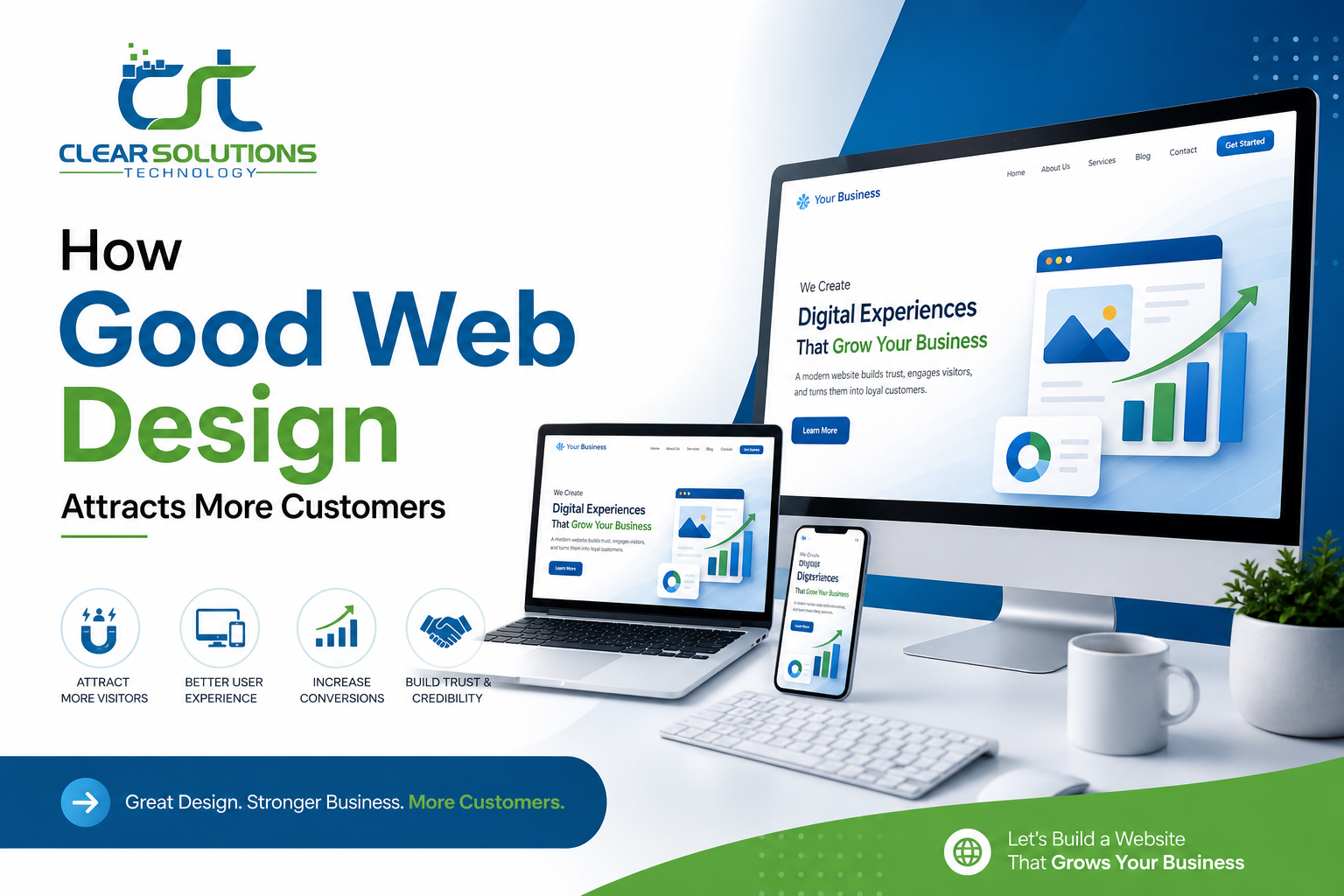

You know that feeling when you walk into a restaurant and the lighting is warm, the tables are spotless, and the menu is beautifully printed on thick cardstock? You immediately think, "This place is going to be amazing." Now imagine the opposite — flickering fluorescent lights, sticky floors, and a laminated menu held together with duct tape. Same kitchen, same chef, same food. Completely different first impression. That, in a nutshell, is what web design does for your business online.
Your website is the very first interaction most potential customers will ever have with your brand. And here's the kicker: they'll judge you in roughly 50 milliseconds. That's not a typo. Fifty milliseconds. Before they've read a single word of your copy, before they've seen your pricing, before they've scrolled past the fold — their brain has already decided whether you're credible or forgettable. Good web design is the difference between a digital handshake that inspires confidence and one that makes people wipe their palms on their jeans. Let's dig into exactly how thoughtful, strategic web design attracts more customers and turns casual browsers into loyal buyers.
The First Impression That Happens in Milliseconds
Why Your Website Is Your Digital Storefront
Think about it. When was the last time you researched a product or service without Googling it first? Exactly. Your customers are doing the same thing right now, at this very moment, and the website they land on is your storefront, your salesperson, and your brand ambassador all rolled into one. If your web design looks outdated, cluttered, or amateurish, visitors will bounce faster than a tennis ball off a concrete wall — and they'll head straight to a competitor whose site looks like it was built in this decade.
The Psychology Behind Visual Appeal
Humans are profoundly visual creatures. We process images 60,000 times faster than text, and our emotional response to color, layout, and typography happens almost entirely on a subconscious level. Blue communicates trust and reliability — which is why banks and tech companies lean heavily on it. Green signals growth and prosperity. White space conveys elegance and clarity. When your web design leverages these psychological triggers intentionally, you're not just making things "look pretty." You're engineering an emotional experience that nudges visitors toward saying yes.
The Key Elements of Web Design That Drive Conversions
Mobile Responsiveness and Cross-Device Compatibility
The Mobile-First Imperative
Over sixty percent of all web traffic now comes from smartphones and tablets. Let that number sink in for a moment. If your web design looks gorgeous on a 27-inch iMac but crumbles into an unreadable mess on an iPhone, you're slamming the door in the face of the majority of your potential customers. Mobile-first web design means designing for the smallest screen first and scaling up, not the other way around. It forces you to ruthlessly prioritize what matters most and strip away the decorative fluff that slows everything down.
Touch-Friendly Navigation
Have you ever tried to tap a tiny link on your phone and accidentally clicked the wrong thing three times in a row? Frustrating, right? That's a web design failure. Touch-friendly buttons, generously spaced navigation menus, and swipeable galleries aren't optional luxuries — they're baseline expectations. If users have to pinch and zoom to read your content, they're gone. Period.
Speed, Performance, and User Experience
Core Web Vitals You Can't Ignore
Google doesn't just evaluate what your site says. It evaluates how your site feels. Core Web Vitals — metrics like Largest Contentful Paint, Interaction to Next Paint, and Cumulative Layout Shift — measure real-world loading speed, responsiveness, and visual stability. If your hero image takes four seconds to render or your layout jumps around like a popcorn kernel in a hot pan, Google will penalize your rankings and users will abandon ship. Great web design and blazing-fast performance are not competing priorities. They're two sides of the same coin.
How Web Development Underpins Great Design
Here's a truth that often gets overlooked: the most stunning web design in the world is worthless if the web development behind it is sloppy. Clean code, optimized databases, efficient server-side rendering, and properly minified CSS and JavaScript files are the invisible engines that make your beautiful design actually work. Web design and development must operate in lockstep. One without the other is like a Ferrari body sitting on a lawnmower engine — it looks incredible in the driveway, but it's not winning any races.
Visual Hierarchy and Clear Calls to Action
Great web design is essentially visual storytelling. It guides the visitor's eye on a deliberate journey from headline to supporting content to call to action, like a well-lit path through a garden. Your most important message should be the biggest, boldest element on the page. Your CTA button should contrast sharply with the background and use action-oriented language that creates urgency. "Get Your Free Quote" will always outperform a generic "Submit" button. Every pixel should serve a purpose. If it doesn't earn its place on the screen, cut it.

How Web Design and SEO Work Together to Attract Customers
Technical SEO Built Into Web Design
Here's the thing most business owners don't realize until it's too late: SEO and web design are not separate projects that happen to coexist on the same server. They're deeply intertwined disciplines that must be planned together from day one. A visually stunning site that loads slowly, lacks proper heading structure, has no XML sitemap, or serves duplicate content across multiple URLs is essentially invisible to search engines. Technical SEO — clean URL architecture, schema markup, proper canonical tags, and crawlable navigation — needs to be baked directly into your web design blueprint. If you're a Calgary-based business looking to dominate local search results, pairing expert search engine optimization Calgary with a technically sound web design foundation is your fastest path to page-one visibility.
Content Layout and On-Page Optimization
Beyond the technical plumbing, web design shapes how your content is consumed. Strategic use of headings, bullet points, short paragraphs, and embedded media keeps readers engaged and signals topical relevance to Google. A well-designed blog layout with intuitive category filters and internal linking structures doesn't just look professional — it actively boosts your SEO performance by helping search engines understand the depth and breadth of your expertise.
The Bigger Picture: Web Design Within Your Digital Marketing Strategy
Landing Pages That Convert Paid Traffic
Your digital marketing campaigns — whether it's Google Ads, Facebook campaigns, or LinkedIn sponsored content — are only as effective as the landing pages they send traffic to. You can spend thousands of dollars driving perfectly targeted visitors to your site, but if your web design fails to convert them, you're essentially lighting money on fire. High-converting landing pages feature minimal distractions, a single clear CTA, compelling social proof, and a friction-free form or checkout process. Every element of the web design should serve one singular goal: turning that click into a customer. A full-spectrum digital marketing services Calgary strategy only reaches its true potential when paired with landing pages designed to convert.
Brand Consistency Across All Channels
Your web design doesn't exist in a vacuum. It needs to echo the visual language of your social media profiles, email templates, print materials, and paid ads. Consistent colors, typography, imagery, and tone of voice across every touchpoint build recognition and trust. When a customer clicks from your Instagram ad to your website and the experience feels seamless, their confidence in your brand skyrockets. Fragmented design, on the other hand, creates cognitive dissonance that erodes trust faster than you'd believe.
Don't Let Your Investment Decay: Website Maintenance
Keeping Your Design Fresh and Functional
You wouldn't buy a beautiful house and then never clean the gutters, fix the leaky roof, or repaint the peeling walls, would you? Your website deserves the same ongoing care. Website maintenance ensures your web design stays sharp, your plugins stay updated, your links stay unbroken, and your content stays relevant. Design trends evolve. Browser standards shift. New devices hit the market with unfamiliar screen sizes. Without regular website maintenance, even the most cutting-edge web design will gradually degrade into a relic.
Security and Performance Monitoring
Cyber threats don't take vacations. An outdated theme or an unpatched plugin can turn your gorgeous website into a hacker's playground overnight. Proactive website maintenance includes security scans, SSL certificate renewals, malware removal, and real-time uptime monitoring. If you'd rather not lose sleep over these nerve-wracking details, a reliable website maintenance Calgary service can handle everything behind the scenes so you can focus on growing your business.
Comparing Web Design Approaches for Customer Attraction
| Approach | Pros | Cons | Best For |
|---|---|---|---|
| Custom Web Design | Unique branding, full creative control, tailored UX | Higher cost, longer timeline | Established brands seeking differentiation |
| Template-Based Design | Fast launch, budget-friendly, easy updates | Generic look, limited flexibility | Startups and solopreneurs |
| Hybrid Web Design and Development | Balance of speed and customization, scalable | Requires skilled developers | Growing businesses with evolving needs |
Budget Breakdown for a High-Converting Website
| Investment Category | Recommended % of Budget | Expected ROI Impact |
|---|---|---|
| Web Design and Development | 40% | Very High |
| SEO and Content Strategy | 25% | High |
| Digital Marketing Campaigns | 20% | Medium–High |
| Website Maintenance | 15% | Essential |
Allocating your budget strategically across web design, SEO, digital marketing, and website maintenance ensures that every dollar compounds over time. Skimping on web design to save a few bucks upfront is like buying cheap running shoes for a marathon — you'll pay for it dearly in the long run.
How to Get Started With Professional Web Design
Evaluating Your Current Site
Before you dive into a complete overhaul, take an honest, critical look at what you already have. Run your site through Google PageSpeed Insights. Check your mobile usability report. Ask five brutally honest friends to navigate your checkout process and tell you exactly where they got confused. A thorough audit reveals the hidden friction points that are silently costing you customers every single day. If you're looking for a professional web design Calgary team to conduct a comprehensive evaluation, reaching out to seasoned experts can save you months of frustrating guesswork.
Choosing the Right Web Design Partner
Not all web design agencies are created equal. Look for a partner who listens more than they pitch, who asks probing questions about your business goals, and whose portfolio makes you genuinely excited. A truly great web design and development team won't just hand you a pretty website and vanish into the ether — they'll build you a growth engine that evolves alongside your business. Companies like Clear Solutions IT bring web design, web development, SEO, digital marketing, and website maintenance together under one roof, giving you a seamless, stress-free experience from concept to launch and far beyond.
Conclusion
Good web design is far more than aesthetics — it's a strategic growth lever that attracts customers, builds trust, and converts visitors into loyal advocates for your brand. From the split-second first impression that determines whether someone stays or bounces, to the seamless mobile experience that keeps them scrolling, to the technical SEO foundation that ensures they find you in the first place, every single element of your web design plays a critical role in your bottom line. When you combine exceptional web design and development with smart digital marketing, ongoing website maintenance, and a relentless focus on user experience, you don't just build a website. You build a tireless, 24/7 customer attraction machine that works relentlessly while you sleep. So stop settling for a digital storefront that quietly turns people away. Invest in web design that rolls out the red carpet for every visitor — and watch your customer base grow in ways you never thought possible.
Frequently Asked Questions
1. How quickly does web design impact customer behavior?
Almost instantaneously. Research shows that visitors form an opinion about your website in roughly 50 milliseconds — before they've read a single word. If your web design feels outdated, cluttered, or untrustworthy in that razor-thin window, they'll bounce immediately. First impressions are everything, and your web design is the handshake that either wins people over or sends them running to your competitors.
2. Can good web design really improve my SEO rankings?
Absolutely. Web design and SEO are deeply interconnected. Google rewards sites that load quickly, render properly on mobile devices, feature clean heading structures, and provide excellent user experiences. A technically sound web design that incorporates SEO best practices from the ground up gives you a massive advantage in organic search rankings compared to competitors who treat design and optimization as separate afterthoughts.
3. How often should I update my web design?
A full web design overhaul is typically recommended every two to three years to keep pace with evolving design trends, browser standards, and user expectations. However, smaller iterative improvements — updated imagery, refreshed copy, A/B tested CTAs — should happen continuously as part of your regular website maintenance routine. The goal is to never let your site feel stale or disconnected from your brand's current identity.
4. What's the difference between web design and web development?
Web design focuses on the visual and experiential aspects of your site — layout, color schemes, typography, user interface, and overall aesthetic. Web development handles the technical implementation — coding, database management, server configuration, and functionality. Together, web design and development create a website that looks stunning and performs flawlessly. One without the other is incomplete.
5. Is professional web design worth the investment for a small business?
Without question. Your website is often the very first interaction potential customers have with your brand, and a professionally crafted web design builds instant credibility and trust. The ROI speaks for itself: higher conversion rates, better SEO rankings, stronger digital marketing performance, and fewer costly emergencies thanks to proper website maintenance. Think of professional web design not as an expense but as a revenue-generating investment that pays dividends for years to come.



