

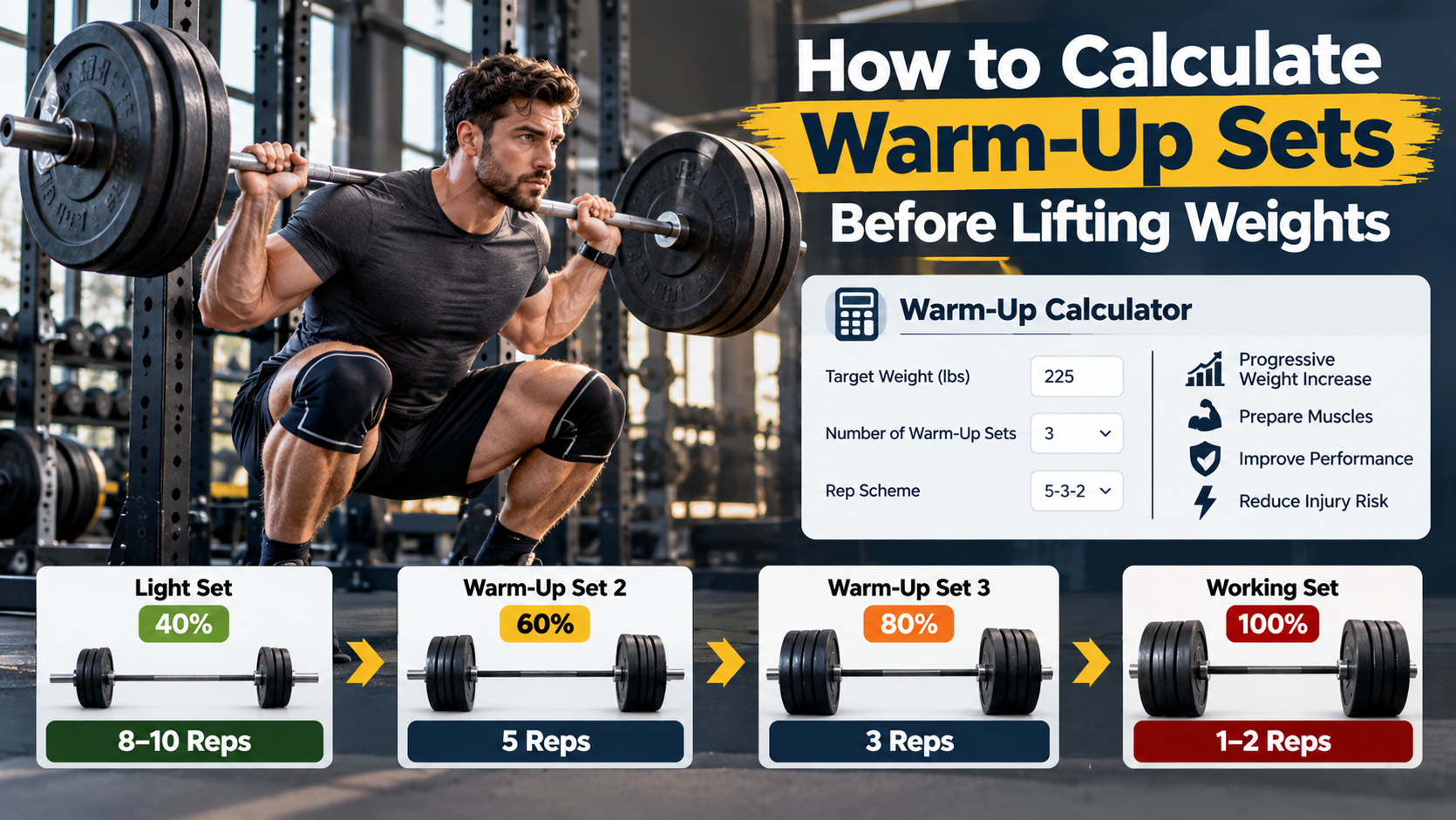

When I first started lifting, my warm-up was a few lazy reps with the empty bar and then straight to my working weight. Some days that worked. Other days my first heavy set felt like a brick, and once or twice my lower back let me know it wasn’t ready. It took me way too long to learn that warming up is part of the workout, not something you rush through to get to it.
These days I plan my warm-ups just like my main sets. I type my working weight into a free warm up calculator, and it gives me every set, rep, and plate I need on the way up. I like that it rounds each step down to a weight I can actually load, so the warm-ups never creep heavier than planned. It also has a separate option for test days, which comes in handy when I’m going for a new max.
Why Warm-Up Sets Matter
Warm-up sets do more than get your blood moving. They let your joints, muscles, and nervous system get used to the movement before the weight gets heavy. Each set is a chance to practice your form under a load that won’t punish a mistake.
They also tell you how you feel that day. If 70% of your working weight feels heavy and slow, that’s useful information. You might need an extra warm-up set, or you might need to pull back a little on your main work.
The Simple Idea Behind a Good Warm-Up
A good warm-up follows one basic rule. The weight goes up and the reps go down.
You start light with more reps to get loose. As the bar gets heavier, you do fewer reps so you don’t burn energy you need for your real sets. By the time you reach your working weight, you should feel ready and sharp, not tired.
How to Calculate Your Warm-Up Sets
Most warm-ups use percentages of your working weight. Here’s a simple five-step ramp that works for most main lifts like the squat, bench press, and deadlift:
- Empty bar for 10 reps. This loosens you up and grooves the movement.
- About 40% for 5 reps. Still easy, but now there’s real weight on the bar.
- About 55% for 5 reps. You should start to feel the lift working.
- About 70% for 3 reps. Fewer reps now, so you save your energy.
- About 85% for 1 rep. One heavy single to prepare you for the real thing.
After that last single, rest a couple of minutes and start your working sets. Round each warm-up weight down to the nearest plate you can load. A few pounds lighter won’t hurt, but a warm-up that ends up too heavy can tire you out before your main work.
A Worked Example
Let’s say your plan calls for 225 lb on the bench press for sets of 5. Using the ramp above, and rounding down to the nearest 5 lb, your warm-up looks like this:
- 45 lb (empty bar) × 10
- 90 lb × 5
- 120 lb × 5
- 155 lb × 3
- 190 lb × 1
Then you go into your working sets at 225 lb. Notice that no warm-up set touches your working weight, and each one is a clear step up from the last. That steady climb is what makes the first working set feel smooth instead of shocking.
Warming Up for a Max Attempt
Test days need a different approach. When you’re going for a new one rep max, you want more steps, smaller jumps near the top, and singles instead of triples. The goal is to reach your attempt feeling sharp, without using up your strength along the way.
A common pattern is to work up with sets of 5, then 3, then 2, and then two or three singles that get closer to your attempt. Rest longer between those heavy singles, usually 2 to 4 minutes. Rushing them is one of the most common reasons people miss a max they could have made.
How Many Warm-Up Sets Do You Need?
It depends on how heavy you’re going. A light day or an accessory exercise might only need one or two warm-up sets. A heavy squat or deadlift day usually needs four or five.
Here’s a rough guide I follow:
- Light day or accessory lift: 1 to 2 warm-up sets
- Normal heavy training day: 4 to 5 warm-up sets
- Max test day: 6 to 8 warm-up sets, with more singles near the top
Stronger lifters often need more warm-up sets simply because the gap between the empty bar and their working weight is bigger. A beginner benching 95 lb doesn’t need the same ramp as someone benching 315.
Mistakes to Avoid
The first mistake is doing too many reps in your warm-ups. Sets of 10 at 70% will leave your legs or chest tired before your main work even starts. Keep the reps low as the weight climbs.
The second is jumping too far between sets. Going from the empty bar straight to 85% skips the steps that prepare you. The third is skipping warm-ups on later exercises. If your second lift of the day is heavy, it deserves at least a short ramp too.
Small Habits That Help
I write my warm-up weights in my training log next to my working sets. It saves time the following week, and I can spot when a warm-up weight starts feeling easier, which usually means I’m getting stronger.
I also use the warm-up sets as a technique check. If my bar path looks off at 55%, I fix it there instead of finding out at my working weight. A few minutes of focus on the way up makes the heavy sets much safer.
Final Thoughts
Warm-up sets are easy to rush, but they make a big difference in how your workout goes. Plan them with simple percentages, keep the reps low as the bar gets heavier, and round down when in doubt. Give it a try on your next heavy day, and you’ll probably notice your first working set feels better than it has in a long time.



