

Saudi Arabia Engineering Plastics Market Size, Share, Research & Growth Forecast 2026-2034

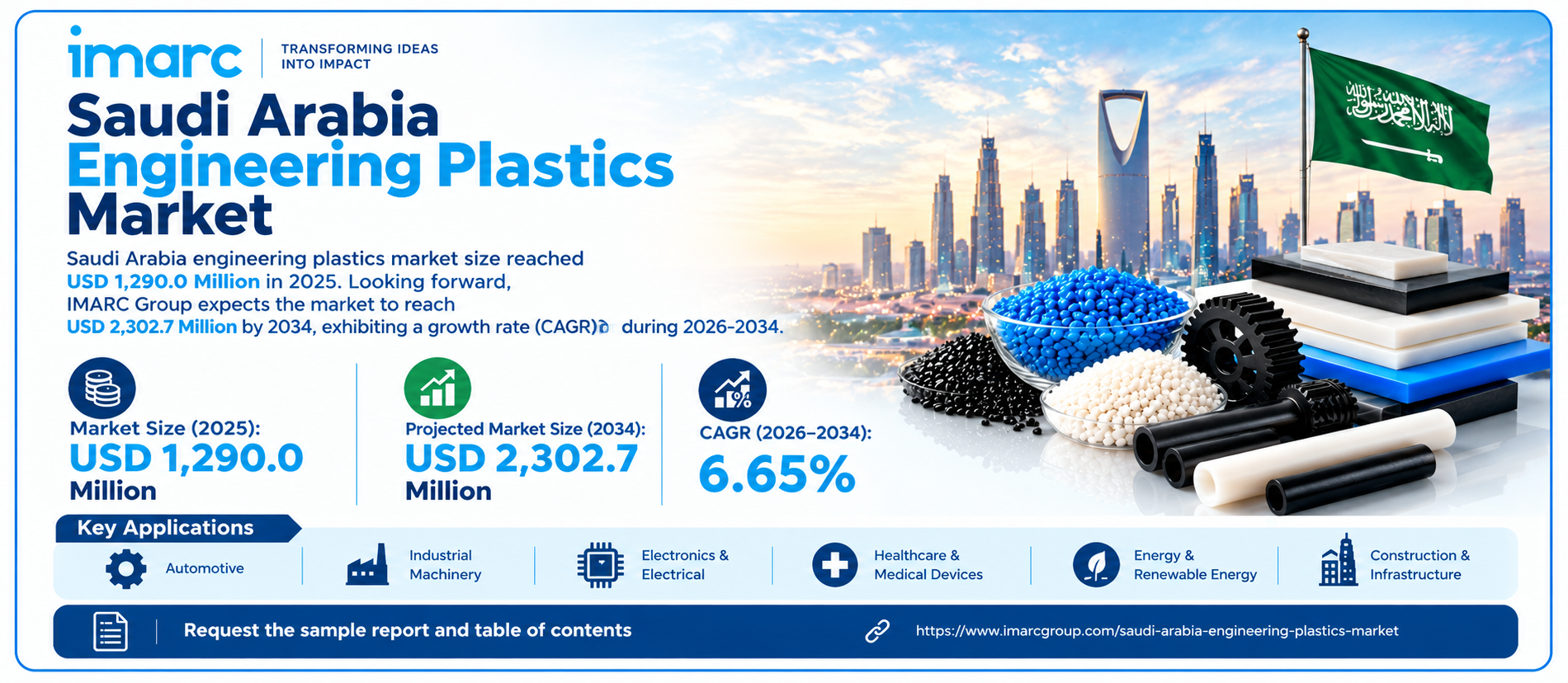
IMARC Group, a leading global market research and management consulting firm, has published its latest market intelligence report on the Saudi Arabia engineering plastics market. The Saudi Arabia engineering plastics market size was valued at USD 1,290.0 Million in 2025 and is projected to reach USD 2,302.7 Million by 2034, exhibiting a CAGR of 6.65% during 2026-2034, driven by rising adoption of engineering-grade resins across electronics, automotive, and electrical appliances, Vision 2030-aligned industrial diversification, and the expansion of the Kingdom's integrated downstream petrochemical value chain.
The market is gaining structural momentum as Saudi Arabia pushes to convert its upstream petrochemical scale into higher-value downstream manufacturing. Engineering plastics, prized for their heat resistance, mechanical strength, and electrical insulation properties, are increasingly displacing metal and glass components across automotive lightweighting, electrical and electronics housings, and industrial machinery parts. The National Industrial Strategy has named engineering plastics one of its priority downstream conversion segments, targeting more than 8.8 million tonnes of additional plastics and rubber conversion capacity nationwide, while SABIC's integrated ethylene-to-polymer feedstock base and dedicated downstream clusters such as PlasChem Park in Jubail Industrial City II continue to anchor compounding and conversion capacity inside the Kingdom rather than across the broader GCC.
Saudi Arabia Engineering Plastics Market at a Glance:
- Market Size (2025): USD 1,290.0 Million
- Forecast Market Size (2034): USD 2,302.7 Million
- CAGR (2026-2034): 6.65%
- Base Year: 2025
- Historical Period: 2020-2025
- Forecast Period: 2026-2034
- Key End-Use Industries: Aerospace, Automotive, Building and Construction, Electrical and Electronics, Industrial and Machinery, Packaging
- Key Downstream Hub: PlasChem Park, Jubail Industrial City II (12 sq. km, dedicated to chemical and plastics conversion industries)
How Technology is Reshaping the Future of the Saudi Arabia Engineering Plastics Market
- AI-Accelerated Polymer Design and Material Discovery: Global resin suppliers active in the Kingdom's supply chain are using AI-driven simulation and generative design tools to screen polymer formulations faster, narrowing material libraries for automotive and electronics applications and cutting prototype-to-production cycles for engineering resin grades.
- EV and Automotive Lightweighting: Rising local vehicle assembly and component manufacturing are pulling engineering plastics into battery housings, connectors, and structural parts as manufacturers substitute metal for lighter, corrosion-resistant polymers to improve range and fuel efficiency.
- Smart Compounding and Process Automation: Compounding facilities in industrial hubs such as Jubail are adopting automated dosing, inline quality sensors, and predictive maintenance to maintain tight tolerances on heat-resistant and flame-retardant engineering grades supplied to electronics and industrial machinery customers.
Grab a sample PDF of this report:
https://www.imarcgroup.com/saudi-arabia-engineering-plastics-market/requestsample
Saudi Arabia Engineering Plastics Market Trends and Drivers:
Demand is being pulled by the same industries driving the Kingdom's non-oil diversification agenda. Automotive assembly and component manufacturing, expanding electrical and electronics production, and infrastructure-linked building and construction activity are all increasing consumption of heat-resistant, high-strength resins in place of traditional metal and glass. The National Industrial Strategy has formally designated engineering plastics as one of twenty priority plastics and rubber conversion segments, alongside high-value packaging, automotive components, and medical applications, signalling direct policy support for downstream capacity expansion rather than continued reliance on resin exports.
Feedstock integration remains the Kingdom's core structural advantage. SABIC's position as a global leader in ethylene, polyethylene, and engineering plastics derivatives gives Saudi-based converters direct access to competitively priced resin at the source, while Sadara Chemical Company's ethylene oxide and propylene oxide pipelines feed dedicated clusters inside PlasChem Park, a 12-square-kilometer zone in Jubail Industrial City II purpose-built for chemical and plastics conversion investment. The King Salman Energy Park (SPARK) in Buqaiq is adding further integrated industrial capacity, and National Industrial Development and Logistics Program (NIDLP) incentives continue to draw downstream and specialty chemical investors to locate compounding and conversion facilities inside the Kingdom.
Government Schemes and Vision 2030 Initiatives Driving Demand:
- National Industrial Strategy (NIS): Names engineering plastics among its priority downstream conversion segments and targets more than 8.8 million tonnes of additional plastics and rubber conversion capacity across the Kingdom.
- National Industrial Development and Logistics Program (NIDLP): A Vision 2030 realization program coordinating investment incentives, feedstock allocation, and regulatory support for downstream chemical and plastics manufacturers, including the long-term supply agreements anchoring new entrants inside PlasChem Park.
- PlasChem Park, Jubail Industrial City II: A 12-square-kilometer zone developed by Sadara and the Royal Commission for Jubail and Yanbu, dedicated to downstream chemical, plastics, and polyurethane conversion industries that draw feedstock directly from Sadara's EO/PO and MDI value chains.
- King Salman Energy Park (SPARK): An integrated industrial ecosystem in Buqaiq, with its first phase completed in 2021, adding further downstream manufacturing capacity linked to the Kingdom's energy and petrochemical infrastructure.
- Vision 2030 Non-Oil Diversification: The Kingdom's broader push to grow manufacturing's share of non-oil GDP is formally positioning higher-value plastics conversion, including engineering grades for automotive, electronics, and construction, as a core pillar alongside logistics and tourism.
Saudi Arabia Engineering Plastics Industry Segmentation:
The report has segmented the market into the following categories:
Breakup By End Use Industry:
- Aerospace
- Automotive
- Building and Construction
- Electrical and Electronics
- Industrial and Machinery
- Packaging
- Others
Automotive and electrical and electronics are the primary demand centers for engineering plastics in the Kingdom, reflecting rising local vehicle component manufacturing and an expanding electronics assembly base, while building and construction consumption is tracking the Kingdom's broader infrastructure and giga-project pipeline.
Breakup By Resin Type:
- Fluoropolymer (Ethylenetetrafluoroethylene (ETFE), Fluorinated Ethylene-propylene (FEP), Polytetrafluoroethylene (PTFE), Polyvinylfluoride (PVF), Polyvinylidene Fluoride (PVDF), Others)
- Liquid Crystal Polymer (LCP)
- Polyamide (PA) (Aramid, Polyamide (PA) 6, Polyamide (PA) 66, Polyphthalamide)
- Polybutylene Terephthalate (PBT)
- Polycarbonate (PC)
- Polyether Ether Ketone (PEEK)
- Polyethylene Terephthalate (PET)
- Polyimide (PI)
- Polymethyl Methacrylate (PMMA)
- Polyoxymethylene (POM)
- Styrene Copolymers (ABS and SAN)
Polyamide, polycarbonate, and styrene copolymers such as ABS carry the broadest industrial uptake given their established use in automotive components, consumer electronics housings, and general-purpose engineering parts, while high-performance grades such as PEEK and fluoropolymers are seeing faster relative growth in specialized aerospace, electrical insulation, and chemical-resistant applications.
Breakup By Region:
- Northern and Central Region
- Western Region
- Eastern Region
- Southern Region
The Eastern Region, anchored by Jubail Industrial City II, PlasChem Park, and SABIC's integrated petrochemical complexes, remains the center of gravity for resin production and compounding capacity, while the Northern and Central Region's concentration of automotive, electronics, and construction activity around Riyadh drives a large share of downstream conversion and end-product demand. The Western Region benefits from Jeddah Islamic Port's import-export connectivity for specialty resins not produced domestically.
Competitive Landscape:
The report provides a comprehensive analysis of the competitive landscape in the Saudi Arabia engineering plastics market with detailed profiles of major companies active across resin production and downstream conversion, including:
- SABIC
- Sadara Chemical Company
- Saudi Specialty Chemicals Company (Specialty Chem)
- Oasis Pioneers Industrial Co.
- Arabian Plastic Manufacturing Company Ltd. (APLACO)
Market Concentration Analysis:
- Upstream Concentration: SABIC's integrated ethylene-to-engineering-plastics feedstock base gives it a dominant position in domestic resin supply, with its Innovative Plastics business operating dedicated engineering thermoplastics compounding capacity at Saudi Specialty Chemicals Company in Jubail.
- Fragmented Downstream Conversion: Compounding, molding, and conversion into finished components remain more fragmented, with specialized and joint-venture players supplying automotive, electronics, and construction customers.
- Portfolio Reshaping: Global producers are actively repositioning engineering plastics portfolios, with SABIC's 2026 divestment of its engineering thermoplastics business outside the Kingdom underscoring a sharper strategic focus on Saudi-based, feedstock-integrated production.
- Capital Inflows: NIDLP-backed incentives and long-term feedstock supply agreements, such as Sadara's MDI arrangement with Oasis Pioneers at PlasChem Park, continue to draw new downstream investment into dedicated conversion zones.
What Does The Full Report Cover?
If you are tracking the Saudi Arabia engineering plastics market for investment decisions, market entry planning, competitive benchmarking, or strategic advisory, IMARC Group's report gives you everything in one place:
- Complete market sizing in value terms with forecasts covering the full 2026-2034 projection period
- Quantified growth driver analysis across end use industry, resin type, and regional markets
- Sub-segment breakdowns for seven end-use industries, eleven resin-type categories, and all four regions of the Kingdom
- Regional data across the Northern and Central, Western, Eastern, and Southern regions of Saudi Arabia
- Competitive profiles of leading resin producers and downstream converters with strategic landscape assessment
- Value chain analysis, market concentration assessment, and investment and growth opportunity mapping
- Latest technology trends covering AI-driven polymer design, automotive lightweighting, and Vision 2030-driven industrial diversification opportunities shaping market competition across the Kingdom
Recent News and Developments in Saudi Arabia Engineering Plastics Market
- August 2026: SABIC completed the divestment of its engineering thermoplastics business in the Americas and Europe to German investment firm Mutares for an enterprise value of USD 450 Million, part of a broader portfolio optimization program that is sharpening the company's focus on Saudi-based, feedstock-integrated production.
- January 2026: SABIC announced combined divestment deals worth USD 950 Million, covering its European petrochemicals business and its engineering thermoplastics business in Europe and the Americas, alongside continued domestic capital investment plans of up to USD 4 Billion for 2026.
- January 2025: Sadara Chemical Company and Oasis Pioneers Industrial Co. signed a long-term supply agreement under which Sadara will supply Methylenediphenyl Diisocyanate (MDI) to a new manufacturing facility Oasis Pioneers is establishing at PlasChem Park in Jubail Industrial City, strengthening the Kingdom's polyurethane and specialty polymer value chain.
Note: If you require specific details, data, or insights that are not currently included in the scope of this report, we are happy to accommodate your request. As part of our customization service, we will gather and provide the additional information you need, tailored to your specific requirements. Please let us know your exact needs, and we will ensure the report is updated accordingly to meet your expectations.
Key Questions This Report Answers
- What is the current Saudi Arabia engineering plastics market size and what is its projected value?
- Which end use industry holds the largest share in the Saudi Arabia engineering plastics market?
- Which resin type is expected to see the fastest growth through 2034?
- What are the key drivers of Saudi Arabia engineering plastics market growth?
- Which region dominates the Saudi Arabia engineering plastics market and why?
- How is Vision 2030, the National Industrial Strategy, and downstream feedstock integration reshaping investment and competitive strategy in the Saudi Arabia engineering plastics industry?
- Who are the top companies in the Saudi Arabia engineering plastics market and what are their competitive strategies?
- What are the investment and market entry opportunities across automotive lightweighting, electronics, and specialty resin conversion in Saudi Arabia?
About Us
IMARC Group is a global management consulting firm that helps the world's most ambitious changemakers to create a lasting impact. The company provides a comprehensive suite of market entry and expansion services. IMARC offerings include thorough market assessment, feasibility studies, company incorporation assistance, factory setup support, regulatory approvals and licensing navigation, branding, marketing and sales strategies, competitive landscape and benchmarking analyses, pricing and cost research, and procurement research.
Media and Sales Contact
IMARC Group
Email: sales@imarcgroup.com
United States: +1-201-971-6302
India: +91-120-433-0800
United Kingdom: +44-753-714-6104



