

If you're tired of fogged-up glasses, dry contact lenses, or reaching for your specs the moment you wake up, you've probably wondered whether LASIK is worth it. This guide covers what LASIK does, which types are available in Delhi, what it costs, and how to know if you're a candidate.
What Is LASIK and How Does It Work?
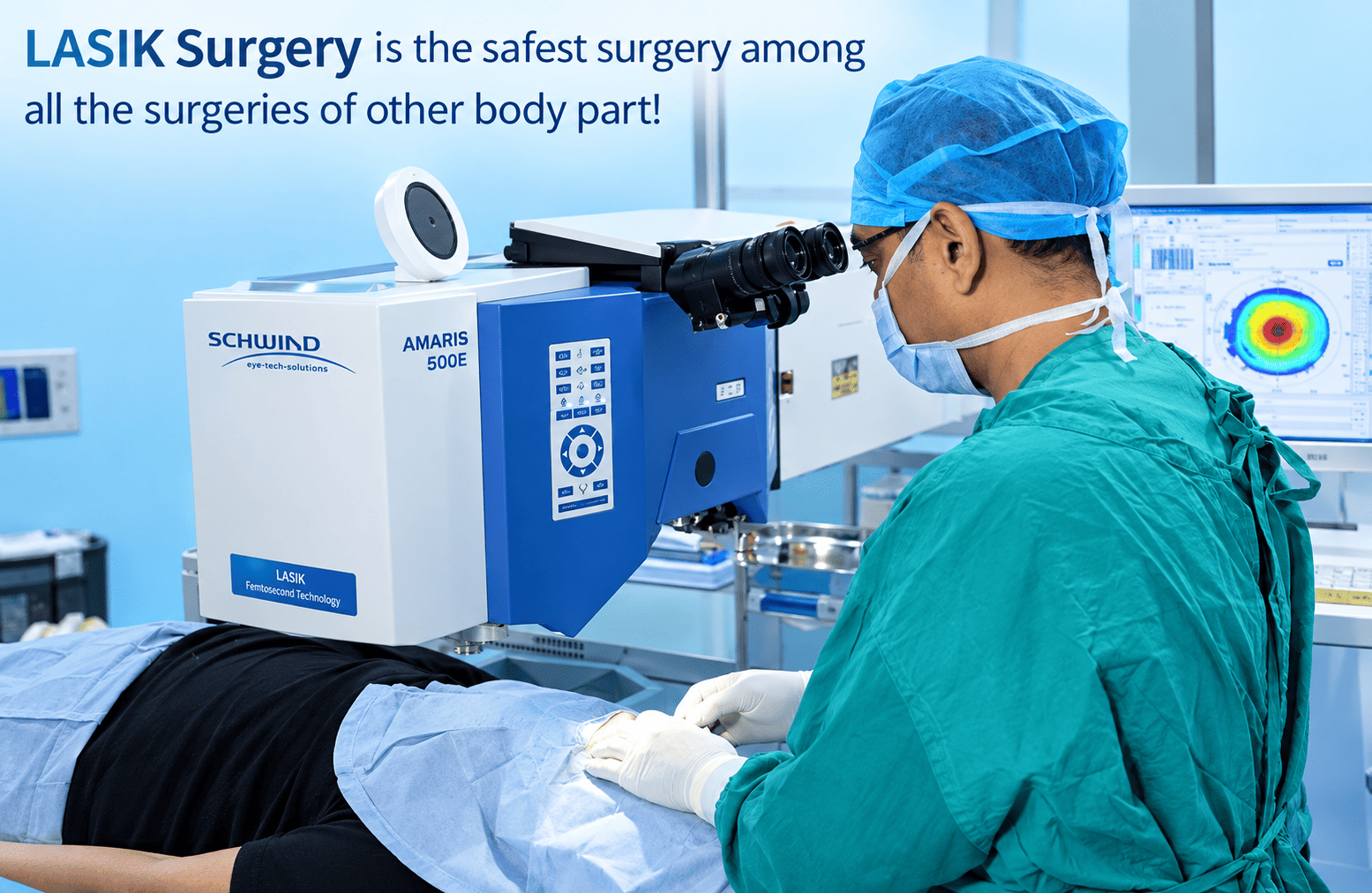
LASIK (Laser-Assisted In Situ Keratomileusis) is a refractive surgery that uses an excimer laser to reshape the cornea, the clear front surface of the eye. A cornea that is too steep, too flat, or uneven makes light focus in the wrong place, which causes blur. Reshaping it lets light focus correctly on the retina without glasses or lenses.
LASIK can treat three common refractive errors:
- Myopia (nearsightedness): typically up to about −10D
- Hyperopia (farsightedness): typically up to about +5D
- Astigmatism: typically up to about −5D cylinder
The laser time is under two minutes per eye, and the whole visit usually takes 3 to 4 hours. Both eyes are normally treated in the same sitting.
Types of LASIK Available in Delhi
There is no single "best" LASIK. The right type depends on your corneal thickness, eye power and lifestyle. Many advanced LASIK surgery options in Delhi are available today:
| Type | How it works | Good for |
|---|---|---|
| CLEAR Supra | Lenticule-based, through a tiny incision | Patients wanting minimal tissue disruption |
| SmartSurf | Touchless and flapless | Thinner corneas, active lifestyles |
| Femto (Bladeless) / Contoura Vision | Femtosecond flap plus topography-guided correction | Patients wanting a highly customised result |
| Trans PRK | Single-step, flapless surface treatment | Contact-sport enthusiasts |
| SBK | Ultra-thin flap that preserves more tissue | Borderline corneal thickness |
| Customized LASIK | Eye-mapping with a blade-created flap | Standard, budget-conscious correction |
How Much Does LASIK Cost in Delhi?
Costs vary with the technology used, and prices below are for both eyes. At Save Sight Centre, LASIK surgery starts at ₹10,000 per eye, and the range runs roughly like this:
- Standard LASIK: ₹20,000
- Customized LASIK: ₹35,000
- SBK: ₹45,000
- Trans PRK: ₹60,000
- Femto / Contoura and SmartSurf AI: ₹90,000
- CLEAR Supra: ₹1,25,000
Final pricing depends on your pre-operative assessment. Most insurance plans treat LASIK as elective, so check with your provider, though no-cost EMI options can make it easier to manage.
A useful comparison is that glasses and contact lenses can cost ₹15,000 to ₹30,000 a year. Over a decade or two, a one-time procedure often works out cheaper.
What Tests Are Done Before LASIK?
A good clinic won't just check your glasses number. A proper workup includes:
- Corneal topography: maps the surface of your cornea.
- Pachymetry: measures corneal thickness to confirm there is enough tissue to treat safely.
- Pupil assessment: protects against night-time glare and halos.
- Refraction: both natural and dilated, to set an accurate target.
Advanced scans such as the Pentacam test help detect subtle corneal irregularities before surgery. Stop wearing soft contact lenses at least 5 days beforehand, and rigid (RGP) lenses at least 2 weeks beforehand, so your cornea shows its natural shape.
Recovery Timeline
- First 24 hours: rest, with mild watering and light sensitivity.
- Next morning: most patients see clearly enough to function.
- Week 1: return to desk work (flap-based LASIK often takes 2 to 3 days, while surface procedures take 5 to 7).
- Weeks 2 to 3: night vision settles.
- After week 4: vision is typically stable.
Avoid swimming, eye makeup and contact sports for the period your surgeon advises, and never rub your eyes. Wear UV-protective sunglasses outdoors during healing.
Risks and Side Effects
LASIK is widely performed and generally considered safe, but no surgery is risk-free. Possible effects include:
- Dry eye: the most common, usually temporary
- Night glare or halos: often settle within weeks
- Flap complications: rare in experienced hands
- Corneal ectasia: very rare, and reduced through careful thickness screening
Choosing an accredited hospital and a thorough workup are the best ways to reduce risk.
Who Is a Good Candidate?
You may be suitable if you:
- are 18 or older
- have had a stable prescription for at least 6 months
- have healthy eyes with adequate corneal thickness
- have no active infection or uncontrolled eye or autoimmune disease
LASIK may not suit you if you're pregnant or breastfeeding, have keratoconus, or have severe dry eye or very thin corneas.
What If LASIK Isn't Right for You?
Not being eligible doesn't mean you're stuck with glasses. Patients with high power, thin corneas or dry eyes may be suited to ICL or IPCL lens implants, or to refractive lens exchange (RLE).
If you currently wear lenses and are weighing your options, a contact lens clinic consultation can help you compare them with surgery.
Final Thoughts
LASIK can be a life-changing decision, but it should be a well-informed one. Get a full evaluation, ask which technology is being recommended for your eyes and why, and compare accreditation, surgeon experience and transparency of pricing.
Thinking about LASIK? The team at Save Sight Centre, Delhi offers a detailed pre-LASIK workup to check your eligibility and recommend the most suitable procedure. Book a consultation or call +91-7873-222-000.
Disclaimer: This article is for general information and isn't medical advice. Results vary from person to person. Consult a qualified ophthalmologist before making any treatment decision.
Tips to get real backlinks from this
- Vary your anchor text. Use phrases like "LASIK surgery in Delhi", "Save Sight Centre" and "pre-LASIK workup" so the links look natural. Don't use the exact same keyword every time.
- Publish it in several places. Post the original on your own blog (
/blogs-on-eye-care) first, then offer rewritten versions to health blogs, local Delhi directories and lifestyle sites. Don't copy the same text everywhere, because duplicate content gets ignored. - Pitch it as a guest post. Target health, wellness, parenting and student-life blogs, and offer an expert quote from one of your doctors.
- Use the existing assets. Your patient testimonial videos and the Pentacam page are good link targets.
- Avoid paid link schemes and spammy directories. Google can penalise these, and medical sites are held to a high quality standard.
A few things on your page don't match, so fix them before this goes live. It says "6 types" in some places and "seven" in others, and Dr. Rajeev Jain is listed as having 20+ years in one spot and 25+ in another. Consistent facts help both trust and SEO.



