


What Are Point of Purchase Displays? A Practical Guide
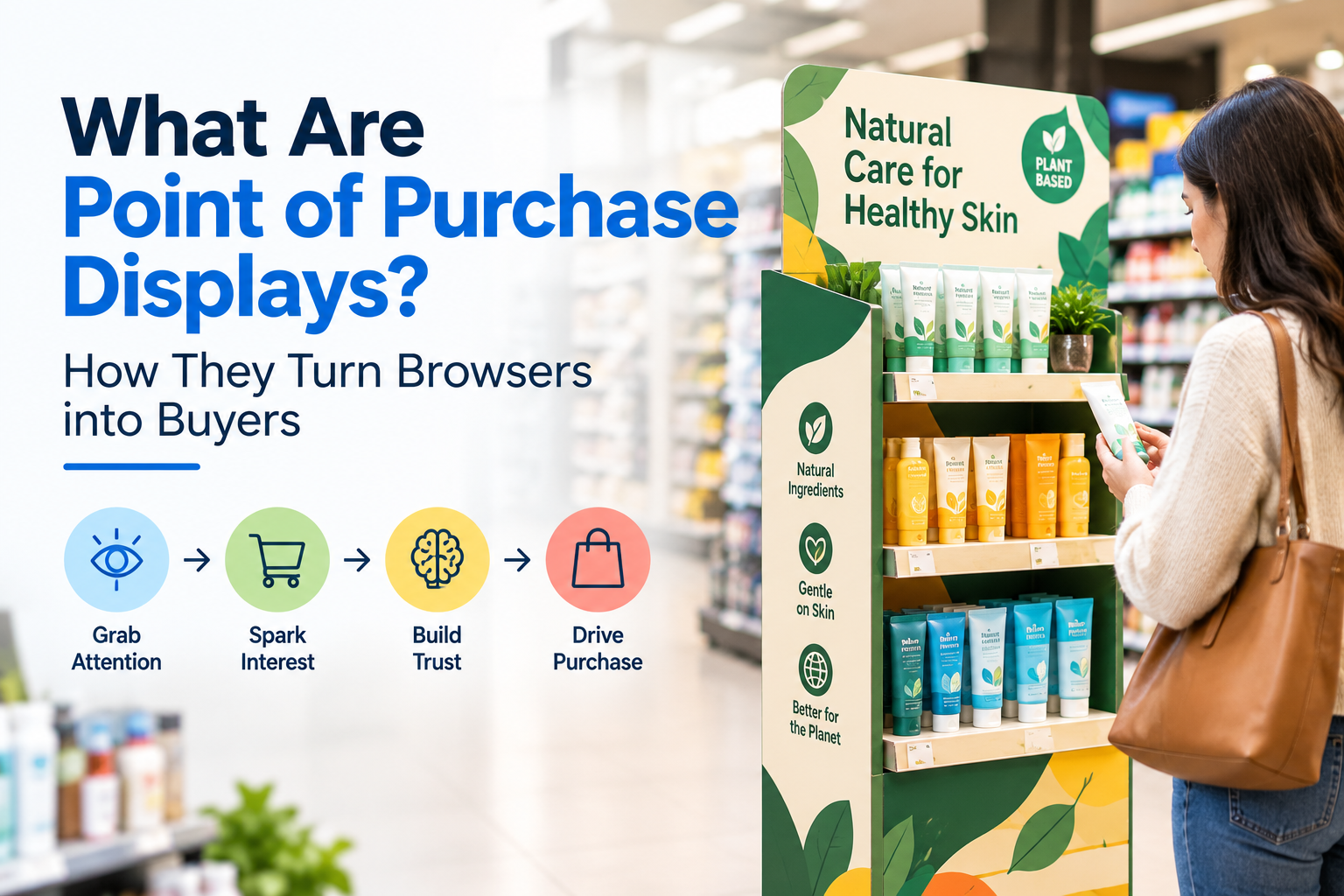
What Are Point of Purchase Displays? How They Turn Browsers into Buyers
Think about the last time you picked up something you hadn't planned to buy. A pack of gum at the register, a phone charger on an end cap, a bag of jerky on a countertop rack. Nobody sent you an ad. The product simply showed up at the exact moment you were ready to spend. That is the whole idea behind point of purchase displays, and it's why retailers and brands fight over the few square feet where decisions get made.
What Point of Purchase Displays Actually Are
A point of purchase (POP) display is any fixture, stand, or structure placed in a retail environment to promote a product at or near the place where the sale happens. You'll also hear "POS display" or "point of sale display," and in most conversations the terms are interchangeable. Some people use "merchandising display" as a wider umbrella, but the core purpose is the same: catch attention, communicate quickly, and make buying effortless.
Common Types You'll See
-
Countertop displays: Small units beside the register, ideal for low-cost impulse items.
-
Floor displays: Freestanding units in aisles or entrances, often used for seasonal or promotional stock.
-
Pallet displays: Product delivered on a branded pallet that goes straight to the sales floor, popular in warehouse and grocery formats.
-
End caps and shelf-edge units: Positioned at the ends of aisles or along shelves, including shelf talkers, wobblers, and clip strips.
-
Dump bins: Open bins that signal a deal and invite shoppers to dig in.
Why They Matter More Than Most Brands Assume
Shelf space is crowded, and shoppers rarely read every label. A good display interrupts that routine. It gives your product its own visual territory, separate from competitors, and it reminds buyers of something they may have meant to pick up anyway.
There is a second, quieter reason: retailers care about sales per square foot. A display that moves product quickly earns its place and gets reordered. One that sits half-full and dusty gets removed. Designing for the retailer's goals, not just your own, is where experienced teams separate themselves.
Key Benefits
Higher visibility. Displays pull your product out of the visual noise of a standard shelf.
Impulse purchases. Products placed near checkout or traffic paths often benefit from unplanned buying, especially lower-priced items.
Product education. A well-designed unit can show usage, ingredients, or promotions in a few seconds of reading.
Brand consistency. Custom graphics and shapes reinforce brand identity in places where your ads can't reach.
New product launches. A dedicated display tells shoppers something is new and worth noticing.
Challenges Worth Planning For
Be honest about the trade-offs before ordering a few hundred units.
-
Retailer approval. Many stores have strict rules on size, placement, and material. A beautiful display that doesn't fit their planogram will never leave the warehouse.
-
Assembly and restocking. If store staff need ten minutes and a diagram to set up a unit, many won't bother. Simple, fast assembly gets displays used.
-
Cost against return. Custom tooling and printing aren't cheap. Without a clear sales target, it's hard to know whether the investment paid off.
-
Durability. Cardboard displays must survive shipping, handling, and weeks of customer traffic without sagging or tearing.
-
Sustainability expectations. More retailers now ask about recyclable materials, so plan for it early.
Best Practices from Real Projects
Design for three seconds. A shopper walking past gives you very little time. One strong image, a clear product name, and a single message beat a crowded layout.
Think about the product's physical behavior. Heavy items need reinforced shelves. Lightweight pouches may need hooks or pockets so they stay upright. Test with actual product, not mock-ups.
Match placement to purchase type. Impulse items belong near the checkout. Items that need explanation do better in aisles where shoppers linger.
Pilot before scaling. Run a small batch in a few stores, track sell-through, gather feedback from store managers, then adjust. I've seen brands save thousands by catching a flawed shelf angle in a ten-store test.
Keep replenishment easy. If restocking is awkward, displays end up empty, and an empty display actively hurts your brand.
Real-Life Applications
Snack and coffee brands are some of the heaviest users of POP displays. A small roaster might place a countertop rack of single-serve pouches near a café register, while a jerky or granola company might use a floor display near the entrance. In these cases, the packaging itself becomes part of the display. Lightweight, resealable customized mylar bags can hang from clip strips or sit in tiered racks, and their printed surface does double duty as a mini billboard. When the pouch graphics and the display graphics are designed together, the whole unit feels intentional rather than assembled from leftovers.
Beyond food, you'll see POP displays for cosmetics testers, batteries, phone accessories, pet treats, supplements, and seasonal gift items. Pharmacies use them for cold-and-flu products during winter, and hardware stores use them for small tools near the register.
Important Factors to Consider Before You Order
-
Location and traffic flow. Walk the store, if you can. Where do people slow down?
-
Product weight and size. The display must support it without bending.
-
Footprint. Retailers often restrict it to a specific number of inches.
-
Message hierarchy. Decide what the shopper should notice first, second, and third.
-
Lifespan. Temporary promotion or semi-permanent fixture? Cardboard suits short campaigns, while acrylic, metal, or wood suit longer runs.
-
Budget for the full lifecycle. Include design, production, shipping, and disposal.
Expert Tips
Talk to store staff before finalizing a design. They know which fixtures get knocked over, which get ignored, and which are a headache to refill. Request a physical prototype and load it with real stock for a week. Keep your claims factual and your pricing readable from a few feet away. And measure results against a baseline, such as sales in comparable stores without the display, so you aren't guessing about impact.
The Bottom Line on POP Displays
A point of purchase display is a small piece of retail real estate with a big job: capture attention at the moment of decision and make the purchase easy. The ones that work are simple, sturdy, sized for the store, and designed around how shoppers and staff actually behave. Start with a clear goal, test small, listen to the people who handle the display daily, and refine from there. Done well, a display doesn't just sit on the floor. It earns its spot, and the retailer keeps asking for more.
- Goth Lifestyle
- Fashion & Style
- Music & Bands
- Art & Photography
- Creative Writing & Poetry
- Events & Scene
- Occult & Spirituality
- DIY & Tutorials
- Beauty & Self-Care
- Relationships & Dating
- Gaming & Media
- Tech & Gadgets
- Body Art & Piercings
- Underground Culture
- Spotlights & Interviews
- Travel & Places
- Lifestyle & Daily Life
- Fitness & Health
- Travel & Adventure
- Books & Literature
- Tech & Gaming
- Movies & TV
- Food & Drinks
- Humor & Memes
- Pets & Animals
- General Arts & Crafts

 English
 French
 Spanish
 Portuguese
 Deutsch
 Turkish
 Dutch
 Italiano
 Russian
 Romaian
 Portuguese (Brazil)
 Greek
