


What Is the Difference Between 1D and 2D Barcodes, and Which Should Businesses Choose?
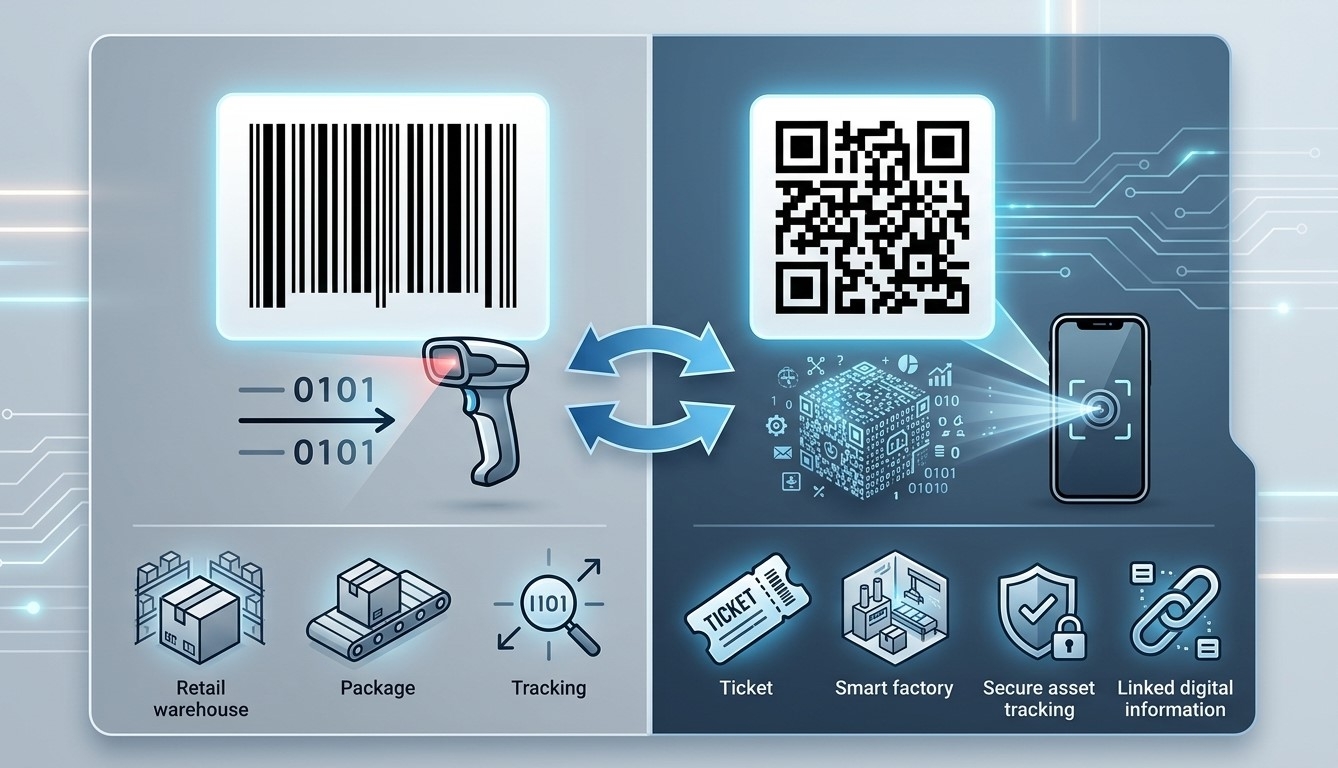
Barcodes play an important role in modern business operations, helping companies identify products, manage inventory, track shipments, and improve data accuracy. However, not all barcodes work the same way. The two main categories are one-dimensional (1D) and two-dimensional (2D) barcodes, each offering different capabilities for data storage and scanning.
Understanding these differences helps businesses select the right barcode technology for their operational needs. Pointus Solutions provides access to barcode and printing products that can support business identification workflows. Companies planning to buy barcode scanner kuwait or compare the thermal label printer price kuwait should understand how barcode types affect equipment compatibility and overall performance.
Table of Contents
-
What Are 1D Barcodes?
-
What Are 2D Barcodes?
-
Key Differences Between 1D and 2D Barcodes
-
Benefits and Limitations of Each Type
-
How to Choose the Right Barcode for Your Business
-
Frequently Asked Questions
-
Conclusion and Call to Action
1. What Are 1D Barcodes?
One-dimensional barcodes, also called linear barcodes, use parallel lines and spaces of varying widths to represent data. They are commonly used in retail, warehouses, logistics, and product identification.
Popular examples include UPC, EAN, and Code 128.
Common Uses of 1D Barcodes
-
Retail product identification and checkout
-
Inventory tracking and stock counting
-
Shipping labels and package identification
-
Warehouse receiving and order fulfillment
-
Asset identification and basic record management
Benefits of 1D Barcodes
1D barcodes are widely supported, relatively simple to generate, and suitable for applications that require a basic identifier. They work well when a barcode links to a product record stored in a connected database.
However, they generally hold less data than 2D barcodes and usually require a clear, unobstructed scan across the barcode's lines.
2. What Are 2D Barcodes?
Two-dimensional barcodes store data using patterns arranged both horizontally and vertically. This structure allows them to encode more information in a compact area than most 1D barcodes.
Common examples include QR codes and Data Matrix codes.
Common Uses of 2D Barcodes
-
Product serialization and traceability
-
Manufacturing and component identification
-
Medical device and healthcare labeling
-
Digital links and product information
-
Warranty records and maintenance tracking
-
Small-item labeling where space is limited
Benefits of 2D Barcodes
2D barcodes can hold more data in a small space and may remain readable even when a portion of the code is damaged, depending on the format and error-correction level. They can also encode information such as serial numbers, batch details, or web addresses.
However, businesses need compatible imaging scanners or devices that can read the selected 2D format. Not every traditional laser scanner supports 2D barcodes.
3. Key Differences Between 1D and 2D Barcodes
| Feature | 1D Barcodes | 2D Barcodes |
|---|---|---|
| Structure | Parallel lines and spaces | Patterns of squares or other symbols |
| Data capacity | Usually lower | Usually higher |
| Label space | Often requires a wider area | Can fit more data into a compact area |
| Common examples | UPC, EAN, Code 128 | QR Code, Data Matrix |
| Scanner requirements | Many laser or imaging scanners | Typically requires an imaging scanner |
| Typical applications | Retail, shipping, inventory | Traceability, serialization, detailed identification |
The right choice depends on how much information the business needs to encode, the available label space, and the scanning equipment already in use.
4. Benefits and Limitations of Each Type
When 1D Barcodes Are a Good Choice
Choose 1D barcodes when your business mainly needs to identify products or inventory records through a database. They are often suitable for retail products, warehouse locations, and shipping labels where simple identification is sufficient.
Their broad compatibility can also make them a practical option for businesses with existing scanning equipment.
When 2D Barcodes Are a Better Choice
Consider 2D barcodes when you need to encode more information, support item-level traceability, or fit codes onto small components. They can be useful for linking products to digital records or identifying individual units throughout manufacturing and distribution.
Before switching, confirm that scanners, software, label printers, and downstream business partners support the chosen format.
5. How to Choose the Right Barcode for Your Business
Follow these steps to make an informed decision.
Step 1: Define your application. Determine whether you need basic product identification, inventory management, serialization, or detailed traceability.
Step 2: Evaluate data requirements. If a simple identifier linked to a database is enough, 1D may work well. If more data must fit within the code, consider 2D.
Step 3: Check scanner compatibility. Businesses planning to buy barcode scanner kuwait should verify whether the device supports the required barcode formats and scanning conditions.
Step 4: Consider label size and durability. Select suitable label dimensions, materials, and printing methods. Barcodes must remain readable on the product's surface and throughout its expected lifecycle.
Step 5: Review printing costs. When researching the thermal label printer price kuwait, compare resolution, print speed, supported label sizes, connectivity, and the supplies required. Both 1D and 2D barcodes can often be printed with suitable thermal label printers.
Step 6: Test before implementation. Print sample labels and test them with the scanners and software used across your operations. Check readability under real working conditions.
6. Frequently Asked Questions
1. Which is better: 1D or 2D barcodes?
Neither is universally better. 1D barcodes are suitable for basic identification, while 2D barcodes are useful when greater data capacity or compact labeling is required.
2. Can a regular barcode scanner read 2D barcodes?
Not always. Many traditional laser scanners read 1D barcodes only. To scan QR codes and Data Matrix codes, businesses generally need a compatible 2D imaging scanner.
3. Are 2D barcodes more expensive to print?
Not necessarily. Printing costs depend on label material, size, printer settings, and production volume. Both formats can be printed using compatible thermal label printing equipment.
4. Can businesses use both 1D and 2D barcodes?
Yes. Some businesses use 1D barcodes for standard inventory processes and 2D codes for serialization or detailed traceability.
5. Do 2D barcodes need an internet connection?
No. A scanner can read the data encoded in a 2D barcode without internet access. However, accessing an online link or retrieving records from a cloud-based system may require connectivity.
7. Conclusion and Call to Action
Choosing between 1D and 2D barcodes starts with understanding your data requirements, scanning environment, label space, and existing systems. While 1D barcodes remain practical for straightforward identification, 2D barcodes provide greater data capacity and support more advanced traceability applications.
Ready to improve your business's barcode operations? Explore Pointus Solutions for barcode scanning and printing products suited to your needs. Whether you want to buy barcode scanner kuwait or compare the thermal label printer price kuwait, selecting compatible equipment can help your business build a reliable and efficient barcode system.
- Goth Lifestyle
- Fashion & Style
- Music & Bands
- Art & Photography
- Creative Writing & Poetry
- Events & Scene
- Occult & Spirituality
- DIY & Tutorials
- Beauty & Self-Care
- Relationships & Dating
- Gaming & Media
- Tech & Gadgets
- Body Art & Piercings
- Underground Culture
- Spotlights & Interviews
- Travel & Places
- Lifestyle & Daily Life
- Fitness & Health
- Travel & Adventure
- Books & Literature
- Tech & Gaming
- Movies & TV
- Food & Drinks
- Humor & Memes
- Pets & Animals
- General Arts & Crafts
 Turkish
 English
 Arabic
 French
 Spanish
 Portuguese
 Deutsch
 Dutch
Dutch
 Italiano
 Russian
 Romaian
 Portuguese (Brazil)
 Greek
Greek
