


Tax Appeals in Pakistan 2026: Commissioner to ATIR Guide
Introduction
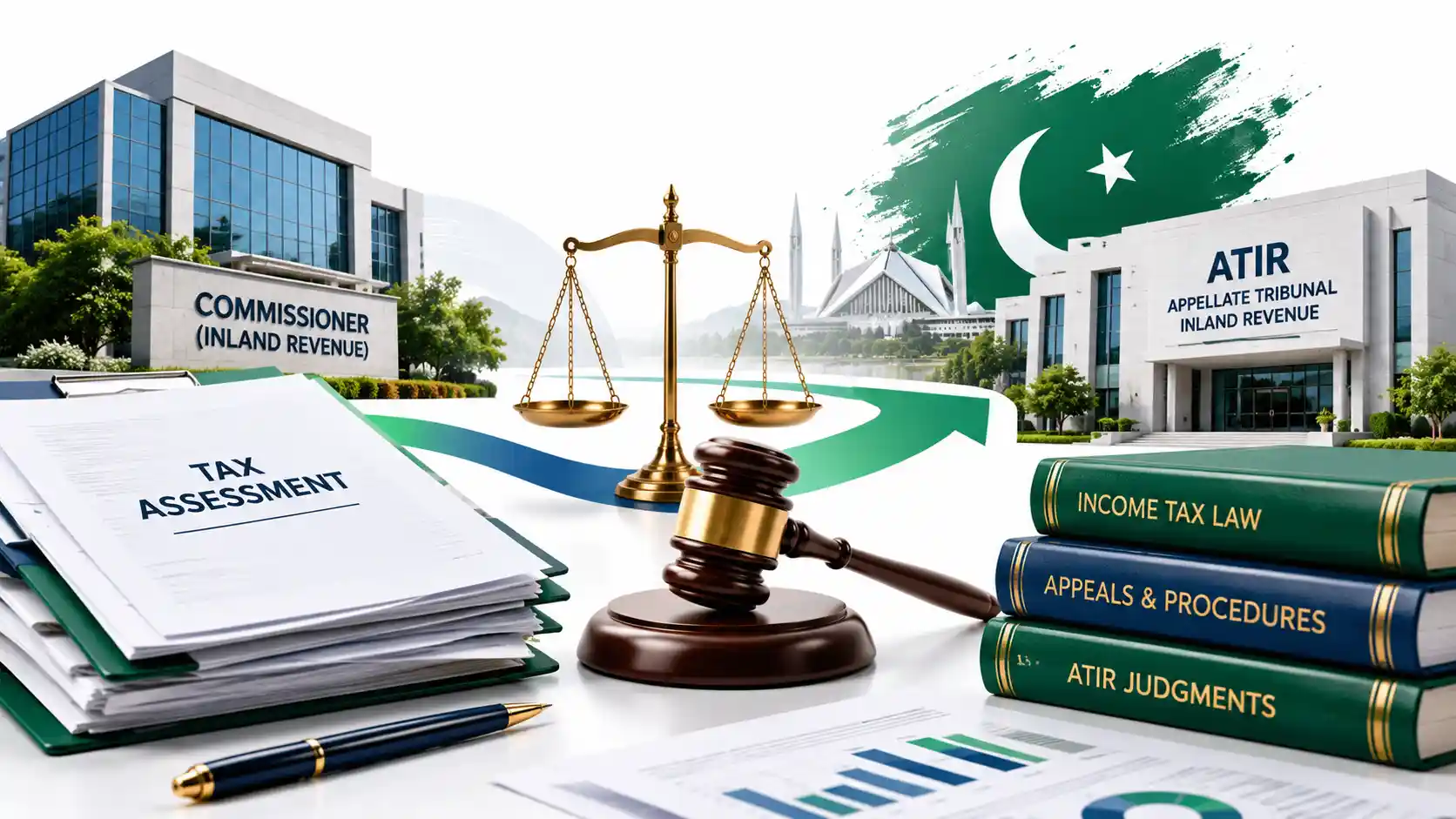
Receiving an assessment order, a penalty order or a refund rejection from the Federal Board of Revenue (FBR) is stressful, but it is rarely the end of the road. Pakistan's tax laws give taxpayers a layered right of appeal, and the taxpayers who use it well are usually the ones who understand the forums, the deadlines and the paperwork before the clock starts running.
The appeal system has also moved quickly. In 2024 the route to the Appellate Tribunal Inland Revenue (ATIR) was reshaped; the Finance Act, 2025 restored a two-tier system and the Finance Act, 2026 added faceless appeals and an internal scrutiny committee for the department's own litigation. If you are working from an article written two years ago, parts of it may now be wrong.
This guide walks you through the full journey: what a tax appeal is, how the Commissioner (Appeals) and ATIR differ, the deadlines, the documents, stay of recovery, and what happens after the Tribunal. It is written for individuals, company owners, accountants and early-career tax practitioners. If you have only received a notice (not yet an order), start with our FBR notices explained guide first.
Quick Answer: What Is a Tax Appeal in Pakistan?
In Pakistan, a taxpayer challenges an FBR assessment or penalty order by appealing first to the Commissioner Inland Revenue (Appeals), generally within 30 days. A further appeal lies to the Appellate Tribunal Inland Revenue (ATIR), and then a reference on a question of law to the High Court. Since the Finance Act 2025, taxpayers may also go directly to ATIR.
Key points
- First appeal: Commissioner Inland Revenue (Appeals), under section 127 of the Income Tax Ordinance, 2001 (and section 45B of the Sales Tax Act, 1990).
- Second appeal: Appellate Tribunal Inland Revenue, under section 131 of the Ordinance; the Tribunal is the last forum that can re-examine the facts.
- Third stage: A reference to the High Court under section 133, limited to questions of law.
- Recovery does not stop automatically: you must apply for a stay.
- Deadlines are strict: a late appeal needs a written request showing "sufficient cause" for the delay.
What Is a Tax Appeal, and What Can You Appeal Against?
A tax appeal is a formal, statutory challenge to a decision made by a tax authority. It is not a letter of complaint, and it is not the same as replying to a notice. You appeal against an order, which is the authority's final decision on a matter, to a higher authority that can confirm, change or cancel it.
Under section 127 of the Ordinance, the orders that can be taken to the Commissioner (Appeals) include orders under sections 120, 121 and 122 (assessments and amended assessments), orders holding a person liable for tax not deducted or collected, refund orders under section 170 and penalty orders under section 182. In practice, the orders taxpayers most often challenge are:
- An amended assessment after an audit (see our FBR audit notice guide).
- A best judgment assessment issued when a taxpayer did not respond or file.
- A penalty for late filing, non-filing or other defaults (see FBR non-filer penalties).
- A withholding tax order against a person who allegedly failed to deduct or deposit tax (see what withholding tax is and how to handle it).
- A refund rejection or short refund (see the IRIS tax refund process).
Notice versus order: why the difference matters
A notice asks you to do something or explain something. An order records a decision. Many notices (for example, a show-cause notice before an amendment) give you the chance to be heard, and a strong reply can prevent an adverse order altogether. Our guides on responding to an FBR notice under section 114 and how FBR audit notices work cover that stage. This article starts where those end: when an order has been passed and you disagree with it.
Documents to file
- Copy of the impugned order and notice of demand
- Proof of service date (IRIS screenshot, email or courier record)
- Appeal fee challan and proof of any required tax payment
- Return, wealth statement and revised return, if relevant (see how to file a revised return)
- Books of account, invoices, bank statements and withholding certificates
- Show-cause notices, replies and hearing records from the original proceedings
- Power of attorney or authority letter for your representative
- Written application for condonation of delay, where needed
The documents required for a Tax Year 2026 return overlap heavily with what you will need in a dispute about that year.
Additional evidence
The Commissioner (Appeals) can call for particulars or cause further inquiry before deciding. Expect the department's officer to be heard as well. If you hold documents that were not before the assessing officer, take advice on how and when to place them on record, because procedural rules about additional evidence can be technical.
What Does a Tax Appeal Cost?
Costs fall into three groups:
- Statutory fees. Sections 127 and 131 prescribe an appeal fee, which differs between companies and other taxpayers. Check the current amounts in the Ordinance and attach the payment receipt.
- Tax that must be paid. This can include tax admitted on the return, any amount you offer as security for a stay, and any demand a forum orders you to pay.
- Professional fees. These are not fixed by law. They depend on the complexity of the dispute, the amount at stake and the forum. Ask for a written scope and fee estimate before you instruct anyone.
We do not quote an average "cost of an appeal" here because there is no reliable official figure. Anyone offering a flat price without seeing your order should be asked to explain what it includes.
Do You Need a Lawyer or Consultant?
The Income Tax Ordinance addresses appearance by an authorised representative (section 223). Individuals can file and argue simple appeals themselves, particularly at the first appeal stage, but the combination of strict limitation, technical grounds and stay applications makes professional help valuable for anything significant.
- Tax lawyer (advocate): essential for High Court references and constitutional petitions, and highly useful at ATIR.
- Tax consultant / chartered accountant: often best for reconstructing accounts, preparing financial evidence and handling the Commissioner (Appeals) stage.
- A team of both is common in larger disputes.
If you are considering this as a career, see how a Certified Tax Advisor compares with an accountant. ICT is a training institute; it does not represent taxpayers in court, and nothing in this article creates a lawyer–client relationship.
Practitioners who want a structured path into litigation work can read about ICT's Advance Taxation and Litigation course and the practical tax practitioner course in Islamabad.
If you want to build these skills as a career, ICT's Advance Taxation and Litigation course teaches notice replies, assessment defence and appeal strategy, and you can read the 2025 course overview and compare the course fees for 2026 before you decide.
Common Mistakes in Tax Appeals
- Missing the deadline because you counted from the order date rather than the service date.
- Not paying a required pre-appeal amount and having the appeal rejected as defective.
- Vague grounds that do not point to a specific error.
- Raising new grounds at ATIR that did not arise from the order below.
- Forgetting the stay application, leaving the department free to start recovery.
- Weak evidence because books, bank statements and withholding certificates were never organised.
- Ignoring procedural flaws, such as no show-cause notice or no hearing, which can be strong grounds.
- Treating a reference as a second chance to argue facts.
- Citing outdated law. Always confirm that you are quoting the FBR consolidation amended up to 30 June 2026.
Tax Appeal Checklist
- Order downloaded and service date recorded
- Deadline calculated with a margin and diarised
- Pre-appeal payment position checked
- Appeal fee challan paid and saved
- Statement of facts and precise grounds drafted
- Documents indexed and paginated
- Stay application prepared with hardship evidence
- Condonation application ready if the deadline is tight
- Authority letter or power of attorney signed
- Proof of filing and next hearing date saved
Official Sources to Check Before You File
Law changes every Finance Act, so verify the points in this guide against primary sources:
- FBR consolidated Income Tax Ordinance, 2001 (amended up to 30 June 2026)
- Appellate Tribunal Inland Revenue website for forms, rules, benches and cause lists
- Pakistan Code for official statute text
- Dawn's report on the restored two-tier system
- FBR's July 2026 rules on Independent Case Scrutiny Committees
Frequently Asked Questions
1. Where do I file an appeal against an FBR order? First with the Commissioner Inland Revenue (Appeals) that serves your taxpayer jurisdiction. You may alternatively give up that right and file directly before ATIR under the proviso to section 127(1).
2. How long do I have to appeal to the Commissioner (Appeals)? Thirty days from service of the notice of demand or order, under section 127(5) of the Income Tax Ordinance, and 30 days under section 45B of the Sales Tax Act.
3. What is the deadline for appealing to ATIR? The Finance Act 2025 is reported to have set 30 days from receipt of the Commissioner (Appeals)'s order. Older sources say 60 days. Confirm in section 131 of the current consolidation.
4. Can I appeal after the deadline has passed? You can apply for condonation of delay, supported by facts showing sufficient cause. It is discretionary, so do not rely on it.
5. Can FBR recover tax while my appeal is pending? Yes, unless recovery is stayed. Apply for a stay with the appeal and attach evidence of hardship.
6. Is ATIR's decision final? It is the last forum for facts. A reference on a question of law can go to the High Court under section 133 (income tax) or section 47 (sales tax).
7. Do I need a lawyer for an ATIR hearing? Not legally in every case, but representation by an advocate or experienced consultant is strongly advisable for contested matters.
8. What documents should I submit with my appeal? The order, proof of service, fee challan, grounds, statement of facts, supporting accounts and records, and an authority letter if represented.
9. What is the difference between an appeal and rectification? Rectification corrects a mistake apparent from the record under section 221. An appeal challenges the decision itself on facts or law.
10. Can a company file a tax appeal? Yes. Companies, AOPs and individuals all have appeal rights. Fees differ between companies and other taxpayers.
11. What happens if the Tribunal remands the case? The matter goes back to the officer with directions, and fresh proceedings follow. You will usually have new rights of appeal against any new order.
12. How much does an FBR appeal cost? There is a statutory fee that varies by taxpayer type, plus professional fees that are not fixed. Ask for a written estimate.
13. Can I challenge a best judgment assessment? Yes. Orders under section 121 are appealable to the Commissioner (Appeals) within 30 days of service. Strong grounds include defective notice, denial of a hearing and an unsupported estimate. Bring the evidence you did not produce earlier.
14. What if my refund is rejected? Obtain the written order under section 170 and appeal within 30 days of service. Attach the claim, proof of tax paid and a reconciliation of the amount claimed against the amount allowed.
15. Can a non-resident file a tax appeal in Pakistan? Yes, the right of appeal belongs to a "person" aggrieved by an order. Non-residents usually need a representative in Pakistan with a valid authority letter, and should ensure FBR has a correct address for service.
16. How do I check the status of my appeal? For the Commissioner (Appeals), check your IRIS account and hearing notices. For ATIR, check the cause list on atir.gov.pk and confirm dates with your representative. Always keep the filing receipt and diary number.
17. What if FBR does not follow the appellate order? Write to the Commissioner attaching the order and ask for the appeal effect order. Keep proof of each request. If harm continues, consult a lawyer about further remedies, such as a High Court petition.
Why Choose ICT for Tax Appeals in Pakistan 2026: Commissioner to ATIR Training?
The Institute of Corporate and Taxation (ICT) is a taxation and corporate training institute with its campus at I-10/3, Islamabad, and it describes its programmes as practical and industry-focused. For anyone who wants to work on tax appeals, from a first appeal before the Commissioner (Appeals) to a hearing at ATIR, ICT’s Advance Taxation and Litigation course covers notice replies, assessment defence and appeal strategy. Our guides on FBR notices, audit notices and the Income Tax Ordinance 2001 for 2026 are kept updated, so you learn the law as it currently stands. If you want a broader foundation, you can start with the Certified Tax Advisor course, compare the 2026 course fees, and contact ICT to ask about the next intake. ICT is a training institute and does not represent taxpayers before tax authorities or courts.
Conclusion
A tax appeal in Pakistan is a structured journey: the Commissioner (Appeals), then the Appellate Tribunal Inland Revenue, then the High Court on questions of law, with a direct route to ATIR now available if you choose it. What decides outcomes is rarely a single clever argument. It is meeting the deadline, paying what must be paid, stating precise grounds, supporting them with organised evidence and protecting yourself from recovery with a timely stay application.
Because the rules were reshaped in 2024, 2025 and 2026, always work from the current FBR consolidation and the live ATIR forms, and get professional advice for anything involving a large demand.
If you want to build these skills as a career, ICT's Advance Taxation and Litigation course teaches notice replies, assessment defence and appeal strategy, and you can compare the course fees for 2026 before you decide. Practitioners who prefer a broader foundation can start with the Certified Tax Advisor course. To ask about the next intake, contact ICT.
Kaynaklar
- Goth Lifestyle
- Fashion & Style
- Music & Bands
- Art & Photography
- Creative Writing & Poetry
- Events & Scene
- Occult & Spirituality
- DIY & Tutorials
- Beauty & Self-Care
- Relationships & Dating
- Gaming & Media
- Tech & Gadgets
- Body Art & Piercings
- Underground Culture
- Spotlights & Interviews
- Travel & Places
- Lifestyle & Daily Life
- Fitness & Health
- Travel & Adventure
- Books & Literature
- Tech & Gaming
- Movies & TV
- Food & Drinks
- Humor & Memes
- Pets & Animals
- General Arts & Crafts
 Turkish
 English
 Arabic
 French
 Spanish
 Portuguese
 Deutsch
 Dutch
Dutch
 Italiano
 Russian
 Romaian
 Portuguese (Brazil)
 Greek
Greek