


What Is a Fire Risk Assessment? A Complete Guide
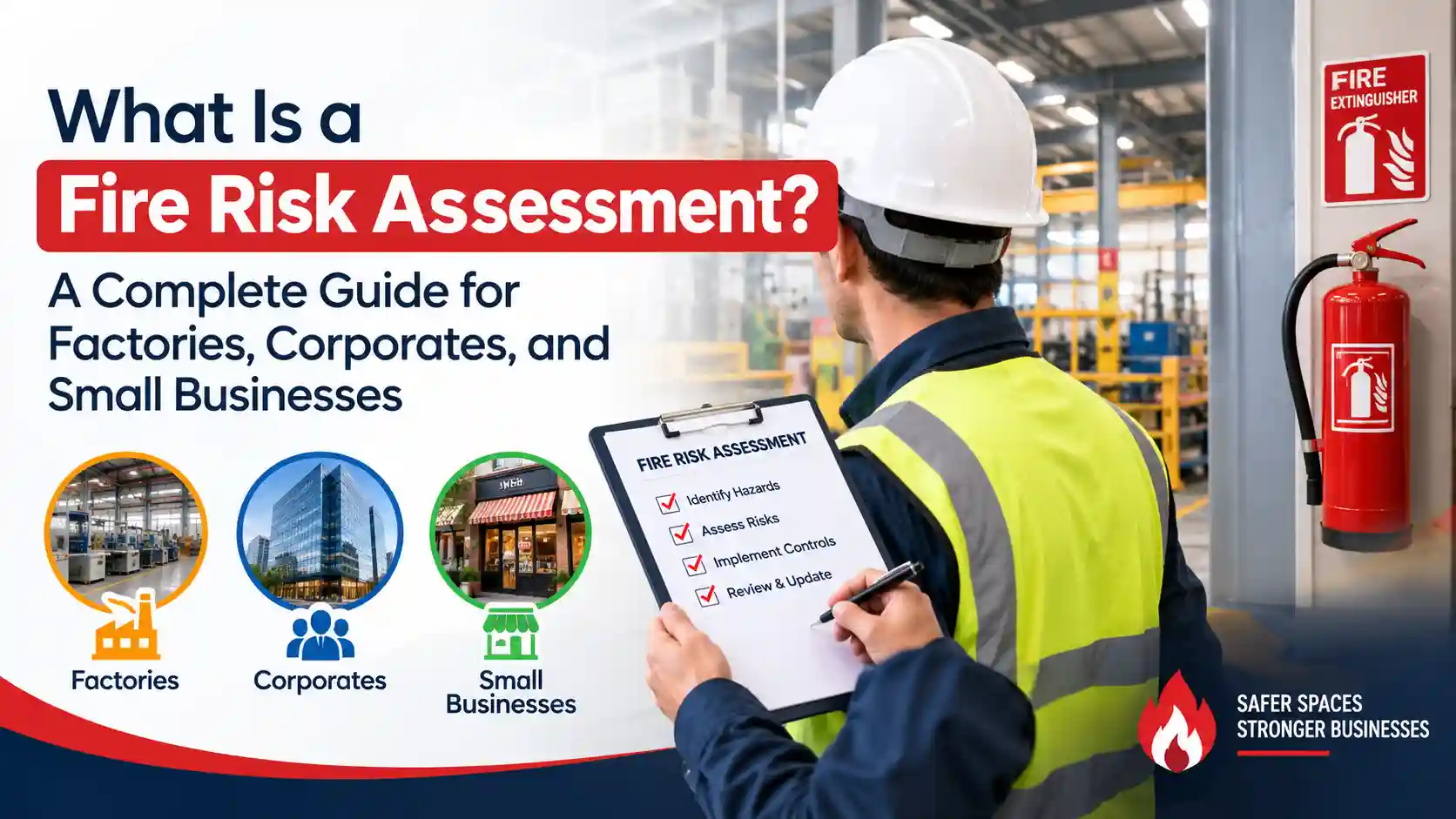
A fire risk assessment is a systematic inspection of your workplace to identify fire hazards, evaluate who's at risk, and put controls in place to reduce that risk and in most jurisdictions, it's a legal requirement, not an optional best practice. Every business, regardless of size, should conduct one before opening, repeat it annually (or after any major change), and document it in writing. Skipping it isn't just a safety gap it's the single most common reason businesses fail fire code inspections and lose insurance claims after a fire.
What Is a Fire Risk Assessment?
A fire risk assessment is a structured process of walking through a building or facility to answer three questions: What could start a fire here? Who could be harmed if it did? And what needs to change to reduce that risk to an acceptable level?
It's not the same as a fire drill (which tests evacuation, not hazard identification) or a fire safety audit (which typically checks compliance against a checklist after controls are already in place). The assessment comes first — it's the diagnostic step that tells you what your fire prevention plan and evacuation procedures actually need to address.
Fire Risk Assessment vs. Fire Safety Audit
| Fire Risk Assessment | Fire Safety Audit | |
|---|---|---|
| Purpose | Identify hazards and risk level | Verify compliance with existing standards |
| Timing | Before/during setup, then periodically | After controls are in place |
| Output | Prioritized hazard list + action plan | Pass/fail compliance report |
| Who performs it | Safety officer, fire marshal, or certified consultant | Internal auditor or regulatory inspector |
Who Is Legally Required to Conduct One?
In the United States, requirements come from a mix of federal, state, and local rules, plus your insurer's own conditions.
OSHA requirements. OSHA's emergency action plan and fire prevention plan requirements are found in 29 CFR 1910.38 and 1910.39, and an employer must have a fire prevention plan whenever a specific OSHA standard in Part 1910 requires one — this includes standards covering process safety management of hazardous chemicals, hazardous waste operations, and fixed fire suppression systems, among others. At minimum, a fire prevention plan must list all major fire hazards, proper handling and storage procedures for hazardous materials, ignition sources and their controls, and the fire protection equipment needed for each major hazard, plus procedures for controlling flammable waste buildup and maintaining heat-producing equipment.
Local fire code and insurance requirements. Even where OSHA doesn't mandate a specific plan, your local fire code (usually based on NFPA 1) and your commercial property insurer almost always require documented fire risk assessments — insurers frequently make it a condition of coverage, and a missing or outdated assessment can void a claim after a loss.
Bottom line for small business owners: if you have employees, hazardous materials, or commercial property insurance, assume you need one — confirm the specifics with your local fire marshal or Authority Having Jurisdiction (AHJ).
The 5-Step Fire Risk Assessment Process
Step 1: Identify Fire Hazards
Walk the entire facility and list every potential ignition source (electrical panels, heat-treating equipment, welding stations, cooking equipment) and every fuel source (paper stock, packaging, chemicals, dust, fabric). In industrial properties, mechanical failure or malfunction is the leading factor contributing to ignition, followed by electrical failure or malfunction, heat sources placed too close to combustibles, and open fires from debris or waste disposal.
Step 2: Identify People at Risk
Map who's in the building and when — night-shift workers, contractors, visitors, and anyone with mobility limitations need specific evacuation provisions, not a generic plan.
Step 3: Evaluate, Remove, and Reduce Risk
For each hazard, decide: can it be eliminated (e.g., replacing damaged wiring), reduced (better storage practices), or controlled (fire suppression, PPE, spacing)? Prioritize by severity and likelihood, not alphabetically.
Step 4: Record, Plan, and Train
Document findings in writing (required even for small employers — those with 10 or fewer employees can communicate plans orally, but written records are still best practice for insurance and legal protection). Build or update your emergency action plan, assign responsibility by name or job title, and train staff on the evacuation signal and routes.
Step 5: Review and Update Regularly
Re-assess annually, after any incident (even a near-miss), after renovations, or when you introduce new equipment or materials. The alarm system itself must comply with the requirements of 29 CFR 1910.165 for employee alarm systems.
What Are the Most Common Fire Hazards in Factories and Warehouses?
Manufacturing and industrial fires are consistently among the costliest fire categories. In 2024, the largest fire losses in the U.S. came from manufacturing facilities, industrial plants, and apartment complexes. Specific hazard patterns to watch for:
- Powered equipment and tools: power tools account for the largest share of fires within the shop tools and industrial equipment category, while heat-treating equipment accounts for the largest share of resulting property damage.
- Off-road vehicles and heavy equipment: over half of vehicle fires at industrial properties involve off-road vehicles or heavy equipment, and mechanical failure is the leading contributing factor.
- Flammable liquids and combustible dust: common in chemical storage, woodworking, and food processing — dust explosions are a frequently underestimated risk in grain, metal, and pharmaceutical processing.
- Overall ignition pattern: roughly three of five structure fires in industrial properties (58%) are unintentional, most often tied to mechanical or electrical failure.
What Are the Most Common Fire Hazards in Offices and Small Businesses?
Smaller commercial spaces face a different hazard mix, more concentrated around everyday equipment rather than industrial machinery. Electrical systems are the standout risk — overloaded outlets, aging wiring, and daisy-chained power strips. Cooking equipment ranks high in offices and retail spaces with breakrooms or on-site food prep. Heating equipment is a leading cause in warehouses and seasonal storage spaces. Store and office fires cause an estimated $932 million in property damage annually in the U.S., with cooking listed as a leading cause — a reminder that fire risk isn't limited to heavy industry.
Practical, low-cost fixes: routine inspection of cords and outlets, keeping storage away from heat sources, visible and rehearsed evacuation routes, and working smoke alarms — homes with working smoke alarms see a death rate roughly 60% lower than those with faulty or missing alarms, and the same logic applies directly to commercial spaces.
How Often Should a Fire Risk Assessment Be Done?
At minimum, annually. You should also redo it immediately after: a fire or near-miss incident, a change in building layout or occupancy, the introduction of new machinery or hazardous materials, or a failed inspection. High-hazard operations (chemical storage, welding, food processing with heavy grease use) often warrant a semi-annual review instead.
Fire Risk Assessment Checklist (Quick Summary)
- Identify all ignition sources and fuel sources
- Map occupancy and identify high-vulnerability individuals
- Check electrical systems, extinguishers, and alarm systems for currency
- Confirm evacuation routes are unobstructed and clearly marked
- Verify your written fire prevention plan and emergency action plan are current
- Train staff and document the training date
- Set a review date and assign an owner
What Happens If You Skip a Fire Risk Assessment?
Beyond the obvious safety risk, the practical consequences are: failed fire code inspections, denied insurance claims after a loss, regulatory fines, and — in the event of a serious incident — potential liability exposure for negligence. Real-world industrial fires show how fast consequences escalate when hazard controls fail: incidents involving improperly stored flammable materials or hazardous chemical storage have resulted in mass casualties and total facility loss in recent years, underscoring why hazard identification and proper storage procedures aren't paperwork exercises — they're what actually prevents catastrophic outcomes.
FAQs
What is a fire risk assessment in simple terms?
It's a walkthrough inspection that identifies what could start a fire in your workplace, who it could harm, and what changes reduce that risk — documented in writing as the basis for your fire prevention and evacuation plans.
Who needs a fire risk assessment — is it only for factories?
No. Any workplace with employees, hazardous materials, or commercial insurance should have one, from a single-office small business to a full manufacturing plant. The depth of the assessment scales with the hazard level, not the industry label.
Is a fire risk assessment legally required in the U.S.?
It depends on the specific OSHA standards that apply to your operation, plus your state and local fire code and insurance policy conditions. Fire prevention plans are mandatory whenever a specific OSHA standard within 29 CFR Part 1910 requires one — check with your local fire marshal to confirm what applies to your facility.
How often should I redo my fire risk assessment? Annually at minimum, and immediately after any fire, near-miss, major renovation, or introduction of new equipment or hazardous materials.
Can I do a fire risk assessment myself, or do I need to hire someone?
Small, low-hazard businesses can often complete a basic assessment in-house using a structured checklist. Facilities with hazardous materials, complex machinery, or a history of incidents should bring in a certified fire safety consultant or your local fire department's prevention division — many offer free or low-cost walkthroughs.
What's the difference between a fire risk assessment and a fire drill?
A fire risk assessment identifies hazards and shapes your plan; a fire drill tests whether people can execute that plan under time pressure. You need both — the assessment informs the drill, not the other way around.
What are the main categories of fire risk assessed?
Ignition sources (electrical, mechanical, heat), fuel sources (combustible materials, chemicals, dust), and oxygen/ventilation factors, cross-referenced against occupancy and evacuation capability.
What's included in an OSHA fire prevention plan?
A list of major fire hazards, proper handling and storage procedures for hazardous materials, ignition sources and their controls, required fire protection equipment, procedures to control flammable waste accumulation, maintenance procedures for heat-producing equipment, and named individuals responsible for hazard control.
- Goth Lifestyle
- Fashion & Style
- Music & Bands
- Art & Photography
- Creative Writing & Poetry
- Events & Scene
- Occult & Spirituality
- DIY & Tutorials
- Beauty & Self-Care
- Relationships & Dating
- Gaming & Media
- Tech & Gadgets
- Body Art & Piercings
- Underground Culture
- Spotlights & Interviews
- Travel & Places
- Lifestyle & Daily Life
- Fitness & Health
- Travel & Adventure
- Books & Literature
- Tech & Gaming
- Movies & TV
- Food & Drinks
- Humor & Memes
- Pets & Animals
- General Arts & Crafts

 English
 Arabic
 French
 Spanish
 Portuguese
 Deutsch
 Turkish
 Italiano
 Russian
 Romaian
 Portuguese (Brazil)
 Greek
Greek